The Importer Security Filing — ISF, also called 10+2 — is the single most common way a first-time ocean importer gets hit with a penalty they did not see coming. Not because the rule is complex, but because almost everyone misreads the deadline.
ISF filing must happen at least 24 hours before the vessel departs the origin port. Not 24 hours before it arrives in the US. Departs. By the time your container is on the water, it is already too late to fix.
What it costs to get wrong
The penalty for a late, inaccurate or incomplete ISF is $5,000 per violation, with penalties on a single filing generally capped at $10,000. Each shipment is a separate potential violation, so a seller doing monthly containers who has misunderstood the rule can accumulate serious exposure before anyone tells them.
There is meaningful relief for first offences. First-time violators frequently see fines mitigated to the $1,000-$2,000 range depending on circumstances, and members of C-TPAT (the Customs-Trade Partnership Against Terrorism) can receive up to 50% penalty mitigation. Mitigation is discretionary, though — it is a reason to file a good-faith correction promptly, not a reason to be relaxed.
Beyond the fine, non-compliant cargo attracts holds and examinations. The delay and the exam fees routinely cost more than the penalty itself.
Why it is called 10+2
Ten data elements come from you, the importer. Two come from the carrier. Your ten:
- Seller (the party selling the goods)
- Buyer (the party buying them)
- Importer of record number / FTZ applicant identification number
- Consignee number
- Manufacturer or supplier
- Ship-to party
- Country of origin
- Harmonized Tariff Schedule (HTS) number, to at least 6 digits
- Container stuffing location
- Consolidator (stuffer)
Note items 9 and 10 — container stuffing location and consolidator. These are the two that trip people up, because they live with your supplier or your origin agent, not with you. If you are chasing them the day before departure, you have already lost.
The realistic timeline
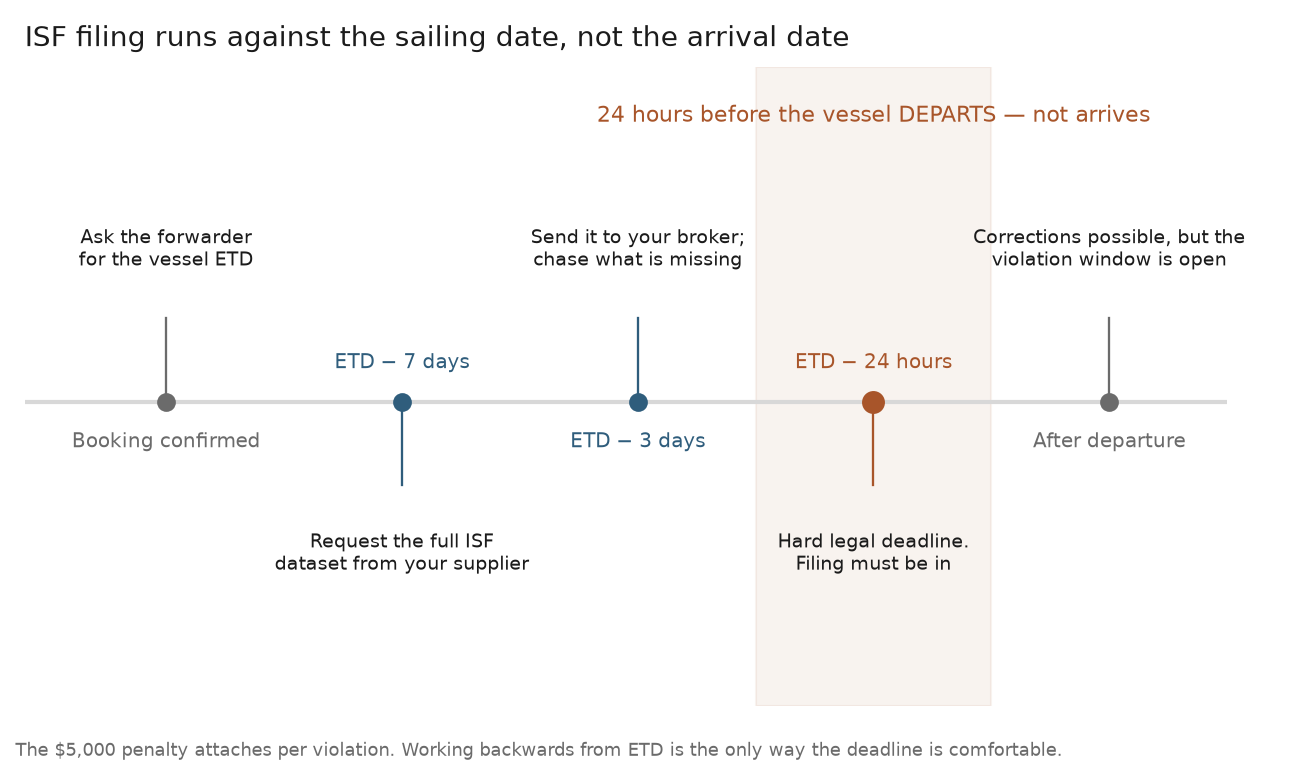
Work backwards from vessel departure, not from your own convenience:
| When | What happens |
|---|---|
| Booking confirmed | Ask your forwarder for the vessel’s ETD immediately |
| ETD minus 7 days | Request the full ISF dataset from your supplier |
| ETD minus 3 days | Send everything to your broker; chase any missing element hard |
| ETD minus 24 hours | Hard legal deadline. Filing must be in |
| After departure | Corrections still possible, but the violation window has opened |
The gap between “ETD minus 7 days” and “ETD minus 24 hours” exists entirely to absorb a slow supplier. Suppliers are frequently slow. Build the buffer in and the rule stops being stressful.
Who does the ISF filing
You can do the ISF filing yourself, but almost nobody does. In practice your customs broker or freight forwarder files on your behalf — and if you hold a continuous customs bond, your ISF obligations are covered under it rather than requiring a separate ISF bond each time.
Delegating the ISF filing does not delegate the responsibility. The legal obligation sits with the Importer of Record — you. If your forwarder files late using data you supplied late, the penalty notice still arrives with your name on it. Which is why the only reliable protection is supplying the data early, in full, every time.
The one habit that prevents all of this
Create a standing ISF data sheet and send it to every new supplier before your first order, not before your first shipment. Ten fields, filled in once per supplier, updated only when something changes. Most of the elements — seller, manufacturer, country of origin, stuffing location — are stable across orders from the same factory.
Sellers who do this complete the ISF filing in ten minutes. Sellers who do not spend every shipment cycle chasing a factory contact across a time zone gap, 48 hours before a vessel sails.
LCL changes who holds the answers
Two of your ten elements — the container stuffing location and the consolidator — behave completely differently depending on how you ship. This is where a large share of late ISF filing errors come from, and it is invisible until the first time you switch mode.
On a full container, both answers sit with your supplier. The box is stuffed at their factory or at a yard they nominate, and for practical purposes they are the consolidator. One email to one contact gets you both fields, and the answer is stable across every shipment you place with them.
On LCL, neither answer is theirs. Your cargo is trucked to a container freight station where a forwarder consolidates it with other shippers’ goods. The stuffing location is that facility, and the consolidator is whoever operates it. Your supplier genuinely does not know. Asking them produces either a guess or a delay, and a guess is worse, because the filing has to be accurate rather than merely on time.
So on LCL, ask your forwarder for those two fields at booking. They have them as soon as the origin station is nominated, which is normally before the cargo leaves the factory.
This also explains a failure that looks baffling from the outside. A seller ships FCL for a year without incident, places one smaller order as LCL, sends the same data request to the same factory contact, receives nothing usable, and files late on the cheapest shipment they have ever made — against a penalty that does not scale down with the cargo.
The other eight elements do not change by mode. Manufacturer, seller, buyer, ship-to party, importer of record number, consignee number, country of origin and the HTS number all come from your purchase order and commercial invoice. Those are stable for as long as you keep buying the same product from the same supplier, which is exactly why the standing data sheet works.
Working out your own numbers? The free freight RFP generator builds the quote request that gets you comparable prices from several forwarders at once — so you are comparing the same scope, not four different ones.
This article is general guidance, not legal or customs advice. Rules and rates change, and your situation may differ. Confirm anything specific with a licensed customs broker before you act on it.