Learning how to write a freight RFP properly is what turns three vague verbal quotes into three quotes you can actually put side by side.
You’ve decided to formally request quotes instead of just emailing a few 3PLs and hoping for the best. Good call — but now you’re staring at a blank document, and “freight RFP” isn’t exactly a template that comes bundled with Google Docs. Here’s what actually needs to go into one, in what order, and why each section exists.
Why the Structure Matters More Than the Wording
A freight RFP isn’t a sales pitch and it isn’t a legal contract. It’s a comparison instrument. Its entire job is to make sure every 3PL you send it to is answering the exact same questions, about the exact same shipment, scored against the exact same criteria. If your sections are vague or inconsistent, you’ll get back quotes that are impossible to compare fairly — one provider assumes door-to-door, another assumes port-to-port, and now you’re not comparing prices, you’re comparing apples to a different fruit entirely.
That’s the whole reason to write a freight RFP instead of just asking “what would you charge?” — structure is the product, not the prose.
That’s the real skill in how to write a freight RFP: forcing every provider to answer the same questions, not collecting opinions.
This isn’t unique to freight — procurement teams across every industry follow the same principle of standardizing evaluation criteria before sending anything out, specifically to keep vendor comparisons objective.
How to Write a Freight RFP: The Sections You Need
Here’s what a complete freight RFP should include, roughly in this order:
| Section | What goes in it | Why it’s there |
| Company Overview | A short paragraph on your business — what you sell, how you sell it, what you’re looking for in a partner | Gives context so providers understand your business, not just your box count |
| Shipment Profile | Product category, monthly volume, origin, destination, service type required, shipping frequency | The hard numbers every quote has to be built around |
| Scope of Services | Which specific services you need — freight forwarding, customs brokerage, insurance, tracking, warehousing | Prevents providers from quoting a narrower (cheaper-looking) service than you actually need |
| Information Requested from Suppliers | What you want back from them — rate cards, transit times, on-time performance history, payment terms, insurance limits | Turns “send me a quote” into “send me a quote in this exact format” |
| Evaluation Criteria | The weighted criteria you’ll score responses against | Signals upfront what actually matters to you, and forces your own thinking about priorities |
| Supplier Pricing Template | A blank rate table for them to fill in — per-unit or per-CBM rate, fuel surcharge, customs fee, accessorials, currency, quote validity | Makes every quote structurally identical, so you’re comparing numbers, not paragraphs |
| SLA Expectations | The service levels you expect — on-time delivery target, claims response time, communication turnaround | Sets the bar before you sign, not after something goes wrong |
| Terms & Conditions | A short, plain-language note on process (not a binding legal contract) | Clarifies this is a formal comparison process, not a casual inquiry |
| Submission Instructions | Deadline, format, and who to send it to | Removes any excuse for a late or incomplete response |
Nine sections sounds like a lot, but most of them are two or three lines each. A tight, well-organized one-page RFP beats a rambling five-page one every time — providers are more likely to respond thoroughly to something they can read in five minutes.
Setting Evaluation Criteria That Actually Mean Something
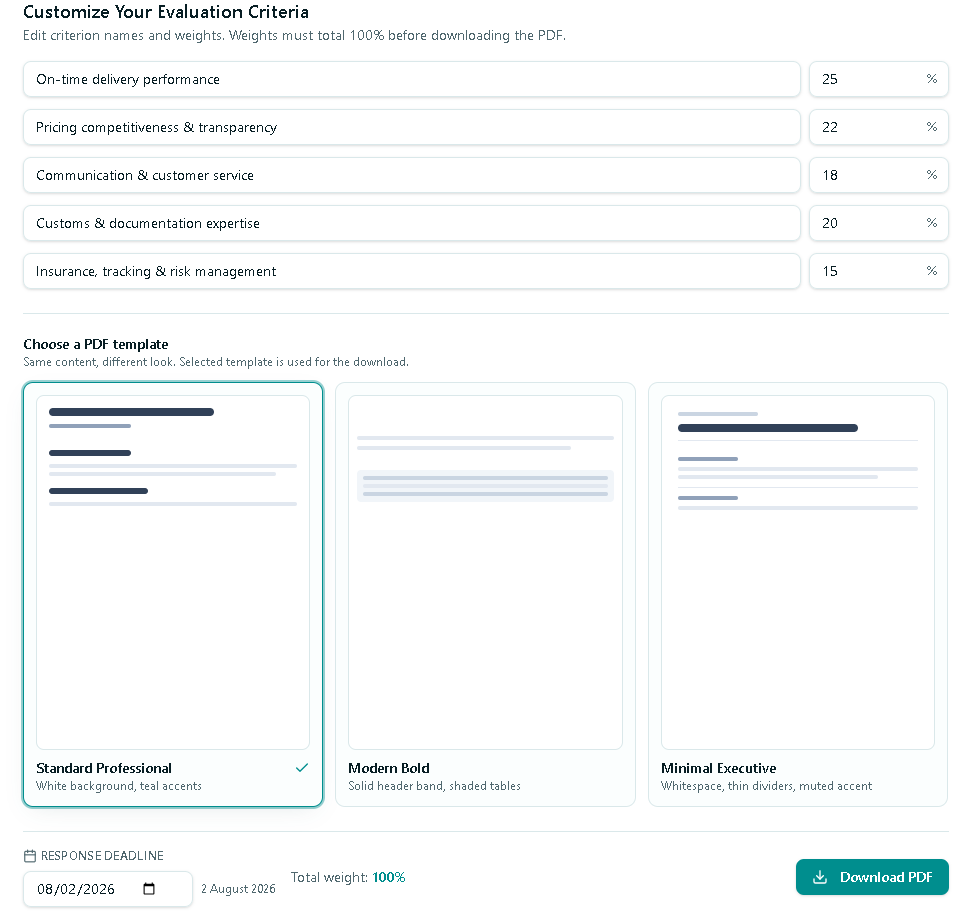
This is the section people either skip or fake. A generic list like “price, quality, service” tells a provider nothing and tells you even less when the quotes come back. Instead, pick five or so specific, measurable criteria and assign each one a percentage weight that adds up to 100%. A reasonable starting point most sellers use:
- On-time delivery performance — 25%
- Pricing competitiveness & transparency — 22%
- Communication & customer service — 18%
- Customs & documentation expertise — 20%
- Insurance, tracking & risk management — 15%
These numbers aren’t sacred — if you’re shipping high-value electronics, insurance and risk management might deserve more weight than 15%. If you’re shipping internationally for the first time, customs expertise might matter more than pricing. The point of assigning weights isn’t to hit a “correct” formula, it’s to force yourself to decide, in writing, what actually matters before you’re staring at three quotes and going with your gut.
Common Mistakes That Sink an RFP Before It’s Sent
- Being vague about volume. “A few hundred units a month” gets you a padded quote. Give an actual number, even if it’s a range.
- Forgetting seasonality. If your Q4 volume is triple your normal month, say so. A 3PL that can’t handle the spike needs to rule themselves out now, not in November.
- No deadline, or an unrealistic one. Give providers at least a week to respond properly — a rushed quote is often an inflated or incomplete one.
- Scoring criteria that don’t apply. Don’t ask about cold chain handling if you’re shipping electronics. Every irrelevant question is one more reason for a busy provider to skim your RFP instead of answering it properly.
- Sending it to too many providers. Three to five well-matched 3PLs beats a mass email to fifteen — you’ll get more thoughtful responses and it’s actually manageable to compare five detailed quotes side by side.
Skip the Blank Page
f you’d rather not build this structure from scratch, our free RFP generator does it for you — enter your shipment details once, and it produces a complete, ready-to-send RFP with all nine sections above, using editable evaluation criteria and scope of services so it’s genuinely yours, not a generic template. No login, no email required.
If you haven’t yet worked through what you’re actually looking for in a provider, our guide on how to choose a 3PL covers the five criteria that matter most and the questions worth asking before you request a single quote.
Quick-Start Checklist
Before you send your RFP to anyone — and before you finalize how to write a freight RFP for your specific shipment — run through this checklist:
- Confirm your shipment profile numbers are accurate, not rough guesses
- Decide your must-have services and leave out anything irrelevant
- Set your five evaluation criteria and weights so they total 100%
- Include a blank pricing template so every quote comes back in the same format
- Set a realistic response deadline — at least a week
- Send it to three to five providers, not fifteen
A well-structured RFP takes maybe twenty extra minutes to put together compared to a quick “what would you charge” email. Given that the resulting decision affects your fulfillment operations for the next year or more, that’s a fairly small price for a genuinely comparable set of answers.
Table of Contents
Before you send that RFP
- Which Incoterm to quote on — FOB, EXW or DDP changes what your RFP is even asking for.
- The charges that are not in the quote — Describe your delivery properly or the invoice will not match.
- LCL or a full container? — Work out which one you should be requesting before you ask.