If you are shipping less than a full container, you are paying by the cubic metre (CBM). That feels fair — you pay for the space you use. But LCL pricing has a floor of fixed costs that do not shrink with your shipment, and past a certain volume you are paying full-container money for less-than-container service.
The short answer: the LCL vs FCL break-even usually sits between 12 and 18 CBM, with 15 CBM as the rule of thumb. Below that, LCL is normally cheaper. Above it, a 20ft container almost always wins. But the exact number moves with your lane and your destination charges, and this is the calculation that tells you which side of it you are on.
Why per-CBM pricing misleads you
An LCL quote is rarely just the ocean rate. Your cargo has to be consolidated into a shared container at origin, and deconsolidated at destination — and those handling steps are charged per shipment, not per CBM. A 3 CBM shipment and a 14 CBM shipment can attract nearly identical consolidation, documentation and terminal fees.
This is why the quoted rate deceives in any LCL vs FCL comparison. At $120/CBM, 14 CBM looks like $1,680 of ocean freight. By the time consolidation, deconsolidation, terminal handling and documentation are added, the landed number can be well over $3,000 — which is 20ft container territory.
Industry practitioners see this constantly: shipments around 14 CBM moved as LCL routinely end up costing more in total than a 20ft FCL would have, purely because of stacked consolidation and destination fees.
What a 20ft container actually holds
A standard 20ft container has an internal volume of roughly 33 CBM. You will never fill that. Between pallet footprints, wall clearance, box dimensions that do not tile neatly and the need to avoid crushing lower cartons, usable volume is realistically 25-28 CBM.
That matters for the break-even because it means a 20ft container’s cost is spread over ~26 CBM, not 33. If a 20ft runs $3,000, your effective rate at a good fill is about $115/CBM — right in the middle of typical LCL pricing. That is the whole reason the break-even lands where it does.
The actual LCL vs FCL calculation
Here is the LCL vs FCL comparison worked through with mid-range 2026 numbers on a China-to-US-West-Coast lane. Substitute your own quotes; the structure is what matters.
| Volume | LCL at $120/CBM + ~$900 fixed fees | 20ft FCL at ~$3,000 all-in | Cheaper |
|---|---|---|---|
| 5 CBM | $1,500 | $3,000 | LCL |
| 10 CBM | $2,100 | $3,000 | LCL |
| 14 CBM | $2,580 | $3,000 | LCL, barely |
| 18 CBM | $3,060 | $3,000 | FCL |
| 25 CBM | $3,900 | $3,000 | FCL, clearly |
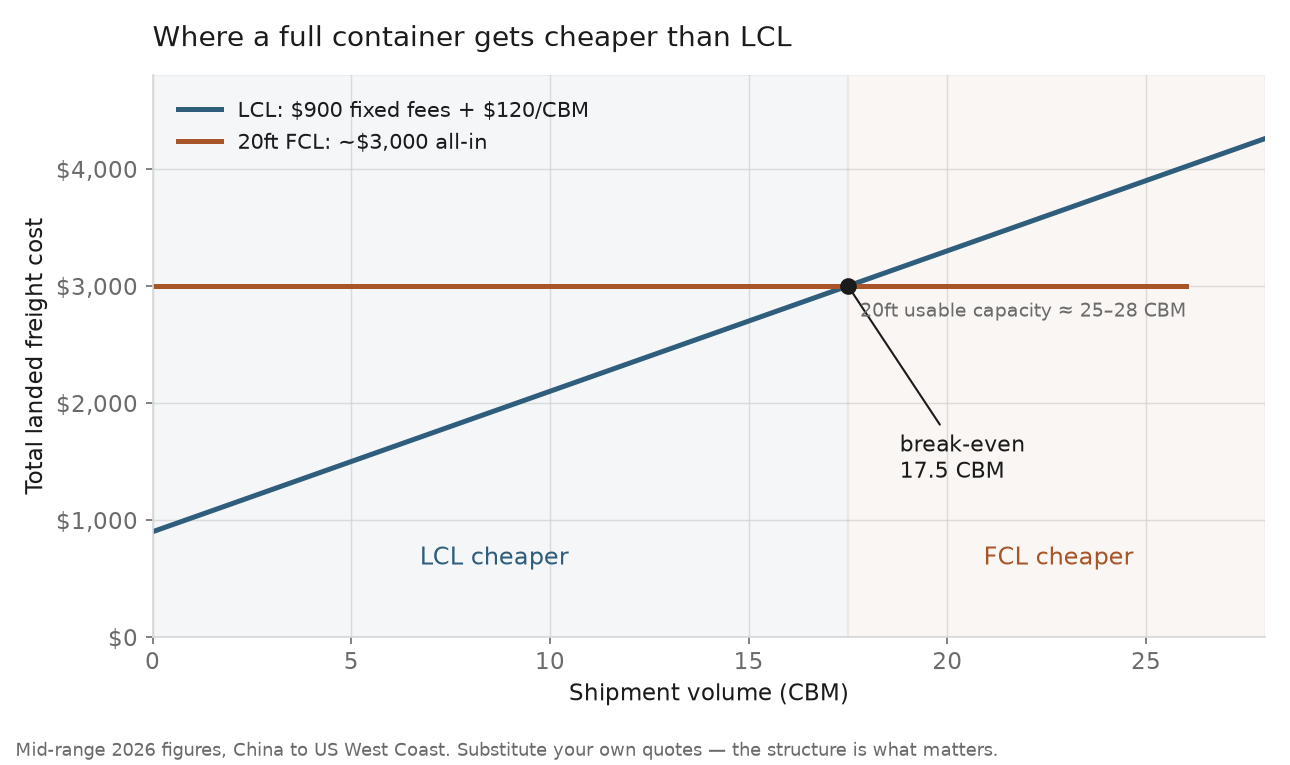
Two things jump out. First, the crossover in this example is around 17-18 CBM — higher than the 15 CBM rule of thumb, because the fixed-fee assumption is modest. Raise those fixed fees to $1,400 and the crossover drops below 14 CBM. Your destination charges, not the ocean rate, decide where your line sits.
Second, notice how flat the FCL column is. Once you have paid for the container, extra volume is free until you run out of space. That asymmetry is what makes waiting too long to switch expensive.
Three cases where FCL wins below 15 CBM
- Fragile or high-value cargo. LCL means your pallets are handled repeatedly and share space with whatever else is in the box. Damage rates are higher. If a 2% damage rate on $40,000 of goods costs you $800, that alone can close a $500 price gap.
- Deadline-sensitive inventory. LCL adds consolidation waiting time at origin and deconsolidation at destination — often 7-14 extra days end to end. If you are racing a Q4 cutoff or an Amazon restock window, the container’s speed is worth paying for.
- Customs risk. In a shared container, another importer’s problem becomes your delay. If anything in that box gets flagged for examination, everything in it waits.
How to find your own break-even in one afternoon
- Ask for an LCL quote at your actual volume, itemised — ocean rate, consolidation, deconsolidation, terminal handling, documentation, delivery. Refuse a single lump number.
- Ask the same forwarder for a 20ft FCL quote on the same lane, door to door.
- Add up every LCL line item. Compare the totals, not the headline rates.
- Divide the FCL total by 26 CBM. That is your true per-CBM container cost. If your LCL rate is anywhere near it, you are already at the switch point.
Do this with at least three forwarders. The spread between quotes on identical cargo is routinely 30-40%, which is often larger than the LCL-versus-FCL difference you are agonising over.
When the answer is a 40ft rather than a 20ft
The break-even above is drawn against a 20ft container because that is the usual first step up from LCL. There is a second crossover behind it that sellers reach faster than they expect.
A 40ft container costs more than a 20ft, but rarely twice as much. Ocean freight is priced per box rather than per cubic metre, and much of the cost — terminal handling, documentation, customs entry, drayage — is identical whichever size you book. Roughly double the volume for well under double the cost is the normal shape of it.
Which means the question is not really “do I have enough for a 40ft”. It is whether you would rather hold more stock than pay to ship the same goods twice. If you are shipping a 20ft every eight weeks from the same supplier, one 40ft every sixteen is usually cheaper per unit, and it halves the number of entries, arrivals and receiving events you have to manage.
Two things stop it being automatic:
- Weight, not volume, may bind first. Dense cargo hits the road weight limit long before it fills a 40ft. A 40ft full of ceramics is not a legal move.
- Cash and shelf life. A 40ft is a bigger single payment and a longer holding period. The freight saving is real, and so is the working capital tied up in it.
Working out your own numbers? The free freight RFP generator builds the quote request that gets you comparable prices from several forwarders at once — so you are comparing the same scope, not four different ones.
The mistake that costs the most
It is not choosing wrong at 14 CBM. It is never rechecking. Sellers pick LCL when they are shipping 4 CBM, grow to 20 CBM over two years, and never revisit the decision because the invoices arrive monthly and each one looks normal in isolation.
Recalculate every time your shipment volume rises by half. That is the whole discipline.