Container weight limits start with a number that misleads: a 40ft container can structurally carry close to 59,000 lb. You will almost never be allowed to move that on a US road. The gap between what the box can hold and what the law lets you haul is where a lot of first-time importers lose money, usually by discovering it after the container has been packed on the other side of the world.
There are three separate container weight limits in play, they are set by three different authorities, and only one of them is about the container.
Container weight limits: which one actually binds
| Limit | Set by | What it governs |
|---|---|---|
| ISO maximum gross | The container’s own rating | What the box can structurally carry without failing |
| Road gross vehicle weight | Federal and state highway law | What the truck, chassis, container and cargo may weigh combined |
| Verified Gross Mass (VGM) | SOLAS, via the IMO | What you must declare before the box may be loaded onto a vessel |
Of the three container weight limits, the road limit is nearly always the binding one. The ISO rating tells you the container will survive the load. It says nothing about whether a truck may legally carry it to your warehouse, and the truck is the part that gets pulled over.
The federal ceiling
On the Interstate system, the Federal Highway Administration’s limits are:
- 80,000 lb gross vehicle weight
- 34,000 lb on a tandem axle
- 20,000 lb on a single axle
A bridge formula, in force since 1975 to protect highway bridges, can require a lower gross weight still, depending on how the axles are spaced. States set their own rules off the Interstate, and they are not identical. The 80,000 lb figure is the ceiling to plan against, not a guarantee that 80,000 lb is always permitted.
Working out the payload you actually have
The 80,000 lb allowance covers everything on the road, not just your goods. Subtract the equipment first:
| Component | Typical weight |
|---|---|
| Tractor | ~17,000 – 19,000 lb |
| Chassis | ~5,300 – 6,000 lb |
| Empty 40ft container | ~8,200 lb |
| Remaining for cargo | roughly 43,500 – 44,500 lb |
Those equipment weights vary by carrier, so treat the result as an estimate and confirm the exact tare figures with whoever is doing your drayage. But the shape of the answer is stable: a 40ft container that can structurally hold nearly 59,000 lb has a road-legal payload of roughly three quarters of that.
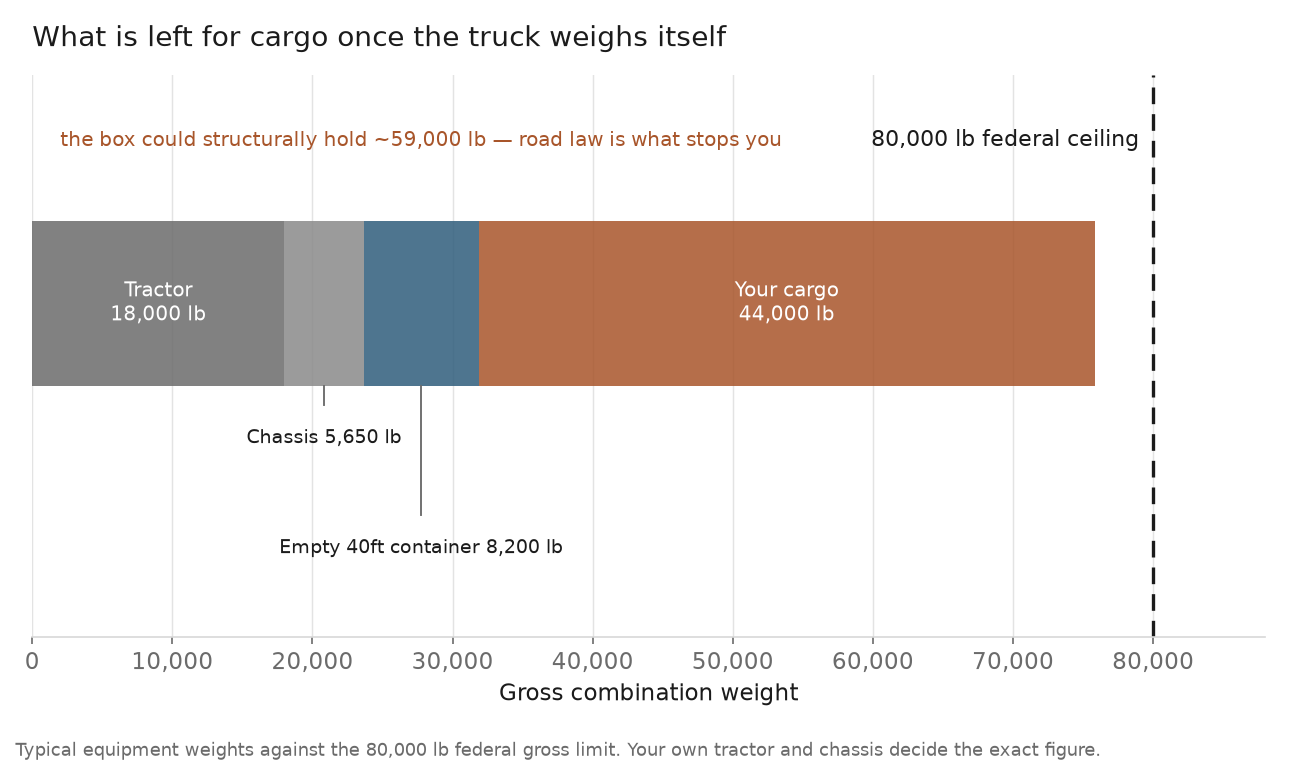
Exceeding it does not make the shipment impossible, it makes it a permitted move. Many states will issue an overweight permit, commonly up to around 90,000 lb gross, with route and time-of-travel restrictions attached. Permits cost money, take time, and constrain which roads the container may use, which is a poor thing to discover on arrival.
VGM: the declaration that stops the box being loaded
Since 1 July 2016, SOLAS has required the shipper named on the bill of lading to provide a Verified Gross Mass for every packed container before it may be loaded onto a vessel. The IMO’s requirement is blunt about the consequence: no valid VGM, no loading.
Two things follow that catch small importers out. First, the obligation sits with the shipper, and if you are buying on FOB terms that may be your supplier rather than you — but the commercial consequence of a missed sailing lands on you either way. Second, the costs of a container that misses its vessel for a missing or wrong VGM, including storage and re-handling, are the shipper’s.
Ask your supplier to confirm the VGM has been submitted, and to send you the figure. If the declared mass and the packing list disagree materially, you want to know that before the vessel sails rather than when the container is weighed at a US gate.
The practical discipline
Weight and volume constrain a container from opposite directions, and which one binds depends entirely on what you sell. Dense products hit the weight ceiling with the container half empty; light ones fill the space with tonnes of allowance unused. Knowing which case you are in changes how you pack and how you buy.
- Work out your product’s density before the first container, not after. The same arithmetic that drives freight class on the road tells you which limit binds at sea.
- Give your supplier a maximum loaded weight, in writing, alongside the carton count. Factories load to fill space unless told otherwise.
- If weight binds, consider whether two lighter containers or an LCL consignment beats one permitted overweight move.
- Check the declared VGM against your own arithmetic. Cartons times unit weight plus pallets plus the container tare is a two-minute sanity check.
None of this is difficult. It is simply invisible until the first time a container arrives that cannot legally be driven to your warehouse, at which point it becomes an expensive education.
If the container is already overweight when it lands
The uncomfortable version of this problem is the one you discover after the box is on the water, when the packing list and the weight ticket do not agree. You have three options and none of them is free.
- An overweight permit. Available in many states for a fee, on defined routes, sometimes with escort or time-of-day conditions. It works best when you are marginally over and the route is short.
- A partial devan at the port. Some cargo is stripped out at a nearby facility so the container travels legal, and the remainder follows separately. You pay for the handling, the storage and a second move.
- A transload. The whole load is transferred into domestic trailers, which have different weight rules and can often take the cargo legally in one or two moves. Common on long inland runs and usually the cleanest answer for a heavy full container.
All three cost more than loading correctly, and all three consume free time while they are arranged — which is how an overweight container quietly becomes a demurrage problem as well as a weight one.
The prevention is unglamorous and takes one email. Ask the supplier for the loaded gross weight before the container is sealed, not after, and check it against the payload figure you worked out above. A factory that is loading to fill the space will keep loading until the space is gone, because nobody at that end is thinking about a US highway.
Working out your own numbers? The free freight RFP generator builds the quote request that gets you comparable prices from several forwarders at once — so you are comparing the same scope, not four different ones.