If you ship LTL (less-than-truckload) inside the US, your rate is driven by a freight class number between 50 and 500. Get the class wrong and the carrier reclassifies your shipment after the fact — and sends a corrected invoice that can be far above your quote.
This matters more than usual right now, because the classification system has just been through its biggest change in years.
What changed in freight class
The NMFTA began rolling out a major overhaul with Docket 2025-1, effective 19 July 2025, which consolidated roughly 2,000 commodity listings into density-based items and expanded the density scale from 11 subprovisions to 13. Docket 2026-1, effective 6 February 2026, cancelled more legacy items and tightened how the new system applies.
The practical effect: many products that used to have a fixed class assigned by what they are now get classified by how dense they are. Classes 50 and 55 are new, rewarding shippers of very dense freight with lower rates.
The trap: any freight class you looked up before mid-2025 may now be wrong. Relying on old reference material is close to a guarantee of future reclassification charges.
How density is calculated
Density is measured in pounds per cubic foot (PCF):
- Cubic feet = (Length × Width × Height in inches) ÷ 1,728
- PCF = total weight in pounds ÷ total cubic feet
Measure the shipping dimensions, not the product. That means including the pallet, the packaging and any overhang — the space the carrier actually has to sell.
Worked example
One pallet: 48 × 40 × 50 inches, total weight 600 lbs.
- Cubic inches: 48 × 40 × 50 = 96,000
- Cubic feet: 96,000 ÷ 1,728 = 55.6 cu ft
- PCF: 600 ÷ 55.6 = 10.8 lbs per cubic foot
Higher density means a lower freight class number and a lower cost per pound. More weight in less space is what carriers reward, because it is what makes their trailer profitable.
Why you get reclassified
- You estimated dimensions. Carriers now routinely run freight through dimensioning scanners. Your estimate loses to their measurement every time.
- You measured the product, not the pallet. Pallet height, wrap and overhang all count.
- Your packaging changed. A new carton size changes your density and therefore your class, even though the product is identical.
- You used an outdated class. See above – the ground moved in 2025-26.
- Your pallet was mixed. Different SKUs stacked together change the density of the whole unit.
How to stop paying reclassification charges
- Measure and weigh an actual finished, wrapped pallet. Once. Write the numbers down.
- Recalculate PCF whenever packaging or pallet configuration changes.
- Give carriers the real numbers at quote time, even when they are unflattering. A correct higher class quoted up front costs less than a wrong lower class corrected later.
- Confirm your NMFC item number is current under the post-2025 dockets, not one you looked up years ago.
- If you are consistently near a class boundary, look at packaging. Shaving pallet height to raise density can move you a class and pay for itself.
The same principle runs through air freight chargeable weight and pallet math: freight pricing punishes empty space, in every mode, every time.
How density maps to class
Under the density-based system, PCF drives the freight class. The exact bands depend on the current NMFC provisions and the specific commodity item, but the relationship is consistent and worth understanding directionally:
| Density (PCF) | Typical class band | Character of the freight |
|---|---|---|
| 50+ | 50 – 60 | Very dense: bricks, canned goods, machinery parts |
| 30 – 50 | 65 – 85 | Dense packaged goods |
| 15 – 30 | 92.5 – 110 | Typical boxed consumer products |
| 8 – 15 | 125 – 175 | Bulky but moderate weight: small appliances, housewares |
| 4 – 8 | 200 – 300 | Light and bulky: furniture, cushions |
| Under 4 | 400 – 500 | Very light: ping pong balls, foam, empty packaging |
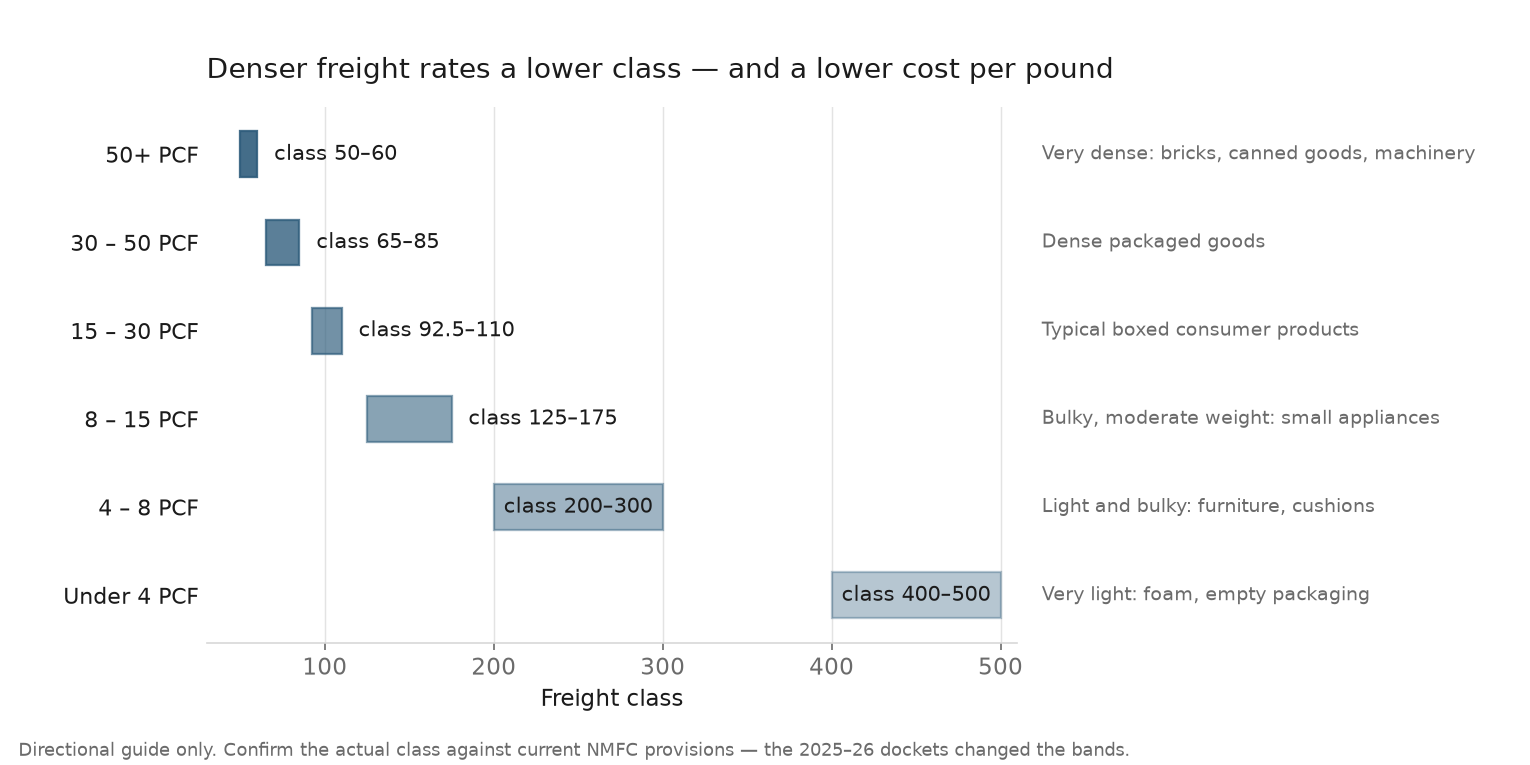
Treat this as orientation, not as a lookup table. Confirm the actual class against current NMFC provisions – the 2025-26 dockets changed both the bands and which commodities are density-based at all.
If you are reclassified
A reclassification arrives as a corrected invoice, often weeks after delivery, and often for a meaningful sum. You are not obliged to simply pay it.
- Request the evidence. Carriers using dimensioning equipment can produce the measurement, usually with a photograph and a timestamp. Ask for it.
- Check what was measured. Disputes frequently turn on whether the pallet was measured with overhang, shrink wrap, or an unusually tall stack that was not yours.
- Compare against your own record. This is why measuring and photographing a finished pallet once is worth the effort – it gives you something to argue with.
- Dispute in writing, promptly. Carriers have time limits for classification disputes and they are shorter than you would expect.
- If you were wrong, fix the source. Update your stored dimensions so the same correction does not recur every shipment.
The pattern worth avoiding is paying reclassification charges repeatedly on the same product because nobody updated the number in the system that generates your quotes.
Documenting freight class density before you need to
A reclassification is an assertion by a carrier that your freight was denser, lighter or bulkier than you declared. Challenging it requires evidence from the day of shipping, which is the one moment nobody is taking photographs.
Build a one-page record for each product that ships regularly:
- Palletised dimensions, measured at the widest points including any overhang, and the pallet height.
- Gross weight of the loaded pallet, from a scale rather than an estimate.
- The calculated PCF, with the arithmetic shown.
- A photograph of the wrapped, labelled pallet against something showing scale.
- The NMFC item number and class you declared, and the date you last checked it against current provisions.
With that on file, a corrected invoice becomes a conversation about two measurements rather than an argument you cannot win. Without it, you are disputing a carrier’s recorded weight with a recollection.
Refresh it whenever packaging changes. A supplier switching to a thicker carton or a taller pallet alters the density without telling anyone, and the first notice you get is the reclassification.
Working out your own numbers? The free freight RFP generator builds the quote request that gets you comparable prices from several forwarders at once — so you are comparing the same scope, not four different ones.
This article is general guidance, not legal or customs advice. Rules and rates change, and your situation may differ. Confirm anything specific with a licensed customs broker before you act on it.