Your forwarder quotes 18 days. Your goods arrive at your warehouse seven weeks after leaving the factory. Nobody lied to you — you were quoted a different measurement from the one you cared about.
Ocean transit times are quoted port to port. Your business runs on factory to warehouse. The gap between those two numbers is where inventory planning goes wrong.
The quoted ocean transit times
| Route | Typical port-to-port |
|---|---|
| China → US West Coast (LA, Long Beach) | 14-25 days |
| China → US East Coast (NY/NJ, via Panama) | 28-40 days |
| Add for LCL rather than FCL | +3-7 days |
Those are schedule figures, and schedules are aspirations. Independent transit tracking has at times shown considerably worse real-world performance — readings in March 2026 put actual China-to-US-West-Coast door-to-door timing around 37 days, and East Coast above 53, against schedules roughly half those lengths.
Those specific figures move constantly with congestion and season. The durable lesson is not the number: it is that the spread between schedule and reality is large, persistent, and always in the same direction.
The full timeline nobody quotes you
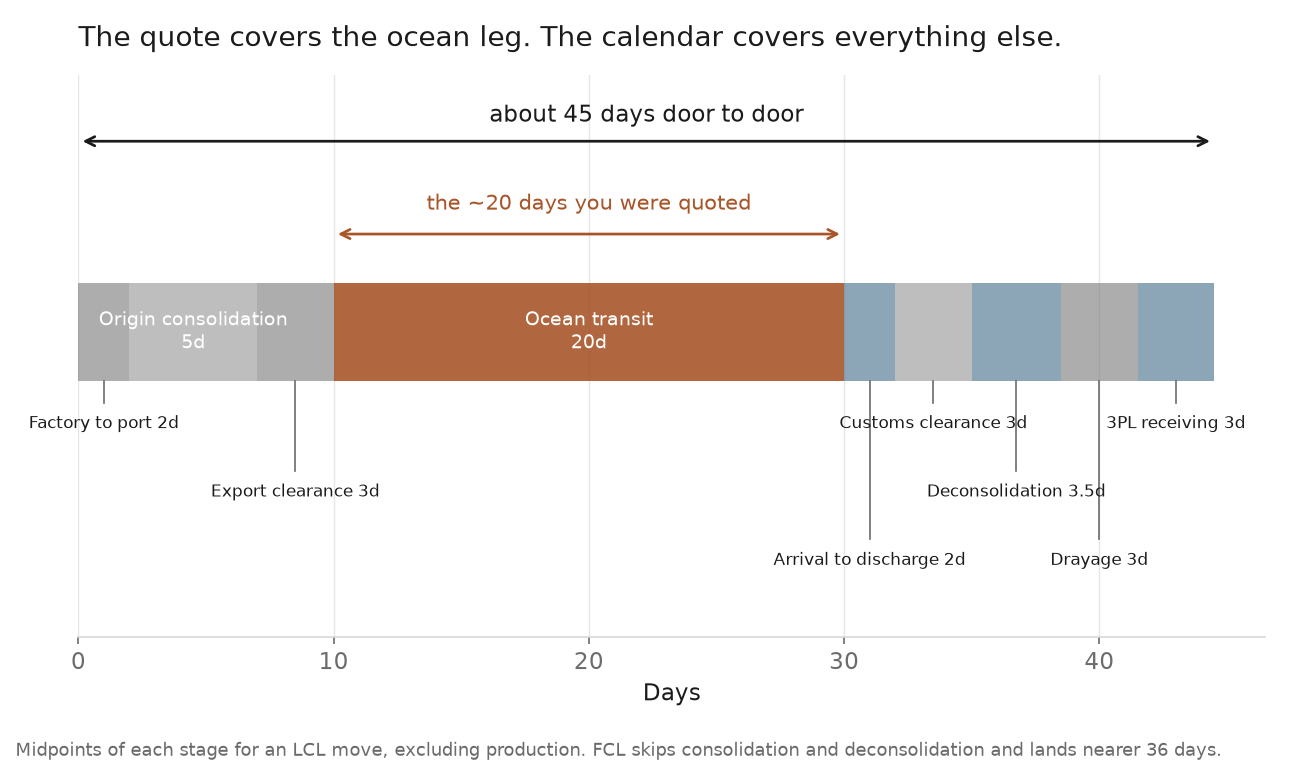
Here is where the other weeks go. Realistic door-to-door for ocean freight from China runs 30 to 50 days, made up of:
| Stage | Typical duration | Who controls it |
|---|---|---|
| Production finishing and QC | Varies – often the largest unknown | Your supplier |
| Factory to origin port (trucking) | 1-3 days | Supplier / origin agent |
| Origin consolidation (LCL only) | 3-7 days | Forwarder |
| Export clearance and port cut-off | 2-5 days before sailing | Origin agent |
| Ocean transit | 14-40 days by route | Carrier |
| Port arrival to discharge | 1-3 days | Terminal |
| Customs clearance | 1-5 days, longer if examined | You |
| Deconsolidation (LCL only) | 2-5 days | Forwarder |
| Drayage to warehouse | 1-5 days by capacity | You / trucker |
| 3PL receiving and putaway | 1-5 days by appointment | Your 3PL |
Two things stand out. First, ocean transit is often less than half the total. Second, several of the slowest stages are yours to control — customs readiness, drayage booking, receiving appointments — which is also where demurrage and detention accrue if you are unprepared.
Why LCL is slower than the difference suggests
LCL adds 3-7 days on paper. In practice it often costs more, because consolidation windows are fixed: if your cargo misses the cut-off for one consolidation, it waits for the next. You are not queuing behind a process, you are queuing behind a schedule.
This is a factor worth weighing alongside the cost calculation in LCL versus FCL. If a restock deadline is real, the container’s schedule reliability can be worth more than the freight saving.
How to plan so this stops hurting
- Plan on door-to-door, never port-to-port. Ask your forwarder explicitly for a door-to-door estimate and make them state their assumptions.
- Add a buffer of at least two weeks against any hard deadline. Not pessimism – the observed gap between schedule and actual routinely exceeds that.
- Treat production time as part of transit. The most common cause of a late shipment is a factory finishing late, and no freight decision recovers that.
- Work backwards from your stockout date, not forwards from your order date. Reorder points should be expressed in weeks of cover, including the buffer.
- Have customs ready before arrival. Entry filed, bond in place, classification settled. Clearance should take days, not weeks – and it only takes weeks when paperwork starts on arrival.
Sellers who run out of stock rarely do so because the ocean was slow. They do so because they planned against the ocean number and everything else was extra.
The two dates that break every China shipping plan
Ocean transit times are averages. Two annual events reliably push them well past the average, and both are predictable years in advance — which means missing them is a planning failure, not bad luck.
Chinese New Year
Chinese New Year 2027 falls on 6 February, with the official break running roughly 4–12 February. The official holiday is about eight days. The practical disruption is six to eight weeks.
The pattern repeats every year:
- 3–4 weeks before: factories scale down as workers begin travelling home. Output falls, quality slips, and everyone in your industry is trying to get orders finished at once — so freight rates rise and space tightens.
- The holiday week: production stops. Ports and forwarders run skeleton operations.
- 2–4 weeks after: the official return to work is not a return to normal output. Staff return unevenly and real capacity commonly runs at 40–70% for several weeks.
- Then the backlog: everything deferred across that whole window ships at once, and congestion follows it across the ocean.
Plan orders that must land before the shutdown to leave the factory a clear month ahead of it, and treat anything ordered inside the window as arriving materially later than any quoted transit time suggests.
Golden Week
China’s National Day holiday — Golden Week, 1–7 October every year — is shorter but follows the same shape. Factories and logistics operations close for the week, with an activity peak in the two to three weeks beforehand as everyone races the cut-off.
The standard advice is to book space at least 3–4 weeks in advance of Golden Week. That means the decision point for October sailings arrives in early September, not late September.
Peak season on top
Layered over both is ocean peak season, broadly running from late summer into autumn as retailers build inventory for the year-end holidays. Rates rise, space tightens, and schedule reliability falls exactly when the two Chinese holidays are also compressing capacity.
If you ship from China, roughly August through February is the difficult half of the year, and March through July is when ocean transit times behave closest to their quoted figures. Build reorder timing around that asymmetry rather than assuming a flat average.
Rolled cargo, the delay nobody warns you about
There is one more source of delay that does not appear on any schedule, and it is common enough to plan around: your container is booked, delivered to the terminal, and then simply does not sail.
Carriers overbook, exactly as airlines do. When a vessel is full, some containers are rolled to the next sailing. On a weekly service that is seven days; on a thinner service it can be a fortnight, and it can happen more than once to the same box.
The cargo most likely to be rolled is the cargo with the least commercial weight behind it — spot-rate bookings, single containers, and shippers without a contracted volume relationship. Which describes almost every small seller.
You will usually not be told promptly. The first sign is a departure date quietly moving in the tracking, so the practical defences are to check that the vessel actually sailed with your container aboard rather than assuming it did, and to build the possibility of one rolled sailing into any deadline that genuinely matters. During peak season, assume it rather than hope against it.
Working out your own numbers? The free freight RFP generator builds the quote request that gets you comparable prices from several forwarders at once — so you are comparing the same scope, not four different ones.