Your ocean quote ends at the terminal gate. The container still has to get from the port to your warehouse, and that short, unglamorous move is called drayage. Drayage costs are usually the least discussed line on the invoice and among the most variable, because it is priced by a completely different set of companies from the ones that quoted you the ocean rate.
Sellers importing their first container are routinely surprised by it. The ocean freight came in at a number they had planned for, and then a separate bill arrives for moving the box forty miles.
What drayage actually covers
Drayage is the truck move between the port terminal and its next stop — your warehouse, a 3PL, a rail ramp or a transload facility. It is short-haul by definition, often under a hundred miles, and it carries costs that have nothing to do with distance:
- A driver and tractor tied up for a fixed slot, whether the terminal is quick or slow.
- A chassis, the wheeled frame the container sits on, which is usually rented separately and is not the trucker’s property.
- Terminal gate transactions, appointment systems and queueing time.
- The return leg, taking the empty container back to a depot the carrier nominates.
That last item matters more than people expect. The move is not finished when your goods are unloaded; it is finished when the empty box is back where the shipping line wants it.
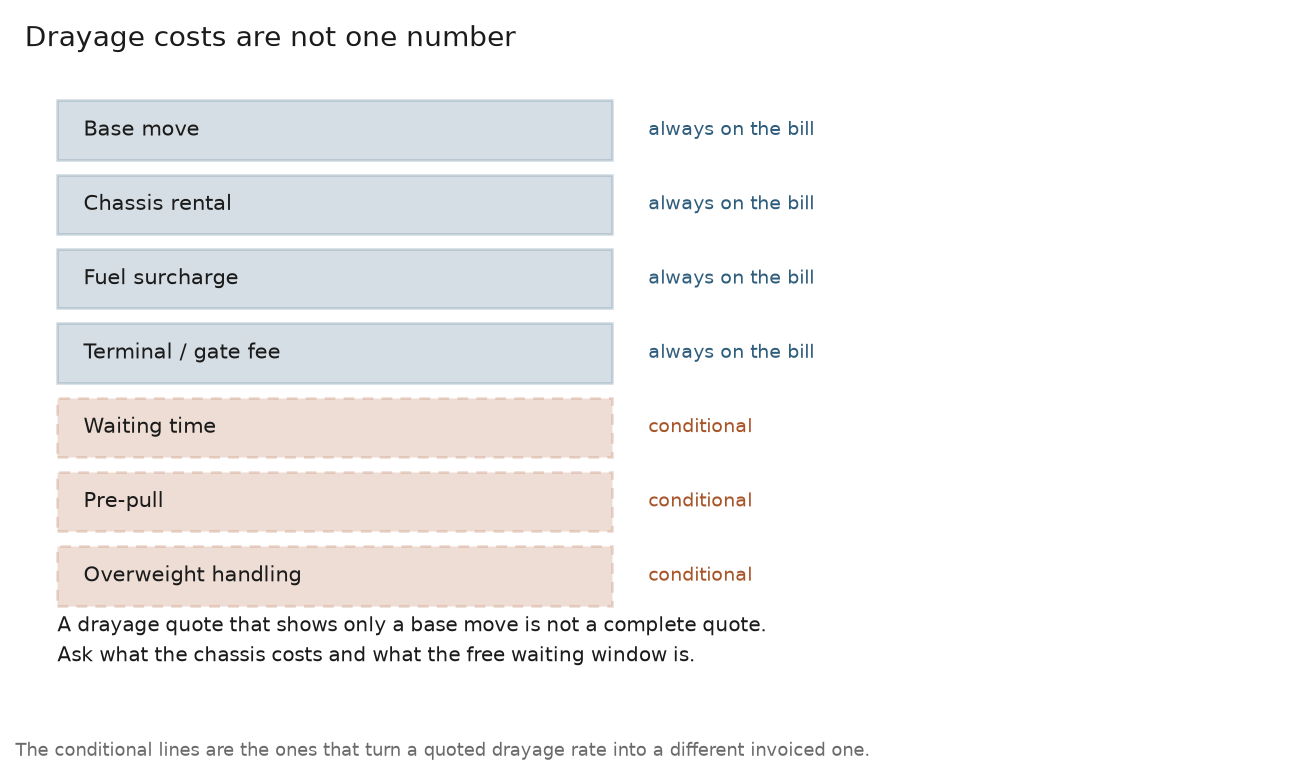
The line items to expect
| Charge | What it is |
|---|---|
| Base move | The trip itself, priced by lane and distance band |
| Chassis rental | Daily or per-move charge for the frame under the container |
| Fuel surcharge | A percentage on the base rate, indexed and unavoidable |
| Terminal handling / gate fee | Moving your box within the yard and processing the gate transaction |
| Congestion or waiting time | Charged once the driver waits beyond a free window |
| Pre-pull | Collecting the container early and parking it, to stop demurrage running |
| Overweight or special handling | Applies once the loaded box exceeds road limits |
At the ports of Los Angeles and Long Beach there is an additional traffic mitigation fee levied by PierPASS on non-exempt loaded containers moving during peak hours. It changes periodically, so check the current figure rather than budgeting from a number you read last year.
Drayage costs, and why any range you read is only a starting point
Local moves at most US gateways in 2026 are commonly quoted in the mid hundreds of dollars per container, with regional moves inland running higher, and the all-in figure landing well above the base rate once chassis and fuel are added.
Be careful with published ranges, including that one. Drayage costs vary by port, by week and by how tight local trucking capacity is, and a rate quoted in January can be meaningfully different by June. Treat any figure you find online as an order of magnitude for budgeting, and get a real quote for the actual decision.
What does not vary is the shape of the bill. If a drayage quote arrives as a single number with no chassis line, no fuel line and no waiting-time policy, it is not a complete quote and the difference will appear later.
The charge that dwarfs the drayage itself
The expensive failure in port logistics is almost never the truck. It is the container sitting still. Once free time expires, demurrage and detention accrue daily and escalate, and a container held for a week past free time can cost more than several drayage moves combined.
This is why the pre-pull exists. Paying a modest fee to collect the box early and park it on the trucker’s yard is frequently cheaper than leaving it inside a terminal where the clock is running at a higher rate. Ask your drayage provider what the two options cost side by side before you need the answer.
It is also why realistic transit time planning matters at the port end and not only at sea. A warehouse that cannot receive on the day the container is available turns a free collection window into a daily charge.
Getting a drayage quote that survives the invoice
Give the provider the five facts that determine your drayage costs, before they quote:
- Port and terminal, and the shipping line, because empty return locations differ.
- Container size and the loaded weight, since road weight limits decide whether special permits apply.
- Delivery address, and whether the site has a dock, a forklift and staff to unload.
- How long you need the container on site, which determines chassis and per diem exposure.
- Whether you want a live unload or a drop-and-pick.
Then ask two direct questions: what is the free waiting time at delivery, and what does the pre-pull cost. Those two answers explain most of the gap between quoted drayage and billed drayage.
The honest summary is that drayage costs are not high relative to ocean freight. They are unpredictable relative to how little attention they usually get, and the unpredictability is almost entirely made up of charges that were knowable in advance.
Live unload or drop-and-pick
This is the single choice that most affects your drayage costs, and it is usually made by default rather than decided.
A live unload means the driver stays while you empty the container, then leaves with it. You pay for the driver’s time beyond a free window, so the cost depends entirely on how fast your receiving operation moves. For a floor-loaded container being unloaded by hand, this is where waiting charges are made.
A drop-and-pick means the container is left on your site on a chassis and collected later. The driver’s time is not at risk, so waiting charges disappear — but the chassis is rented for the whole period and the shipping line’s per-diem clock keeps running on the container itself.
The rule of thumb is unglamorous: if you can unload inside the free window, live is cheaper. If you cannot, drop-and-pick usually is, right up until the point where detention on the box overtakes the waiting time you avoided.
Which means the answer depends on facts you already know — dock access, staff on the day, whether the load is palletised — and not on the drayage rate. Decide it when you book, and tell the provider, because the two options are quoted differently.
Working out your own numbers? The free freight RFP generator builds the quote request that gets you comparable prices from several forwarders at once — so you are comparing the same scope, not four different ones.