Your container has arrived. You cannot collect it until the cargo is released, and how that release works was decided months ago when the bill of lading was issued. Choose wrong and your goods sit at the terminal accruing daily charges while a courier envelope crosses the world.
There are three options: an original bill of lading, a telex release, or a seaway bill. They are not interchangeable, and the difference matters most on your first few shipments, when you have the least leverage and the least experience.
Original Bill of Lading
A physical document, issued as a set of originals. At least one original must be physically presented at destination before the cargo is released. No paper, no container.
This is the traditional instrument and it exists for a good reason: it is a document of title. Whoever holds the original controls the goods. That protects a seller who has not been paid — they simply do not release the originals until the money arrives.
The cost: the paper has to physically travel to you. On a fast ocean lane the documents can arrive after the vessel, which is precisely how demurrage starts accruing on a shipment where nothing actually went wrong.
Telex Release
A middle path. The shipper surrenders the full set of originals to the carrier at origin and requests a telex release. The carrier messages its destination agent, and you collect the cargo without presenting any paper.
You get the security structure of an original B/L — the shipper still controls the moment of release — without the courier race. For most established supplier relationships where payment terms are settled, this is the sensible default.
Seaway Bill
A non-negotiable document issued at booking. No originals are ever printed, so there is nothing to surrender and nothing to lose. The named consignee identifies themselves at destination and collects.
Fastest and simplest. The trade-off is that it is not a document of title — it carries no mechanism for withholding goods pending payment. Use it when you are shipping to yourself, or with a supplier you have already paid and trust completely.
Side by side
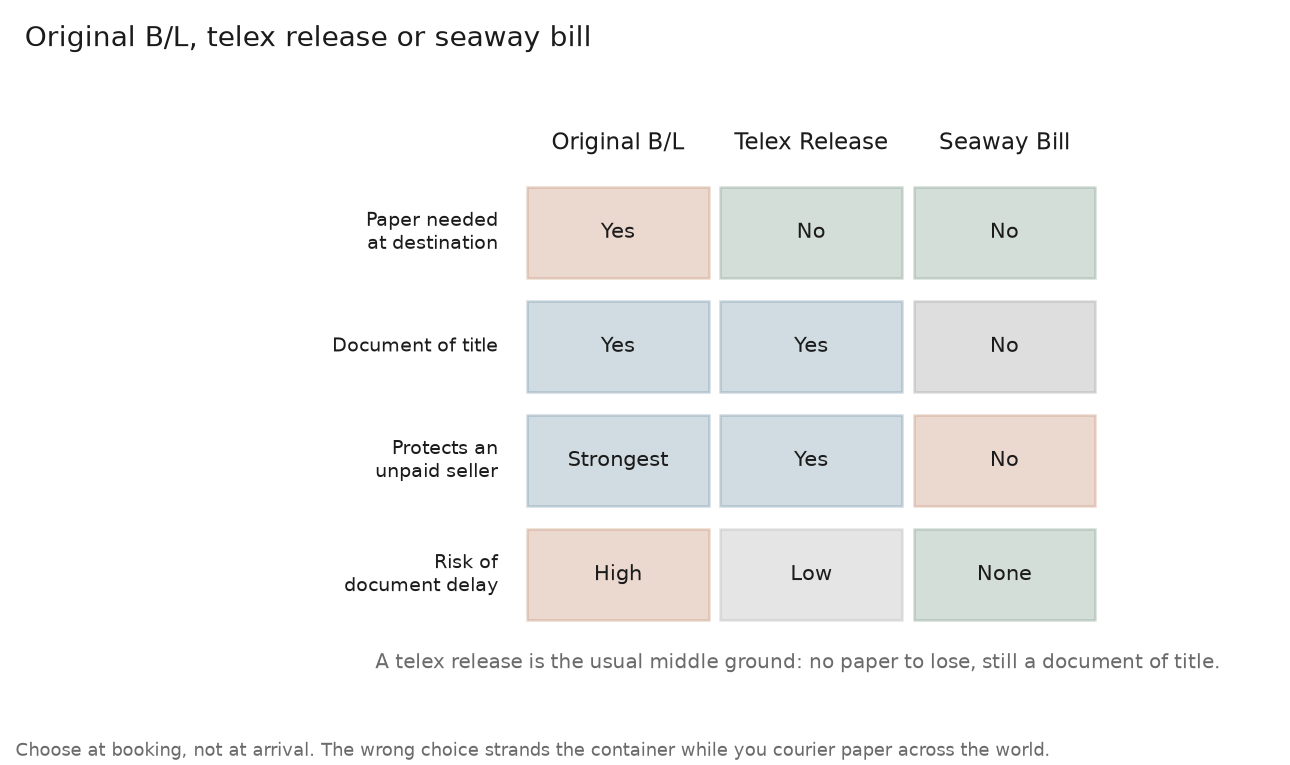
| Original B/L | Telex Release | Seaway Bill | |
|---|---|---|---|
| Physical paper needed at destination | Yes | No | No |
| Document of title | Yes | Yes | No |
| Protects an unpaid seller | Strongest | Yes | No |
| Risk of document delay | High | Low | None |
| Best for | New or unpaid relationships | Most established suppliers | Shipping to yourself, fully prepaid |
What happens if an original is lost
This is the scenario worth understanding before it happens, because the answer is worse than most people expect.
The carrier will not simply reissue it. To release cargo against a lost original, you will generally be required to post security — commonly an indemnity or bank guarantee around 110% of the value of the goods, which can be held for around two years.
That is not a fee; it is capital locked up. For a small seller, having 110% of a shipment’s value frozen for two years is frequently more damaging than the shipment itself is worth. It is the single strongest argument for avoiding original B/Ls when you do not specifically need the protection they provide.
What to actually do
- Decide the release method at booking, not on arrival. It is a question your forwarder can answer in one line and almost never raises unprompted.
- For a first order with a new supplier, an original B/L or telex release protects both sides. Expect the supplier to want it.
- Once the relationship is established and terms are settled, ask for telex release as standard.
- If you are moving your own goods to your own 3PL, a seaway bill removes an entire category of problem.
- If originals are in play, track the courier as carefully as you track the vessel. The paper is on a deadline too.
Whatever you choose, the failure mode is the same and it is expensive: cargo on the ground, clock running, waiting on a document. See accessorial charges for what that costs per day.
Decide at the purchase order, not at the port
The release method is fixed when the bill of lading is issued, which is typically after the cargo has already sailed. By the time anyone is thinking about collection, the choice has been made for you by whatever your supplier and their forwarder do by default.
That default follows the money. A supplier who has not been paid in full has every reason to issue an original bill of lading and hold it, because it is the only one of the three that lets them keep control of the goods after shipment. A supplier who has been paid has no such interest and will usually do whatever is administratively easiest.
So the release method is really a payment-terms conversation, and it belongs in the purchase order:
- Say which one you want, by name. “Telex release” and “seaway bill” are unambiguous terms of art. “Send the documents” is not.
- Tie it to the payment milestone. If the balance is due against a passed inspection or against shipment, say that the release follows that payment, so nobody is waiting on an ambiguity.
- Name who receives it. A telex release goes carrier to carrier; a seaway bill names a consignee. Getting the consignee wrong is a correction, and corrections at destination are chargeable.
- Ask what their forwarder does by default. Some issue originals as a matter of habit regardless of payment status, which creates a courier dependency nobody wanted.
On a first order with a new supplier, an original bill of lading is often the honest answer — you are both taking a risk and the document reflects that. The mistake is leaving it on originals for years afterwards out of inertia, paying courier fees and carrying delay risk on every shipment with a supplier you now trust completely.
Working out your own numbers? The free freight RFP generator builds the quote request that gets you comparable prices from several forwarders at once — so you are comparing the same scope, not four different ones.
This article is general guidance, not legal or customs advice. Rules and rates change, and your situation may differ. Confirm anything specific with a licensed customs broker before you act on it.