Most sellers carry no cargo insurance, because they assume that if a carrier loses or destroys their goods, the carrier pays for it. That assumption is wrong, and the gap between what people expect and what the law provides is one of the largest uninsured risks a small importer carries.
Under the US Carriage of Goods by Sea Act (COGSA), a carrier’s liability is generally limited to $500 per package, unless you declared a higher value before shipment and had that declaration written into the bill of lading.
It does not matter whether the container held $5,000 of goods or $5 million. Absent a declared value, the ceiling is the same.
The word doing all the work is “package”
Everything turns on how a package is counted, and this is where it gets genuinely dangerous.
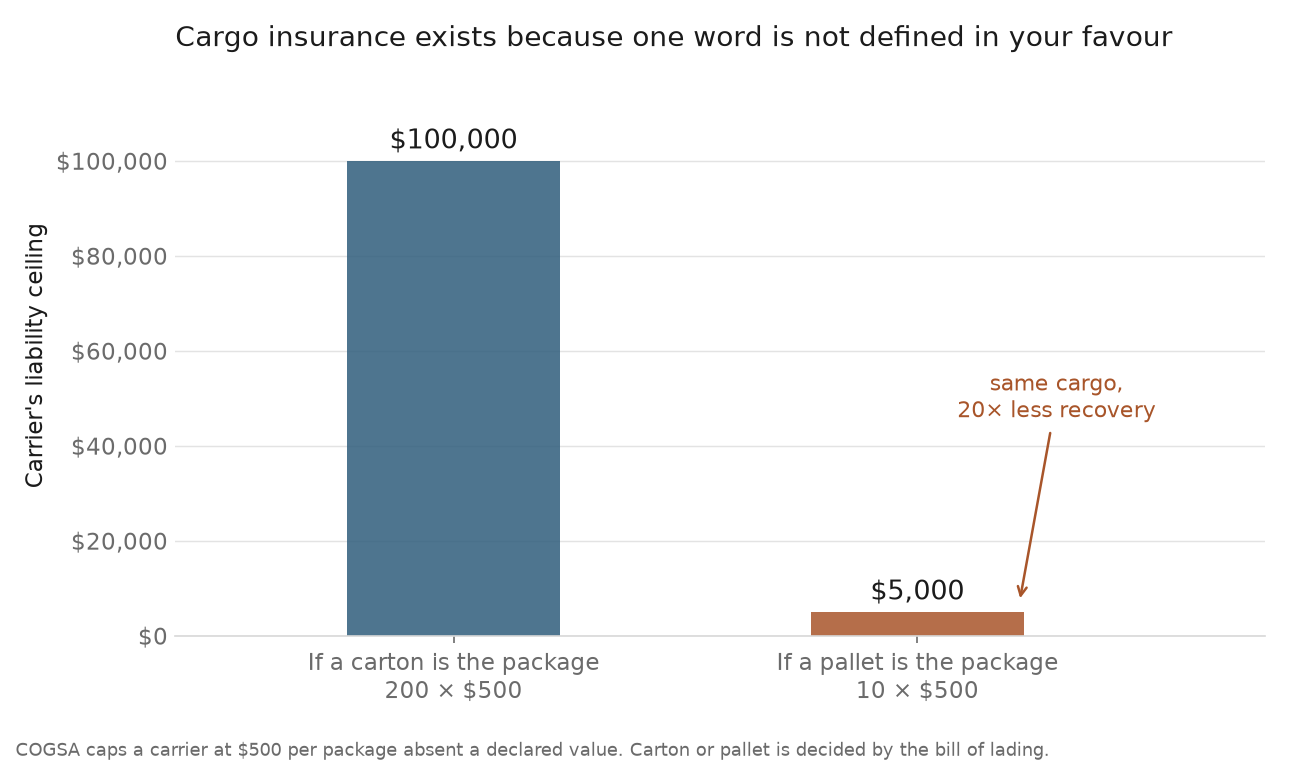
If your 200 cartons each count as a package, the ceiling is 200 × $500 = $100,000. If the pallet counts as the package, and you shipped 10 pallets, the ceiling is 10 × $500 = $5,000 for the same cargo.
That distinction is live law, not theory. In March 2026, a federal appeals court in New York allowed a carrier to define “package” as the pallet rather than the individual cartons, based on the terms of the bill of lading. A follow-up case showed courts will still examine the facts — including why goods were palletised — so outcomes turn on where a case is filed and what evidence exists.
The practical lesson is not to become an expert in COGSA case law. It is that your recovery ceiling may be an order of magnitude lower than you assume, and it is partly determined by paperwork you never read.
How the bill of lading affects your exposure
Since the package definition can be driven by bill of lading terms, the document you skim on arrival is quietly setting your maximum recovery. Two things are worth doing:
- Read how the carrier describes your cargo. If the B/L says “10 pallets” and your cartons are not enumerated, you have handed the carrier the pallet argument.
- Ask for cartons to be enumerated in the description where practical — “10 pallets containing 200 cartons” is materially better for you than “10 pallets”.
This connects directly to which bill of lading you asked for. The document controls release, and it also shapes liability.
Declared value versus cargo insurance
You can declare a higher value with the carrier and pay an ad valorem charge to raise the liability ceiling. In practice this is usually expensive relative to buying cargo insurance, and it still leaves you claiming against a carrier who will contest fault.
The important distinction:
| Carrier liability | Cargo insurance | |
|---|---|---|
| Requires proving carrier fault | Yes | No |
| Covers general average | No | Yes, under standard clauses |
| Typical ceiling | $500 per package unless declared | Insured value, commonly invoice + 10% |
| Who you claim against | The carrier, who will defend | Your insurer |
| Applies if nobody is at fault | No | Generally yes, under all-risk |
That second row deserves attention. General average is a maritime principle where, if cargo is sacrificed or extraordinary costs incurred to save a voyage, every cargo owner contributes proportionally — even if your goods were entirely undamaged. Uninsured, you can be asked to pay a share, and your cargo can be held until you do. Insurance covers it; carrier liability does not.
What all-risk actually means
Marine cargo policies are usually written against the Institute Cargo Clauses:
- Clause A – all-risk. Everything is covered except what is explicitly excluded. This is what most importers should want.
- Clause B – named perils, moderate coverage.
- Clause C – named perils, most limited.
All-risk works on a reverse principle: rather than listing what is covered, it lists what is not. Common exclusions include inherent vice (the goods deteriorating on their own), insufficient packing, ordinary wear, delay, and deliberate acts.
Insufficient packing is the exclusion that catches sellers. If cargo is damaged because it was packed inadequately for normal transit conditions, the claim can fail. This is the same principle that makes pallet stability a financial matter and not just an operational one.
What to do
- Assume carrier liability will not make you whole. Plan around the $500 figure, not your invoice value.
- Buy cargo insurance on any shipment whose loss would genuinely hurt. Rates are typically a small fraction of cargo value.
- Insure on invoice value plus freight plus a margin – commonly invoice + 10% – so a total loss does not leave you out of pocket on the shipping you already paid for.
- Check whether your policy is Clause A, B or C. Many forwarder-arranged policies are narrower than buyers assume.
- Photograph pallets before they ship. Packing-related claim disputes are won and lost on evidence of how goods left your supplier.
The recurring theme: freight moves on documents and assumptions, and the assumptions are usually in the carrier’s favour. Insurance is how you opt out of that arrangement.
What all-risk cargo insurance still does not cover
“All-risk” is a term of art rather than a promise. It shifts the burden — the insurer must show an exclusion applies, rather than you showing a named peril caused the loss — but the exclusions are substantial and largely standard across policies.
- Insufficient packing. If the goods were not packed to withstand ordinary carriage, the loss is generally not covered. This is the most commonly declined category and the most preventable.
- Inherent vice. Damage arising from the nature of the goods themselves — corrosion, spoilage, ordinary leakage or wear.
- Delay. Loss of market or missed season is excluded even where the delay was caused by an insured event.
- War and strikes. Normally excluded from the base cover and added back by endorsement, which is worth checking on any lane where that is a live consideration.
- Wilful misconduct by the insured, and losses arising from insolvency of the carrier in some wordings.
The practical reading: insurance covers accidents, not consequences and not your own packing decisions. Which puts packing specification and a pre-shipment inspection back at the centre of the conversation, because they are what keeps a claim inside the policy rather than outside it.
Working out your own numbers? The free freight RFP generator builds the quote request that gets you comparable prices from several forwarders at once — so you are comparing the same scope, not four different ones.
This article is general guidance, not legal or customs advice. Rules and rates change, and your situation may differ. Confirm anything specific with a licensed customs broker before you act on it.