Every commercial shipment entering the United States needs one party named as the importer of record. It is the least examined decision in a first import, because it usually arrives disguised as a favour: your supplier or your forwarder offers to “handle the customs side”, you agree, and a name goes on the entry that you never actually chose.
That name carries the legal liability for the shipment. It is worth understanding what it means before someone else decides it for you.
Who is legally allowed to be the importer of record
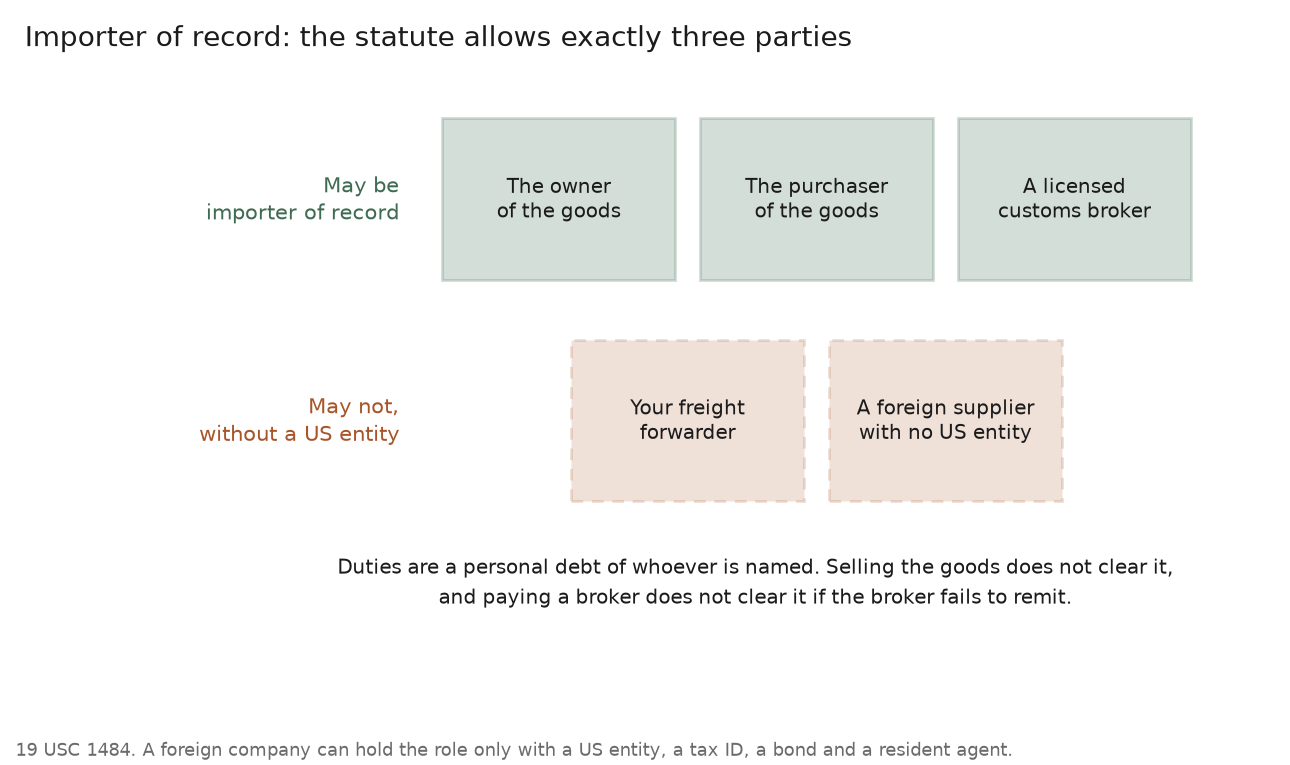
The statute is narrow about this. Under 19 U.S.C. § 1484, entry may only be made by the owner of the goods, the purchaser of the goods, or a licensed customs broker designated by one of them. There is no fourth option.
For a Shopify or Amazon seller buying stock from a factory, that almost always means you. You are the purchaser. A freight forwarder who is not a licensed broker cannot simply take the role because it is convenient, and a foreign supplier can only do it if it has a US entity, a US tax identifier, a customs bond and a resident agent authorised to accept legal service.
What the role actually obliges you to do
The same statute sets the standard: the importer of record must use reasonable care when filing entry documents. In practice that covers three things you are expected to get right, not guess at:
- The classification of the goods — the tariff code that decides the duty rate.
- The declared value, on the correct valuation basis.
- Any other information CBP needs to assess duties and confirm the goods meet other agencies’ requirements.
Reasonable care is deliberately not a checklist. It is judged on the whole picture: how complex the product is, how experienced you are, what resources you had, what effort you made to get the classification right, and your compliance history. A first-time importer is not held to a customs lawyer’s standard, but “my supplier filled it in” is not an answer either. Getting the tariff classification wrong is the most common way this goes badly.
The liability is personal, and it does not follow the goods
This is the part that surprises people. Under 19 CFR § 141.1, duties become a personal debt due from the importer to the United States, and that debt can be discharged only by payment in full.
Two consequences follow, and neither is intuitive:
- Selling the goods does not clear the debt. The liability attached to you on arrival. Passing the stock on to customers does not pass the obligation with it.
- Paying your broker is not the same as paying the duty. If you send funds to a broker and the broker fails to remit them, you still owe the money. The regulation says so directly.
The debt also survives an honest mistake at the border. If a misreading of the rules let the goods clear without the correct duty being collected, the liability can still be enforced afterwards.
Why letting the supplier be importer of record is a poor trade
The offer usually arrives as DDP pricing — a single landed number with customs included. It is genuinely easier, and for a small first order it can be a reasonable way to learn. But understand what you are giving up, because the convenience is priced:
| What you lose | Why it matters |
|---|---|
| Sight of the declared value | You cannot verify what was declared on your behalf, or whether it was understated |
| Sight of the classification | A wrong code is your exposure if you are the purchaser, not just the filer’s |
| The ability to protest or correct an entry | Only the importer of record can challenge how an entry was handled |
| Any duty refund you might be owed | Refunds follow the importer of record, not the person who paid for the goods |
| A compliance record of your own | You build no history with CBP, which matters when you later import at volume |
Undervaluation is the specific risk. A supplier quoting DDP has a direct incentive to declare a low value, because the duty comes out of their margin. If that declaration is wrong, the exposure does not stay neatly with them — you are the purchaser, and CBP is entitled to look at who actually benefited. The Incoterms comparison covers why DDP looks cheapest and usually is not.
What to do instead
Be the importer of record yourself, and buy the two things that make it manageable:
- A customs bond in your own name. A continuous bond is normally the cheaper choice past three or four entries a year.
- A licensed customs broker you have chosen, working under your power of attorney. Note the distinction between a broker and a forwarder — only one of them holds a customs licence, which the forwarder, broker and 3PL comparison sets out.
Then ask your broker for a copy of every entry summary they file for you, and read it. You are looking at three fields: the classification, the declared value, and the country of origin. Those are the three that create liability, and they are the three you are legally responsible for having got right.
None of this is expensive. A continuous bond and a competent broker cost less over a year than a single classification dispute, and considerably less than discovering that duties you thought were settled are still a personal debt in your name.
Getting your own importer number
Being the importer of record requires an identifier CBP can attach the entries to. For a US business that is normally your IRS employer identification number; for a sole trader it can be a social security number, and for a foreign entity it is a CBP-assigned number.
The identifier is registered with CBP using the importer identity form, commonly still called by its old number, CBP Form 5106. Your broker will usually file it as part of onboarding, which is why most sellers never see it. It is worth knowing three things about it anyway:
- It is yours, not your broker’s. Changing broker does not change your importer number, and your entry history follows you.
- The details have to stay current. A change of business address or legal name needs updating, and stale details are a common cause of entries being held for something entirely clerical.
- It is what your compliance record attaches to. Which is the practical reason to hold your own rather than importing under someone else’s — the history you build is an asset when you later need a larger bond or face a classification question.
Once the number exists and a bond is in place, being importer of record is mostly administrative. The liability described above does not go away, but it becomes a thing you manage deliberately rather than a thing that happened to you because someone else filled in a form.
Working out your own numbers? The free freight RFP generator builds the quote request that gets you comparable prices from several forwarders at once — so you are comparing the same scope, not four different ones.