3PL pricing is hard to compare because no two quotes are structured the same way. One warehouse leads with cheap storage and recovers it on pick fees. Another has attractive pick fees and a monthly minimum that quietly sets your floor. The headline number tells you almost nothing.
Here are the 2026 3PL pricing benchmarks for each line, so you can see where a quote sits against the market.
The core 3PL pricing fees, benchmarked
| Fee | Typical 2026 range | What drives it |
|---|---|---|
| Receiving | $5-$15 per pallet; $25-$50 for palletized freight; $0.30-$0.60 per unit loose | Palletized and labelled inbound is far cheaper than loose cartons |
| Storage | $8-$25 per pallet per month (commonly $15-$25) | Coastal and metro warehouses sit at the top of the range |
| Pick & pack | $2-$3 per B2C order; or $3.50-$8.00 flat for a single-item order | Plus roughly $0.50-$1.50 per additional item in the order |
| Monthly minimum | Averaging around $517 | Charged whether you use it or not |
| Setup / onboarding | $250-$1,000 one-time | Integration, account setup, initial SKU load |
For context on the total: small ecommerce brands commonly land in the $2,100-$3,200 per month range all-in. If a quote is far below that, look for what is not included.
The two lines that actually decide it
1. The monthly minimum
This is the one that hurts small sellers, and it is the one buried lowest in the quote. A $500 monthly minimum is irrelevant if you ship 400 orders a month. If you ship 60, you are paying roughly $8 per order in minimum alone before a single fee is counted.
Ask directly: what is the minimum, when does it start, and is there a ramp period before it applies? Many 3PLs will waive or reduce it for the first three months and will not mention this unless asked.
2. Receiving, if your inbound is messy
The gap between $5 per pallet and $0.60 per unit is enormous once you do the arithmetic. A pallet holding 400 units costs $5 to receive palletized — or $240 if it arrives as loose cartons that have to be counted and sorted.
This is almost entirely within your control, and it is decided at your supplier’s factory, not at the warehouse. Palletized, labelled, accurately manifested inbound is the single cheapest operational habit in this whole list.
The questions that make quotes comparable
- What is the monthly minimum, and is there a ramp-up period?
- Is storage charged per pallet, per bin, or per cubic foot? (Per cubic foot favours small, dense SKUs; per pallet favours bulky ones.)
- What exactly is included in the pick fee — packaging materials? Branded inserts? Custom boxes?
- What is the receiving rate for palletized versus loose, in writing?
- What are the fees for returns processing, and for removing inventory if I leave?
- What are the long-term storage surcharges, and at what age do they trigger?
That last pair matters more than sellers expect. Exit costs — removal fees, final month storage, unreturned pallet charges — are where a cheap-looking 3PL recovers its margin when you outgrow it.
When a 3PL stops making sense
Roughly speaking, a 3PL is the right answer when your order volume is high enough to clear the monthly minimum comfortably but not high enough to justify your own space and staff. Below the minimum you are subsidising the warehouse. Well above it, you start paying a margin on every single pick that in-house handling would not cost you.
Recalculate at every doubling of order volume, the same discipline as the LCL to FCL switch. Logistics decisions age badly and almost nobody revisits them on schedule.
The fees that are not on the rate card
Every 3PL pricing quote shows receiving, storage and pick-and-pack. The fees that actually decide whether a relationship stays profitable are usually the ones you have to ask about.
- Long-term storage surcharges. Inventory that ages past a threshold – often 6 or 12 months – attracts a penalty rate. If you carry slow-moving SKUs or seasonal stock, this can quietly become your largest single line.
- Returns processing. Charged per return, and sometimes again to inspect, repackage and restock. A category with a 20% return rate has a completely different 3PL cost profile from one with 3%.
- Kitting and bundling. Any assembly – multipacks, gift sets, inserts – is usually billed per unit or per labour hour, separately from picking.
- Special projects and labour rates. Relabelling, FBA prep, barcode application. Ask the hourly rate now, not when you need it urgently.
- Account or platform fees. A flat monthly charge for the software, on top of the monthly minimum.
- Exit costs. Removal fees, final-month storage, pallet charges. This is where a cheap-looking 3PL recovers its margin when you outgrow it.
Comparing two quotes properly
3PL pricing rate cards are not comparable directly, because each provider structures them to flatter its own strengths. Model them instead against your actual volume.
Take a representative month – say 300 orders, 1.4 items per order average, 6 pallets stored, one inbound container of 12 pallets – and calculate the total under each quote:
| Line | Warehouse A | Warehouse B |
|---|---|---|
| Receiving (12 pallets) | 12 × $8 = $96 | 12 × $30 = $360 |
| Storage (6 pallets) | 6 × $22 = $132 | 6 × $12 = $72 |
| Pick & pack (300 orders) | 300 × $3.20 = $960 | 300 × $2.60 = $780 |
| Extra items (120) | 120 × $0.80 = $96 | 120 × $1.40 = $168 |
| Monthly minimum | $500 (exceeded – not charged) | $350 (exceeded – not charged) |
| Total | $1,284 | $1,380 |
Warehouse B has the cheaper headline pick fee and the cheaper storage, and is still more expensive at this volume – because of receiving. Change the assumptions to 600 orders a month and the answer flips. There is no cheaper 3PL in the abstract, only a cheaper 3PL for your specific shape of business.
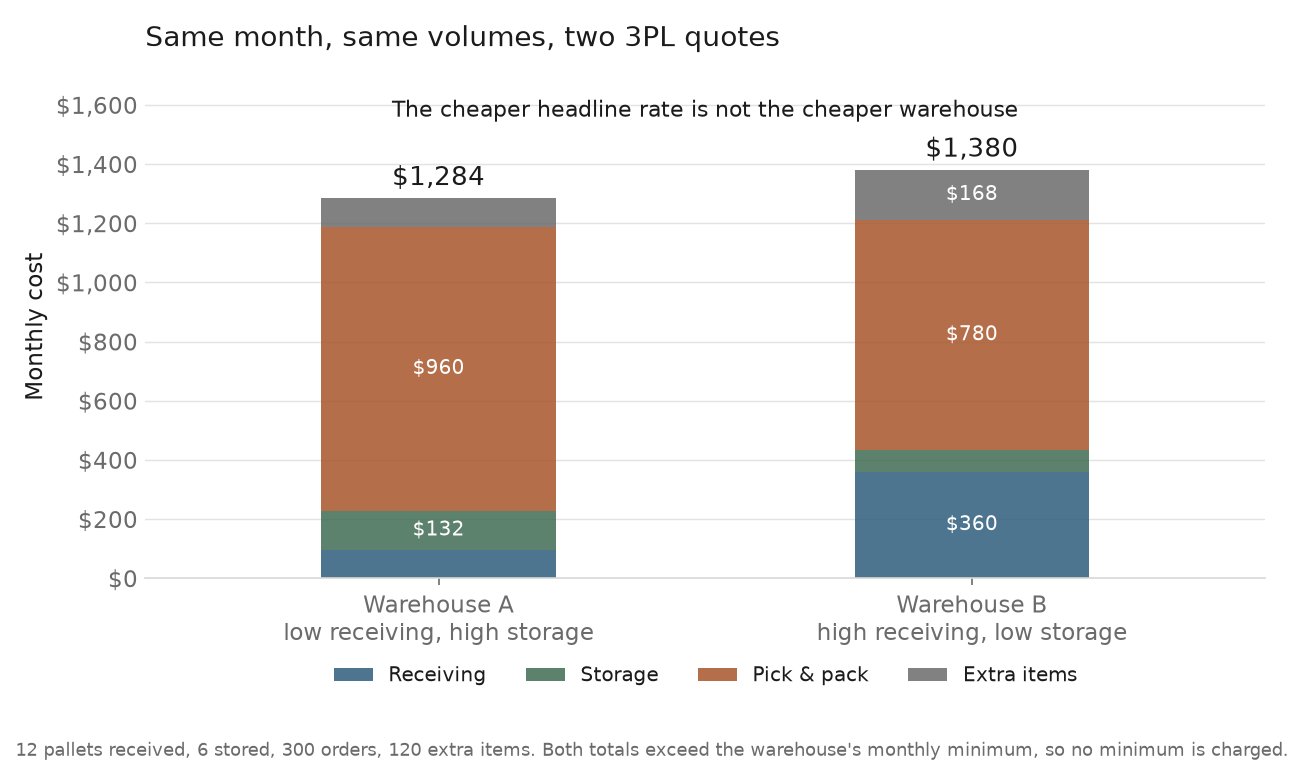
Build this table before you sign anything. It takes twenty minutes and it is the only honest way to compare 3PL pricing.
Peak season, and the fees that only appear in Q4
Rate cards are quoted in the quiet part of the year and tested in the busy one. Several charges either appear or increase in the fourth quarter, and they are rarely volunteered during a sales conversation in spring.
- Peak storage rates. Some 3PLs raise per-pallet storage for the final quarter, exactly when your stock levels are highest.
- Surge or overtime labour. Pick and pack rates can carry a premium once the warehouse is running extended hours.
- Receiving appointment congestion. Inbound slots tighten, which matters if your container lands in November and cannot be booked in for a week.
- Carrier surcharges passed through. Parcel carriers apply their own peak surcharges, and a 3PL quoting you a blended shipping rate will usually pass them on.
Ask directly whether any rate on the sheet changes seasonally, and get the answer in the agreement. The question that gets a useful response is not “do you have peak surcharges” but “what did a client of my size pay per order in November compared with June”.
The same applies to receiving. A container arriving in peak season needs its appointment booked further ahead, and a missed slot turns into detention on equipment you are still paying for.
Working out your own numbers? The free freight RFP generator builds the quote request that gets you comparable prices from several forwarders at once — so you are comparing the same scope, not four different ones.