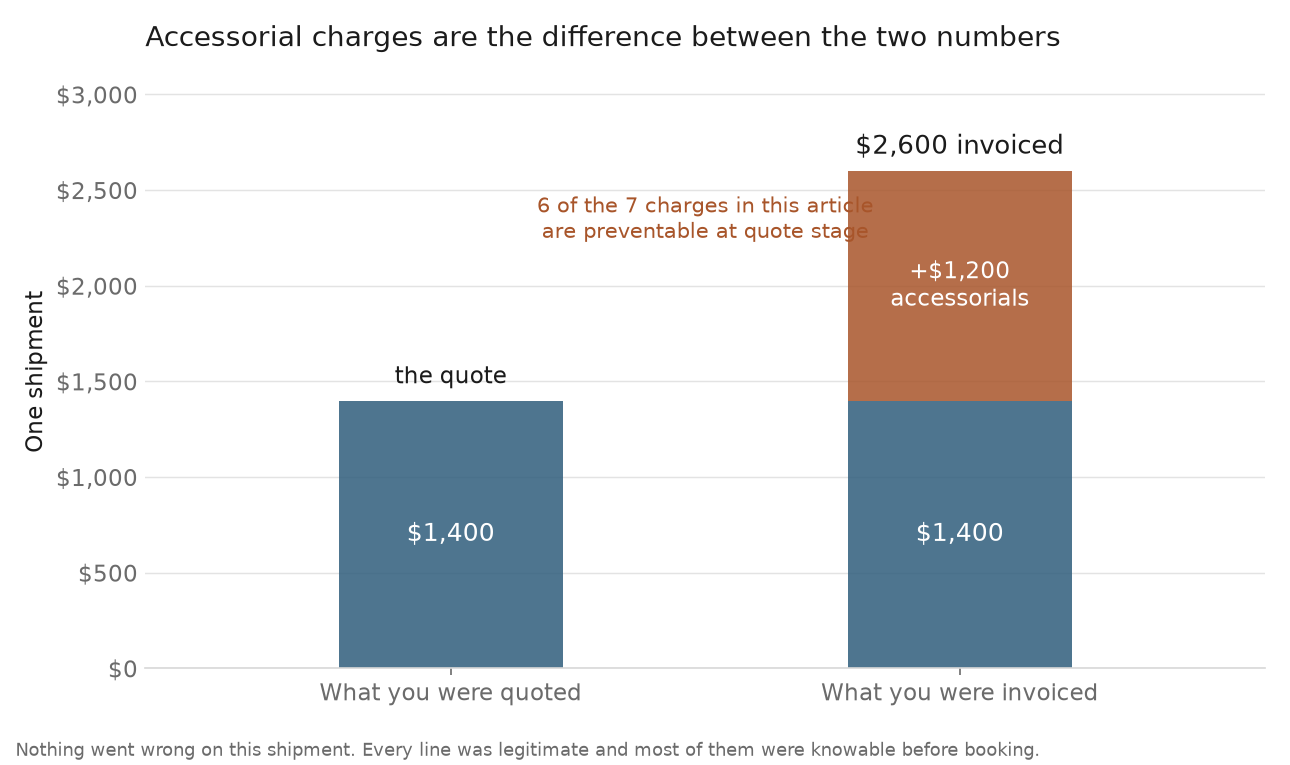
You were quoted $1,400. The invoice says $2,600. Nothing went wrong, nobody made a mistake, and your forwarder will patiently explain that every line is legitimate. Welcome to accessorials.
Accessorial charges are anything billed for work beyond simply moving freight from terminal to terminal. The quote covers the move. Accessorials cover everything the real world adds to it — and because they depend on conditions at the time of delivery, most of them are not in the quote at all.
The good news: roughly two-thirds of accessorial charges are preventable if you know they exist before you book.
The accessorial charges that appear most often
Liftgate delivery
A standard freight truck delivers at dock height. If you do not have a loading dock, the driver needs a hydraulic liftgate to lower the pallet to street level. This is one of the most common surprise charges for sellers running out of a garage, storage unit or small retail unit.
Prevent it by: telling your forwarder at quote time that you have no dock. It gets priced in. Discovered at the door, it costs more and may mean a failed delivery.
Residential delivery
Delivering to an address the carrier classifies as residential costs more than a commercial address, because the trucks and routes are not built for it. Note this is the carrier’s classification, not yours — a home-based business with commercial signage can still be flagged residential.
Limited access delivery
Schools, construction sites, storage facilities, farms, military bases and many strip malls are classified as limited access. Self-storage units catch a surprising number of growing sellers here, since it is exactly where people put inventory before they can justify a warehouse.
Detention
The driver arrives and waits. Carriers allow a free window — often around two hours — then charge per hour. If you are unloading 18 pallets by hand with one person, you will exceed it.
Prevent it by: having help booked for the delivery window, not called after the truck arrives.
Demurrage and detention at the port
Different charge, same name confusion. Demurrage is your container sitting at the terminal past its free days. Detention is the container off-terminal but not returned. Both accrue daily and both escalate. This is where a customs delay turns into real money — the ISF or paperwork problem stops being a compliance issue and starts being a daily meter.
Reconsignment / redelivery
Changing the delivery address after the freight is in motion, or failing a delivery attempt so the carrier must return. Both are billed, and redelivery often includes another day of storage.
Fuel surcharge
A percentage applied on top of the linehaul rate, adjusted against a published index. Entirely normal and entirely unavoidable — but you should know whether your quote was inclusive or exclusive of it, because on a long lane it is not a rounding error.
Which are preventable and which are not
| Charge | Preventable? | How |
|---|---|---|
| Liftgate | Yes | Declare no-dock at quote stage |
| Residential | Yes | Confirm the carrier’s classification of your address up front |
| Limited access | Yes | Name the exact facility type when quoting |
| Detention (delivery) | Yes | Staff the unload; know your free window |
| Demurrage | Mostly | File customs paperwork early; clear before free days run out |
| Reconsignment | Yes | Lock the delivery address before the freight moves |
| Fuel surcharge | No | But confirm whether it is included in the quoted rate |
How to get a quote that survives contact with reality
The fix for accessorial charges is not negotiating harder. It is describing your delivery accurately enough that the conditions are priced in from the start. Before you accept any quote, state:
- Whether you have a dock, and if not, that liftgate is required
- The exact facility type — home, storage unit, retail, warehouse
- How long unloading will realistically take, and who is doing it
- Whether the address is final or might change
- Whether the quoted rate includes fuel surcharge
A forwarder given those five facts produces a quote that resembles the invoice. A forwarder given only a postcode produces a quote that wins your business and then grows.
This is also why comparing quotes from several forwarders only works if every one of them is pricing the same delivery conditions. Two quotes built on different assumptions are not a comparison — they are a guess.
Auditing the invoice when it arrives
Preventing accessorial charges is the first job. The second is checking the ones you are billed for, because an invoice is generated from carrier records and carrier records are not always right about your delivery.
Work through it line by line against the quote rather than against the total. Totals hide the thing you need to see, which is which line is new:
- Anything not on the quote needs a reason. Ask which tariff rule or contract term the charge is levied under. A legitimate accessorial always has one, and a forwarder who cannot name it is worth a second question.
- Fuel surcharges are indexed. They move with a published figure and a date. Confirm which index and which week, particularly on a shipment that moved across a month boundary.
- Waiting time needs evidence. Detention and demurrage are billed from timestamps — arrival, start of unload, departure. Ask for them. Your own receiving log is the check against them, which is a good reason to keep one.
- Reweighs and reclassifications should show the measurement. A corrected invoice that gives a new freight class without the dimensions and weight it was based on is an assertion, not a finding.
Dispute in writing, promptly, and to the person who issued the invoice rather than to your sales contact. Carriers and forwarders generally operate a window for billing disputes, and the practical reality is that a challenge raised within days is investigated while the records are current, whereas one raised weeks later is a negotiation.
Then close the loop. If a charge was correct and you simply had not expected it, add that fact to the standing description of your delivery site so it is priced into the next quote. The goal is not to win arguments about accessorial charges; it is to stop having the same one twice.
Working out your own numbers? The free freight RFP generator builds the quote request that gets you comparable prices from several forwarders at once — so you are comparing the same scope, not four different ones.