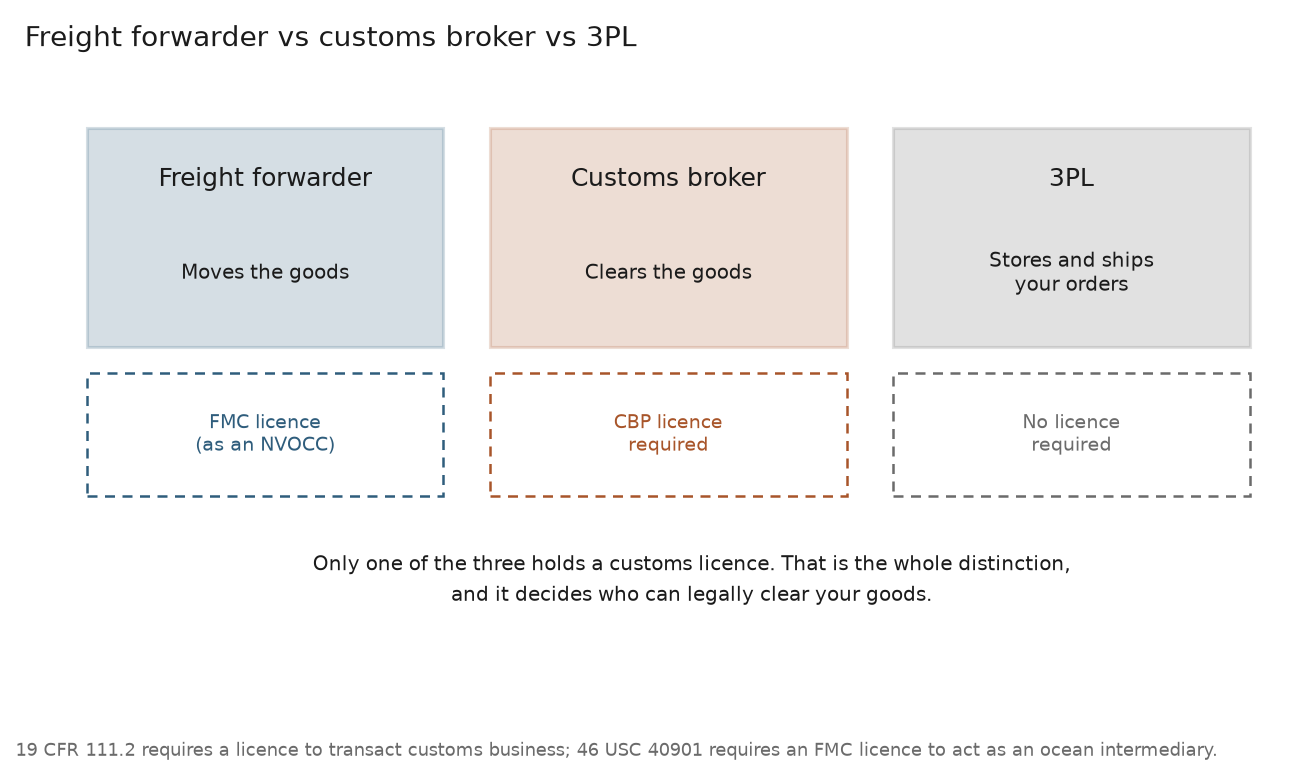
Freight forwarder vs customs broker vs 3PL: these three get used interchangeably, including by the companies selling them. They are not interchangeable. One of them holds a licence the others do not, and knowing which is which stops you paying a middleman to forward your emails.
Freight forwarder
Arranges the movement of your goods. A forwarder does not usually own ships, planes or trucks — they buy capacity in volume and resell it, then coordinate the handoffs between each leg.
What they do for you: book ocean or air space, arrange trucking at both ends, consolidate LCL cargo, produce transport documents, and chase things when a vessel rolls. What they are not: legally responsible for your customs declaration.
Customs broker
Licensed to file customs entries on your behalf. This is the one with a formal credential — in the US, a licence issued by Customs and Border Protection. They classify your goods under the tariff schedule, calculate duty, file the entry, and arrange your customs bond.
The distinction that matters: a broker files for you, but the legal responsibility stays with you as Importer of Record. A good broker will ask you uncomfortable questions about what your product actually is, because misclassification is your liability, not theirs.
Most freight forwarders have in-house brokerage or a partner they route to. That is convenient and usually fine. It is still worth knowing whether the person answering your classification question is licensed or is relaying it to someone who is.
3PL (third-party logistics)
Stores your inventory and ships orders to your customers. The 3PL picks up where freight ends: receiving your pallets, putting them away, then picking, packing and dispatching individual orders as they come in.
Their pricing is structured completely differently from freight — per pallet stored, per order picked, per unit received. See what small sellers actually get quoted for the benchmarks.
Freight forwarder vs customs broker: where the confusion comes from
The categories overlap commercially even though they are distinct functionally. Many forwarders own brokerage arms. Many 3PLs offer freight forwarding. Some companies do all three and market themselves as whichever one you searched for.
That is not necessarily bad — a single provider across all three reduces the number of handoffs where things get dropped. But bundling makes it harder to tell what you are paying for each function, and much harder to replace one piece without replacing everything.
What you actually need, by stage
| Situation | You need |
|---|---|
| First import, small volume, supplier arranging transport | A customs broker. Non-negotiable — you cannot clear without an entry filed |
| Want competitive freight pricing on your own terms | A freight forwarder, buying on FOB so the ocean leg is yours to shop |
| Orders outgrowing your spare room | A 3PL |
| All three, and tired of coordinating | One provider doing all three – but insist on itemised pricing per function |
The question that sorts them out
Ask any provider pitching you: “Are you filing my customs entry yourself under your own licence, or passing it to a broker?”
The answer tells you what they actually are, regardless of what the website says. It also tells you who to call when CBP has a question — and on that day, the difference between a forwarder and a licensed broker stops being academic.
One more category: the NVOCC
You will occasionally see NVOCC – Non-Vessel Operating Common Carrier. An NVOCC buys space from actual shipping lines and issues its own bill of lading, acting as carrier to you while being a customer of the line.
Practically, an NVOCC often looks identical to a freight forwarder from where you sit. The difference that matters is the paperwork: you receive a house bill of lading from the NVOCC rather than a master bill from the shipping line. Both are legitimate, but it changes who you are contracting with, and therefore who you pursue when something goes wrong.
Worth knowing when you are reading your bill of lading and wondering why the issuing party is not the shipping line whose container you can see.
Red flags when choosing any of them
- A single lump-sum quote with no breakdown. Legitimate providers itemise. A refusal to itemise usually means the margin is somewhere you would question.
- No answer on who files your customs entry. Covered above, and still the sharpest diagnostic question available to you.
- Pressure to let them be Importer of Record. Occasionally reasonable, more often a way to obscure duty costs. Your customs record should be yours.
- No physical address or licence number. Customs brokers hold verifiable licences. Ask for the number.
- Quotes far below everyone else. In freight this nearly always means scope has been excluded rather than a better rate secured – usually the accessorials.
Questions worth asking before you commit
- Are you filing my customs entry under your own licence, or passing it to a broker?
- Will I receive a house bill of lading or a master bill?
- What is your process when a container is held for examination, and who pays the exam fee?
- Which of these charges are estimates and which are fixed?
- Who is my named point of contact, and what happens outside their working hours?
The last one sounds soft and is not. Freight problems surface across time zones, and the practical difference between providers is usually not price – it is whether anyone answers when a container is sitting somewhere accruing charges.
What a power of attorney actually authorises
Before a broker can file anything for you, you sign a customs power of attorney. It is handled as a formality and it is worth reading once, because it is the document that lets someone else make legally binding declarations in your name.
Under 19 CFR § 141.46, a broker must hold a valid power of attorney from the importer before transacting customs business on their behalf. Three practical points follow:
- It does not transfer liability. The broker acts as your agent; the declarations remain yours, which is the same principle running through everything else here.
- It should be specific and revocable. Grant it to the broker you chose, for the business you named, and revoke it in writing when the relationship ends rather than letting it sit open.
- A forwarder asking you to sign one is telling you something. If they are not a licensed broker, they cannot use it themselves — they will be passing your entries to a broker you have not chosen and cannot see.
That last case is the practical reason the freight forwarder vs customs broker distinction matters. Not because using a forwarder’s nominated broker is wrong, but because you should know whose licence your declarations are being filed under, and be able to speak to them when CBP asks a question.
Working out your own numbers? The free freight RFP generator builds the quote request that gets you comparable prices from several forwarders at once — so you are comparing the same scope, not four different ones.
This article is general guidance, not legal or customs advice. Rules and rates change, and your situation may differ. Confirm anything specific with a licensed customs broker before you act on it.