Every product entering the United States is assigned a code from the Harmonized Tariff Schedule. HTS codes determine your duty rate and any regulatory requirements attached to the goods. It is ten digits, it is US-specific, and it is your responsibility as importer of record — not your supplier’s, and not your freight forwarder’s.
Getting HTS codes wrong is the most common and most expensive customs mistake importers make. Now that the de minimis exemption has ended and duty applies to essentially everything, it has moved from a background detail to a line item on every shipment you make.
HS code vs HTS code
These get used interchangeably and are not the same thing:
- HS code – the international standard, 6 digits, harmonised across most trading nations. Your supplier will usually quote this.
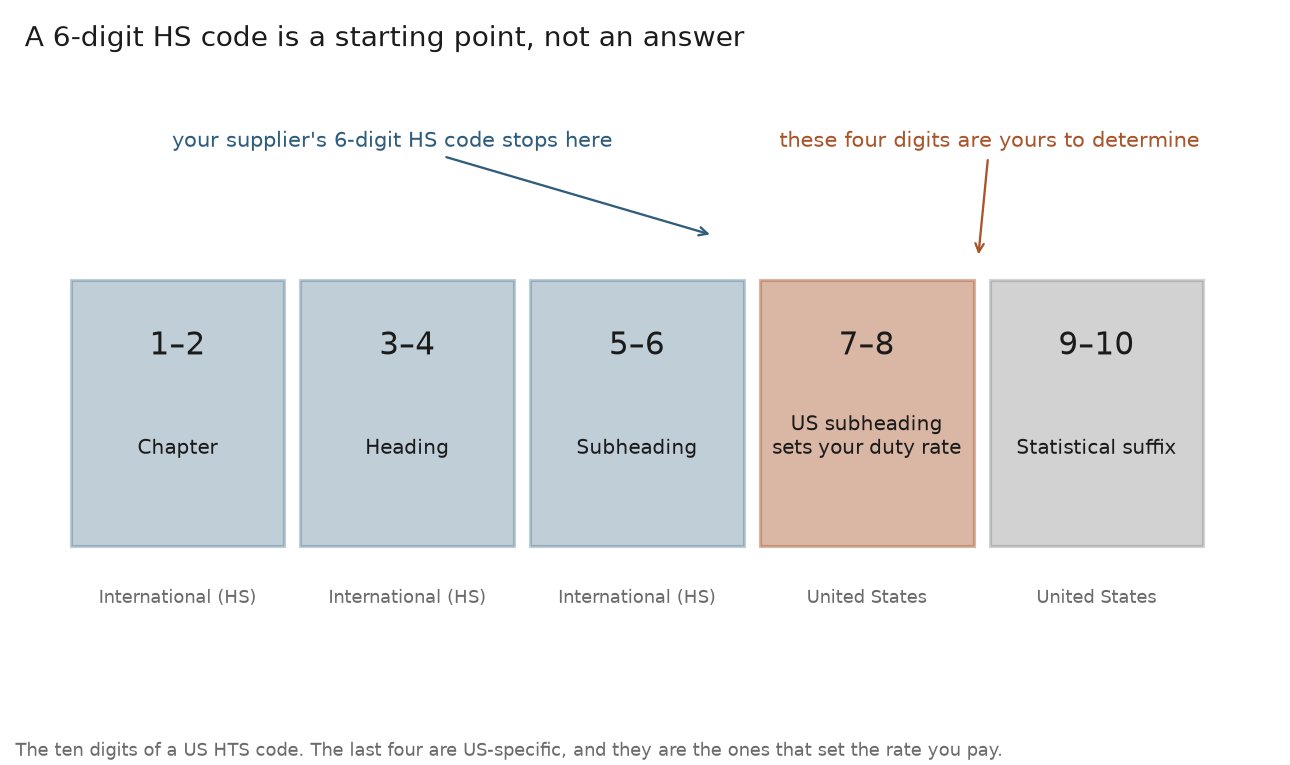
- HTS code – the US extension, 10 digits. The last four digits are US-specific and they are what actually sets your duty rate.
A supplier giving you a 6-digit HS code has given you a starting point, not an answer. The final four digits are yours to determine, and that is exactly where the duty rate lives.
What it costs to get wrong
CBP does not treat classification errors as clerical. The exposure runs in three layers:
| Finding | Consequence |
|---|---|
| Underpaid duty | Charged back, with interest |
| Negligence | Penalties up to 2x the shortfall |
| Fraud | Penalties up to 4x the duty, or the full value of the goods |
In fraud cases, criminal charges are also available to CBP under 19 USC § 1592. That is not the usual outcome for an honest mistake, but the ceiling is worth knowing, because it shows how the system regards classification: as a declaration you are making, not a form you are filling in.
The practical risk for most small sellers is not a fraud finding. It is a retroactive assessment across several years of shipments, arriving at once, on a product you have been importing consistently and confidently.
The tool almost nobody uses: a binding ruling
If your product is genuinely difficult to classify, you can ask CBP directly. A binding ruling is an official decision from CBP establishing the correct classification for your specific product. Once issued, CBP must apply it when your goods are presented.
You submit a written request describing the product in detail, with samples, photographs and technical data sheets. It costs you time rather than money, and it converts your largest open compliance question into a settled matter.
This is the single most under-used protection available to a small importer. Sellers spend months worrying about whether their HTS codes are right, and never spend the afternoon required to simply ask.
A workable process
- Start from your supplier’s 6-digit HS code, but treat it as a hypothesis.
- Have a licensed customs broker determine the full 10-digit HTS code. This is core work for them and they will ask precise questions about material, function and construction.
- Answer those questions accurately, including the unflattering details. Material composition and intended use routinely change the code and the rate.
- If the product sits near a boundary between two codes with materially different rates, request a binding ruling rather than guessing.
- Re-review annually, and whenever HTS revisions are published. Codes change; a classification correct in 2024 may not be correct now.
- Re-check whenever the product itself changes – new material, new function, new packaging.
The recurring theme in customs is that responsibility does not transfer. A broker files for you, a forwarder ships for you, a supplier manufactures for you — and the distinctions between them matter, but none of them absorb your liability as importer of record.
What the ten digits mean
HTS codes are not arbitrary – they narrow from category to specific product, and knowing the structure makes conversations with your broker far more productive.
| Digits | Level | Set by |
|---|---|---|
| 1 – 2 | Chapter – broad category | International (HS) |
| 3 – 4 | Heading – product group | International (HS) |
| 5 – 6 | Subheading – specific product | International (HS) |
| 7 – 8 | US subheading – sets your duty rate | United States |
| 9 – 10 | Statistical suffix – trade data | United States |
Digits 7 and 8 are where the money is. Two products sharing an identical 6-digit HS code internationally can carry materially different US duty rates, which is precisely why a supplier’s 6-digit code cannot answer your question.
Where HTS codes actually go wrong
- Material composition. The dominant material frequently determines the chapter. A bag that is 60% cotton and one that is 60% polyester can classify differently.
- Function versus form. Codes often turn on what a product does, not what it resembles.
- Sets and kits. Multiple items packaged together may classify as a set under a single code, or as separate items – and the rules for deciding are specific.
- Assumed continuity. A code that was correct for last year’s version of your product may not survive a design change you considered cosmetic.
- Copying a competitor. You cannot see whether their classification is correct, and inheriting someone else’s error does not transfer their liability to them.
Keeping a defensible record
If CBP questions your HTS codes, the useful thing to have is not certainty – it is evidence of reasonable care. That standard is met by documentation, and documentation is cheap to create in advance and impossible to create afterwards.
- Keep the technical specification and material breakdown you classified from.
- Record who determined the code and when – broker name, date, the questions they asked.
- Keep any binding ruling, and reference it on entries.
- Log the date of each annual re-review, even when nothing changed.
- When a product changes, re-classify and note why.
Reasonable care is the legal standard importers are held to. A folder demonstrating a considered, documented process is the difference between a correction and a negligence penalty.
Working out your own numbers? The free freight RFP generator builds the quote request that gets you comparable prices from several forwarders at once — so you are comparing the same scope, not four different ones.
This article is general guidance, not legal or customs advice. Rules and rates change, and your situation may differ. Confirm anything specific with a licensed customs broker before you act on it.