For years, the single biggest structural advantage available to a small US importer was the $800 de minimis threshold: shipments under that value entered duty-free with minimal formality. Entire business models were built on it — direct-from-factory parcels, split shipments, China-to-consumer dropshipping.
The de minimis exemption is gone. If your landed-cost spreadsheet still assumes duty-free entry under $800, it is wrong, and the gap between your model and reality is roughly the entire tariff rate on your product.
What happened, and when
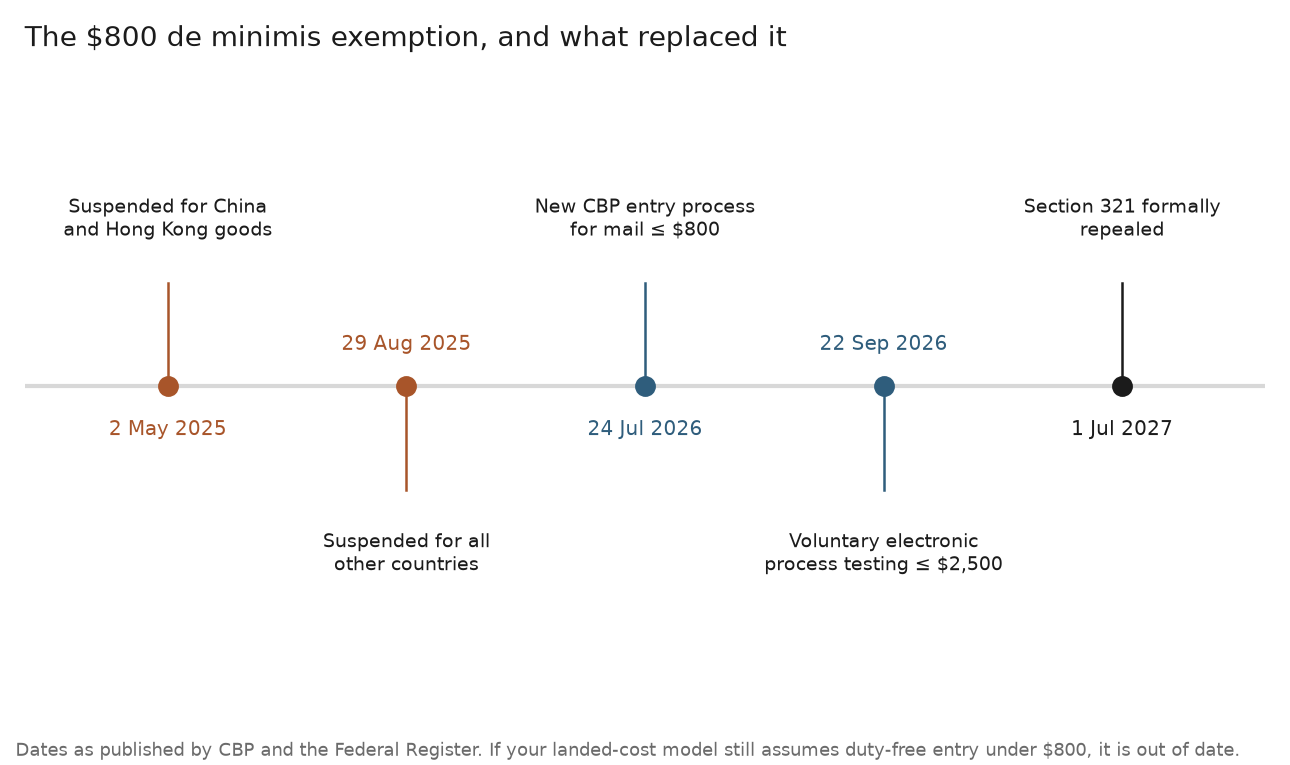
| Date | What changed |
|---|---|
| 2 May 2025 | De minimis treatment suspended for goods of China and Hong Kong |
| 29 August 2025 | Suspended for goods of all other countries |
| 24 July 2026 | New CBP entry process launched for international mail shipments valued $800 or less |
| 22 September 2026 | Voluntary electronic process begins testing for mail shipments up to $2,500 |
| 1 July 2027 | Section 321 formally repealed for all commercial shipments under the One Big Beautiful Bill Act of 2025 |
Note the shape of that timeline. The suspension came first by executive action; the statutory repeal follows in 2027. This is not a temporary measure awaiting reversal — the legislative path has already closed behind it.
What you pay now the de minimis exemption is gone
With the de minimis exemption withdrawn, nearly all low-value shipments now face full tariff treatment. In practice:
- Non-postal shipments (courier, express, freight) are subject to all applicable tariffs, regardless of value.
- Postal parcels incur either a specific fee or an ad valorem duty, depending on the route and the process in effect.
- Everything requires formal entry. Even shipments under $800 must now be entered in ACE by an authorised filer. The paperwork exemption is gone alongside the duty exemption.
That second point is the one that catches people. It is not only that you now owe duty — it is that every shipment now needs a filer, an entry, and the compliance apparatus that goes with it. Which means a customs broker and a customs bond for volumes that previously needed neither.
What this does to your economics
Three shifts follow directly, and they all point the same way.
1. Splitting shipments no longer helps
Breaking a large order into sub-$800 parcels used to avoid duty entirely. Now it multiplies your entry count without reducing your duty — you pay the tariff and the per-entry cost, repeatedly. The tactic has inverted from a saving into a penalty.
2. Consolidation is now clearly better
If every shipment needs a formal entry regardless of size, then fewer, larger shipments cost less in fixed compliance overhead per unit. This pushes small sellers toward exactly the freight decisions this site covers: consolidating into LCL or a full container rather than a stream of parcels.
3. Classification suddenly matters a great deal
When everything was duty-free under $800, your tariff code was close to academic. Now it sets your actual cost on every shipment. Getting it wrong is no longer a paperwork issue — it is a margin issue, and a liability one.
What to do about it
- Rebuild your landed cost model. Add the applicable duty rate to every unit. If your margin assumed duty-free entry, you need the real number before your next purchase order.
- Get a continuous customs bond if you are importing more than a few times a year. Per-shipment bonds do not scale once every shipment needs an entry.
- Verify your HTS classification. It now determines your duty on everything.
- Consolidate. Fewer, larger shipments now beat many small ones on fixed costs as well as freight.
- Re-price if you have to. A tariff you now pay and previously did not is a real cost increase. Absorbing it silently out of margin is a decision – make it deliberately.
The sellers who handle the end of the de minimis exemption well are the ones treating it as a permanent structural change rather than a disruption to wait out. The statutory repeal in July 2027 removes any ambiguity about which it is.
Informal versus formal entry, and which one you now get
With duty applying to shipments that used to clear free, the question stops being whether there is an entry and becomes which kind. The two behave differently enough to change your costs.
Under 19 CFR § 143.21, merchandise not exceeding $2,500 in value is generally eligible for informal entry. Informal entry is the lighter process: no continuous bond is required for the entry itself, and the paperwork burden is smaller.
Above $2,500 you are into formal entry, which requires a customs bond and, in practice, a broker. That threshold has not moved, but its importance has: it used to sit far above the $800 line where most small parcels lived, so almost nobody met it. Now that everything is dutiable, the $2,500 mark is the boundary that actually shapes how you ship.
Two consequences follow for a small seller:
- A parcel that would once have been free is now an informal entry. Cheaper than a formal one, but not free — there is duty, and there is usually a broker or carrier clearance fee attached to it.
- Splitting an order to stay under $2,500 rarely pays. You avoid the formal entry, but you multiply clearance events, and each carries its own fee and its own chance of a hold. The duty is unchanged, because it is charged on value either way.
The planning question is therefore the opposite of the old one. Under de minimis, the instinct was to break shipments down. Now the fixed cost per entry rewards consolidating up — fewer, larger shipments, each properly classified, with the tariff code doing real work on your landed cost rather than sitting unused in a spreadsheet.
The record-keeping that comes with every entry
One consequence of losing the de minimis exemption is easy to miss: entries create records, and records have a retention period. As importer of record you are expected to keep entry documentation for five years from the date of entry.
When a handful of shipments a year were formal entries and everything small cleared free, that obligation was narrow. Now it attaches to essentially everything you import, including the small replenishment orders that used to be invisible.
What to keep is not complicated — the commercial invoice, the packing list, the bill of lading, the entry summary and any correspondence about classification or valuation. What matters is that it is retrievable by shipment several years later, which a folder of email attachments is not.
The reason to care is that a classification question typically arrives long after the goods are sold, and the difference between a correction and a penalty is usually whether you can show a documented, considered process at the time.
Working out your own numbers? The free freight RFP generator builds the quote request that gets you comparable prices from several forwarders at once — so you are comparing the same scope, not four different ones.
This article is general guidance, not legal or customs advice. Rules and rates change, and your situation may differ. Confirm anything specific with a licensed customs broker before you act on it.