Demurrage and detention are the charges that turn a small delay into a serious bill. They are frequently confused, they run on separate clocks, and they escalate — which means the cost of not understanding them compounds daily.
Demurrage and detention: the difference, precisely
| Demurrage | Detention | |
|---|---|---|
| What it charges for | Your container occupying terminal space | Your use of the carrier’s container outside the terminal |
| Where the container is | Still inside the port | At your warehouse, a rail yard, anywhere off-dock |
| Clock starts | After free time from discharge | At gate-out (container leaves the terminal) |
| Clock stops | When the container leaves the terminal | When the empty is returned to the depot |
A useful way to hold it: demurrage is rent on the ground, detention is rent on the box. You can incur both on the same container – demurrage while it sits at the port, then detention once you have collected it and are slow returning the empty.
Note that detention also means something different in trucking, where it refers to a driver waiting at your dock. Same word, unrelated charge. Context tells you which.
How much free time you get
Free time varies by carrier, port and trade lane, but 2026 norms sit in a narrow band:
- Demurrage: commonly 3-7 free days, with 5-7 typical on US imports
- Detention: commonly 4-7 free days from gate-out to empty return
Confirm your actual free days at booking, in writing. This is negotiable, especially if you ship regularly, and it is far cheaper to secure an extra two days up front than to pay for them later.
What it costs when the clock runs
US and Canada import averages in 2026 run $100-$200 per container per day, with benchmarks at major ports between $150 and $300. Typical published figures land around $185 per day for a 20ft and $285 for a 40ft after the first day.
The detail that hurts: rates escalate in tiers. The first few chargeable days are at the base rate; the next band is higher; the band after that higher still. A delay that doubles in length can more than double in cost.
| Days past free time | Illustrative daily rate | Running total (40ft) |
|---|---|---|
| Days 1-3 | $285 | $855 |
| Days 4-6 | ~$400 | $2,055 |
| Days 7-10 | ~$550 | $4,255 |
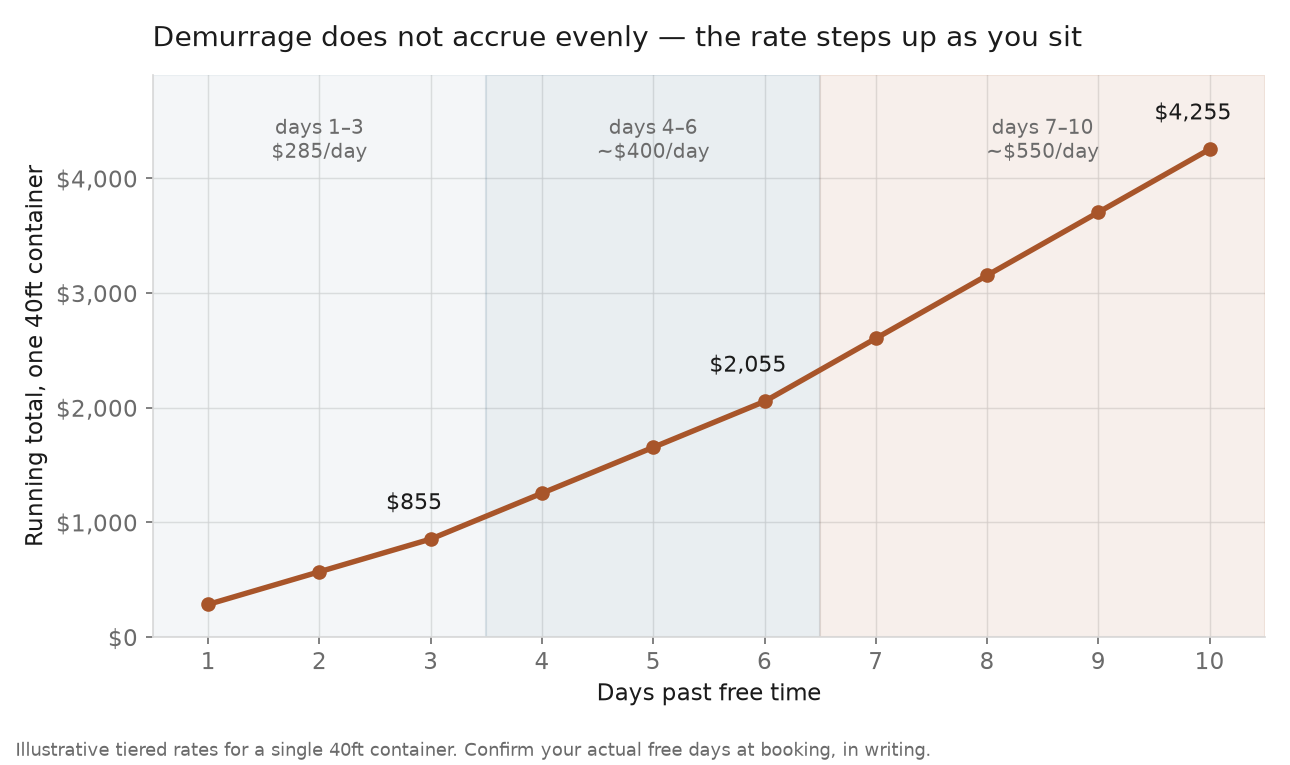
Illustrative only — confirm your carrier’s tariff. The shape is the point: this is not a linear cost, and “a few extra days” is not a small problem.
What actually causes the delays
Almost none of it is the carrier being difficult. In practice the triggers are:
- Customs paperwork not ready. A missing or incorrect entry stops release while free days burn. This is why classification and ISF timing have cost consequences well beyond their own penalties.
- No customs bond in place. Goods are not released without one.
- Original bill of lading in transit. The classic self-inflicted delay, and the reason telex release exists.
- No trucker booked. Drayage capacity at busy ports is not available on demand.
- Nowhere to put the goods. Your 3PL has no appointment slot, so the container waits.
- Terminal congestion. The one genuinely outside your control – which is exactly why you want buffer in the free days you negotiated.
How to keep the clock at zero
- Have the customs entry filed and the bond confirmed before the vessel arrives, not after.
- Use telex release or a seaway bill unless you specifically need an original.
- Book drayage in advance against the ETA, and re-confirm when the ETA moves.
- Book the receiving appointment at your 3PL at the same time as the trucker.
- Track the vessel yourself rather than waiting to be told it has arrived.
- Ask your forwarder to alert you the day free time starts, not the day it ends.
Every item on that list is administrative and free. Demurrage and detention are almost entirely a planning tax — which is why they are the accessorial most worth engineering out of your process rather than negotiating down.
You may not have to pay the invoice at all
Demurrage and detention billing in the US is regulated. Under the Federal Maritime Commission’s final rule on billing practices, an invoice has to meet specific requirements — and failure to meet them eliminates your obligation to pay the charge.
What a compliant invoice must contain
The rule sets a minimum disclosure standard. Among the items your invoice should carry:
- The specific container number, and a reference to the bill of lading
- The actual date and time free time expired — not a vague date range
- The per-diem rate applied
- A citation to the tariff rule or contract clause the charge rests on
- An explanation of why you specifically are the party liable
The two 30-day clocks
- Issuance. Carriers and marine terminal operators must issue the invoice within 30 calendar days of when the charges were last incurred. An invoice arriving later than that is open to challenge on timing alone.
- Dispute. You get at least 30 calendar days to request mitigation, refund or waiver. If you file in time, the billing party must attempt to resolve it within 30 days unless you both agree otherwise.
How to actually use this
Treat every demurrage or detention invoice as something to audit rather than something to pay:
- Check the issue date against when charges stopped accruing. Past 30 days is a deficiency.
- Check each required element is present. A missing tariff citation or a generic date range is a deficiency.
- Check the facts independently — gate-out and empty-return timestamps are recorded, and they sometimes disagree with the invoice.
- Dispute in writing within 30 days, citing the specific deficiency and attaching your evidence. A phone call is not a filing.
- Keep the correspondence. A documented dispute history changes how the next one is handled.
Most small importers pay these invoices without reading them, which is precisely the behaviour the rule exists to correct. An hour spent auditing a four-figure invoice is among the best-paid hours available in this whole business.
The clock you cannot see
One detail catches sellers who have otherwise understood the difference: the two clocks do not always stop when you think they do.
Detention runs until the empty container is returned to the location the shipping line nominates — not until you have finished unloading. If the nominated depot is full and turns the box away, which happens routinely at congested ports, the per-diem generally keeps accruing while you queue at a second one.
Get the empty return location confirmed at the same time as the delivery booking, and have the trucker check it is accepting returns before they load the empty. Where a depot refuses a container, ask for that refusal in writing — a documented turn-away is the basis on which those days are most often waived.
Working out your own numbers? The free freight RFP generator builds the quote request that gets you comparable prices from several forwarders at once — so you are comparing the same scope, not four different ones.