Freight damage claims are mostly won or lost in the minute before you sign the delivery receipt. Everything after that is either supporting a strong position or trying to rescue a weak one.
The reason is simple: a clean signature is the carrier’s evidence that they delivered your goods in good condition. Once you have provided it, you are arguing against your own document.
The single most important habit
Inspect before you sign, and write what you find on the delivery receipt.
Not “subject to inspection” — that phrase is widely used and widely disregarded. Write what you actually observe: “carton 3 crushed on top face”, “pallet leaning, shrink wrap torn, 2 cartons water-stained”, “1 carton short of 12”.
Specific notations on the proof of delivery are your immediate evidence, and they substantially change how a claim is assessed. Vague ones are close to worthless.
If the driver is impatient, that is not your problem to solve. You are allowed a reasonable inspection. A driver’s schedule is not a reason to sign away a claim.
Concealed damage: the five-day rule
Sometimes damage is only visible after unpacking — the outer carton is fine, the contents are not. This is concealed damage, and it carries a much shorter fuse than people expect.
You must give the carrier written notice within 5 business days of delivery. Miss that window and you have not necessarily lost the right to claim, but you have lost the presumption that the damage happened in transit — and proving it afterwards gets harder every day.
Practical consequence: open and inspect inbound freight immediately, even when you do not need the stock yet. Inventory that sits sealed for two weeks before anyone looks at it is inventory whose claims window has quietly closed.
The deadlines that govern everything
| Deadline | What it applies to |
|---|---|
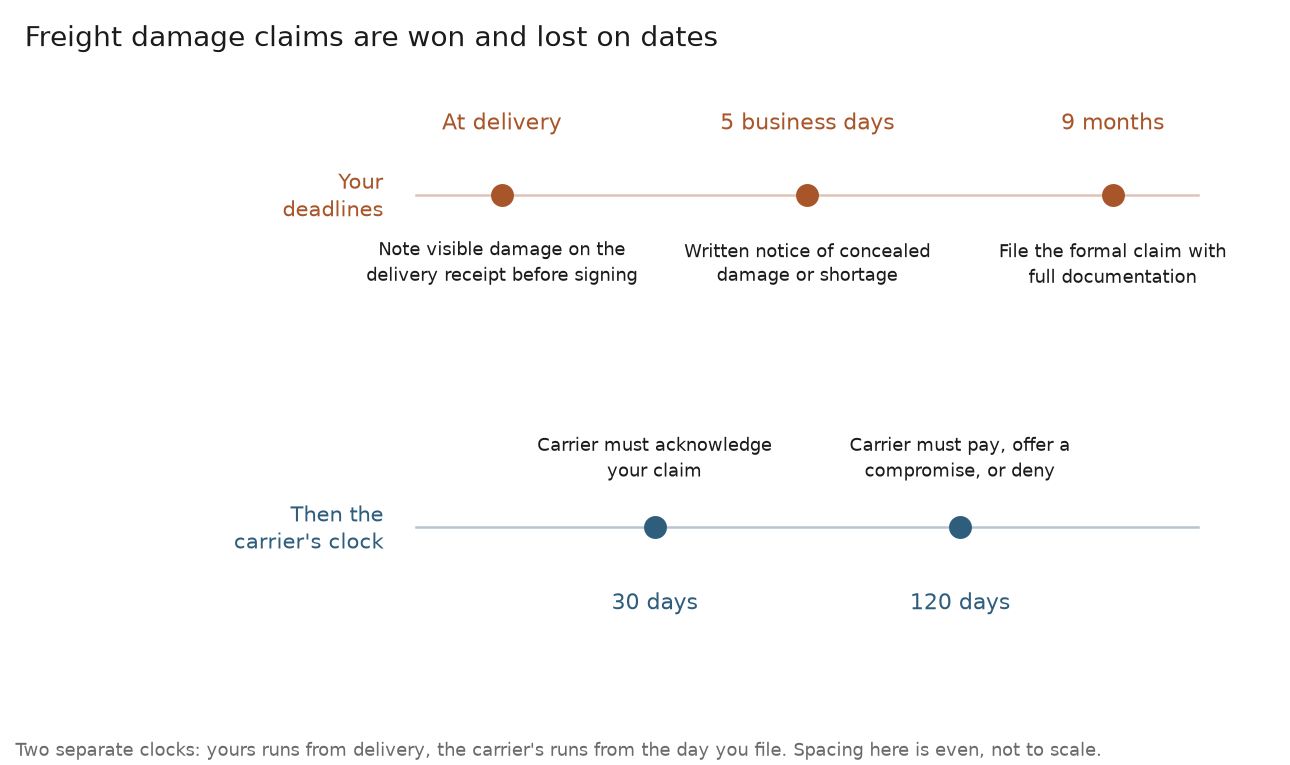
| Immediately, at delivery | Note visible damage on the delivery receipt before signing |
| 5 business days | Written notice of concealed damage or shortage |
| 9 months from delivery | File the formal claim with full documentation |
| 30 days | Carrier must acknowledge receipt of your claim |
| 120 days | Carrier must pay, offer a compromise, or deny |
The nine-month window sounds generous and encourages procrastination. Do not use it. Evidence degrades, staff leave, photographs get deleted, and the carrier’s own records age out. Claims filed in week one settle far more often than claims filed in month eight.
The evidence file
Freight damage claims are documentation exercises: assemble this before you file, not after the carrier asks:
- The annotated delivery receipt – the single most important document.
- Photographs before anything is moved. Wide shots showing the pallet in place on the truck or dock, then close-ups of the damage. Include the shipping labels in frame.
- Photographs of the packaging, not just the product. If the carrier argues insufficient packing, your evidence that it was packed properly lives here.
- The commercial invoice establishing value.
- The bill of lading and packing list.
- A repair estimate or replacement cost, whichever you are claiming.
- Retain the damaged goods and packaging until the claim resolves. Carriers can request inspection, and disposing of the evidence usually ends the claim.
Why freight damage claims get denied
- Clean delivery receipt. The most common reason by a distance.
- Insufficient packing. If the packaging was not adequate for normal transit, the damage is attributed to you – the same exclusion that applies under cargo insurance.
- Late concealed-damage notice. Past five days, the burden shifts to you.
- Goods disposed of. No inspection possible, no claim.
- Claiming the wrong amount. Claims are generally for actual loss, not retail value or lost profit.
Set the expectation correctly
Even a well-documented, promptly filed claim against a road carrier is capped by their liability terms, and ocean claims are limited far more severely still. A perfect claim does not necessarily make you whole — it makes you whole up to a ceiling someone else set.
Which is the honest argument for insuring anything whose loss would actually hurt, and treating the claims process as recovery of a portion rather than restoration of the whole.
How a carrier values what it owes you
With freight damage claims, being accepted and being paid in full are different events. Carriers settle on the value of the goods, and their definition of value is narrower than yours.
The starting point is normally your cost, evidenced by the commercial invoice from your supplier — not the retail price you would have sold at. The reasoning is that a claim restores your position rather than delivering the profit you expected, and it is why the invoice is the first document in the evidence file.
Several things then push the number around:
- Repairable damage is valued as repair, not replacement. If the goods can be made sellable for less than they cost, that is generally the measure.
- Partial loss is valued on the damaged units. A pallet with eleven broken units out of two hundred is an eleven-unit claim, however much handling the rest of the consignment cost you.
- You are expected to mitigate. Damaged goods that can be sold at a discount usually should be, with the shortfall claimed. Writing off saleable stock and claiming the full value tends to be challenged.
- Salvage may belong to the carrier. Where they pay the full value, they can be entitled to the damaged goods. Do not dispose of them while a claim is open.
Over the top of all of that sits the liability limit, which is the reason the arithmetic so often disappoints. A road carrier’s terms cap what they owe, and at sea the COGSA package limitation can cap it far below the value of the cargo. A claim can be perfectly documented, filed on time, accepted in full, and still pay a fraction of what you lost.
Which is the practical case for insuring anything whose loss would genuinely hurt, and treating the claims process as partial recovery rather than as the thing that makes you whole.
Working out your own numbers? The free freight RFP generator builds the quote request that gets you comparable prices from several forwarders at once — so you are comparing the same scope, not four different ones.
This article is general guidance, not legal or customs advice. Rules and rates change, and your situation may differ. Confirm anything specific with a licensed customs broker before you act on it.