Most import duty is predictable. You find the tariff code, you read the rate, you add it to your landed cost and the number does not move. Antidumping duties and countervailing duties break that pattern completely: they are assessed on top of normal duty, they are set per product and per country and often per individual factory, and the rate is not final on the day your goods clear.
Antidumping duties are also the one duty that can exceed the value of the cargo. A seller who has budgeted a few per cent for duty and lands a shipment inside an active order does not get a slightly worse margin; they get a bill that can be larger than the purchase order.
What the two duties are
They are separate remedies that often arrive together:
- Anti-dumping duty (AD) applies where a foreign producer sells into the US below fair value. The rate is set to close that gap.
- Countervailing duty (CVD) applies where a foreign government subsidised the product. The rate is set to offset the subsidy.
Two agencies share the work of setting antidumping duties. The Department of Commerce calculates the rates and defines what the order covers. The International Trade Commission decides separately whether a US industry was actually injured. Both have to agree before an order exists, and once it does, CBP is the agency that collects at the border.
The rate depends on which factory made your goods
This is the detail about antidumping duties that catches small importers. An order does not set one rate for a country. It typically sets:
- Company-specific rates for producers and exporters that took part in the investigation.
- An all-others rate for everyone else who cooperated with the process.
- A country-wide rate for producers that did not cooperate, which is normally the punishing one.
So two identical products from the same country can carry very different duty depending purely on which factory they came from. If you do not know your actual manufacturer — as opposed to your trading company — you cannot know your rate. Asking a supplier for the producing factory’s name is not rude; it is the only way to price the shipment.
Your tariff code does not decide whether you are covered
The single most common mistake with antidumping duties is checking a tariff code, finding it absent from a list, and concluding you are clear. It does not work that way.
Every order carries a written scope — a narrative description of the goods covered. That description governs. Tariff codes are published alongside it for convenience only, and CBP has never treated them as the boundary. A product can sit squarely inside a scope while entering under a code that appears nowhere in the order, and it will still be dutiable.
Read the scope text, not the code list. If your product sits near the edge of one, that ambiguity is worth resolving in advance rather than at liquidation — Commerce issues formal scope rulings for exactly this situation.
What you pay at entry is a deposit, not the bill
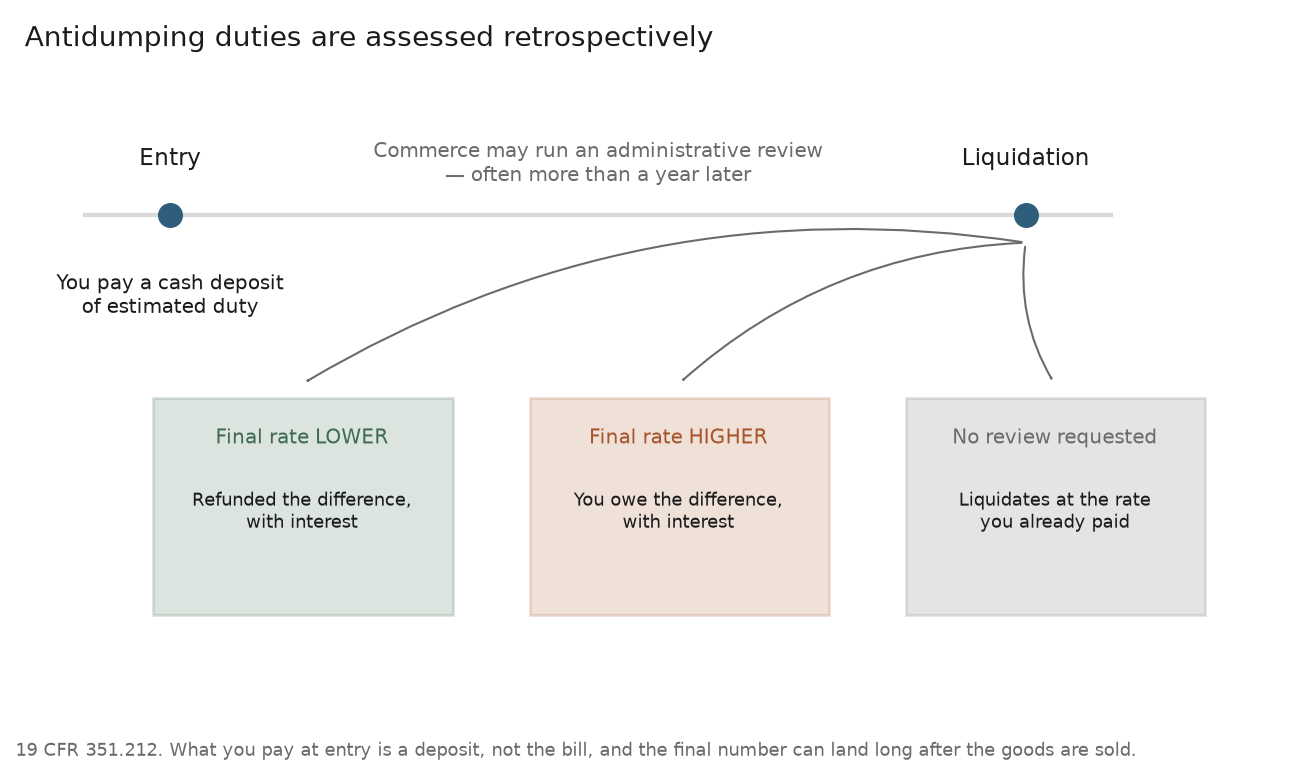
The United States runs a retrospective system, which is unusual and matters enormously for cash planning. Under 19 CFR § 351.212, what you pay when the goods enter is a cash deposit of estimated duty. The final liability is calculated later.
Commerce may run an administrative review of the period covering your entries. When it concludes, CBP liquidates those entries at the reviewed rate:
| Outcome of review | What happens to you |
|---|---|
| Final rate lower than your deposit | You are refunded the difference, with interest |
| Final rate higher than your deposit | You owe the difference, with interest |
| No review requested | Entries liquidate at the deposit rate you already paid |
The uncomfortable part is the timing. A review can conclude well over a year after the goods were sold, so a liability can appear against stock you no longer own and revenue you have already spent. This is not an edge case; it is how the system is designed to work.
It compounds with a fact from the importer of record rules: duty is a personal debt of the importer, and it is not discharged by selling the goods on.
How to check for antidumping duties before you buy
The Commerce Department publishes a public AD/CVD search tool covering active proceedings. You can search by country, product, case number, tariff number or commodity. Do this before placing an order, not after the container sails.
Work through it in this order:
- Search by product and by country, not by tariff code alone.
- Open any case that looks close and read the scope narrative in full.
- Get the producing factory’s name from your supplier and check whether it holds a company-specific rate.
- Ask your customs broker to confirm independently. This is routine work for them and it is far cheaper than being wrong.
Two traps worth naming
Switching country does not always escape an order. Goods that are made in a covered country and merely shipped through a third country remain covered. Routing through a neighbour to change the paperwork is evasion, it is actively investigated, and the liability lands on the importer.
Your bond may be too small. Entries inside an AD/CVD order can attract much larger bond requirements than ordinary cargo, because the surety is covering a liability that is not yet fixed. If you are importing covered goods, discuss the bond amount with your broker before the first shipment rather than discovering the shortfall at the port. Getting the classification right matters here too, since it is the starting point for the whole enquiry.
The honest summary: AD/CVD is not a risk you manage after the fact, because the mechanism is specifically built to reach back. It is a risk you check before you buy, and the check takes about twenty minutes.
Working out your own numbers? The free freight RFP generator builds the quote request that gets you comparable prices from several forwarders at once — so you are comparing the same scope, not four different ones.