This article contains affiliate links. If you sign up through one, we may earn a commission at no extra cost to you. It does not change the figures or recommendations below — see our affiliate disclosure.
For years the Amazon FBA vs 3PL answer was simple: use FBA, because Prime eligibility outweighs everything. That is no longer automatically true. FBA’s fee structure has moved enough that the arithmetic now genuinely depends on your product and your turnover rate.
The short version: a 3PL is commonly 25–40% cheaper once every fee is counted, but cheaper is not the same as better, and the right answer for most sellers is neither one exclusively.
What FBA charges in 2026
| Fee | 2026 rate | Notes |
|---|---|---|
| Fulfillment | Up roughly $0.08/unit on average vs 2025 | Standard-size non-apparel up $0.20–$0.30 per unit |
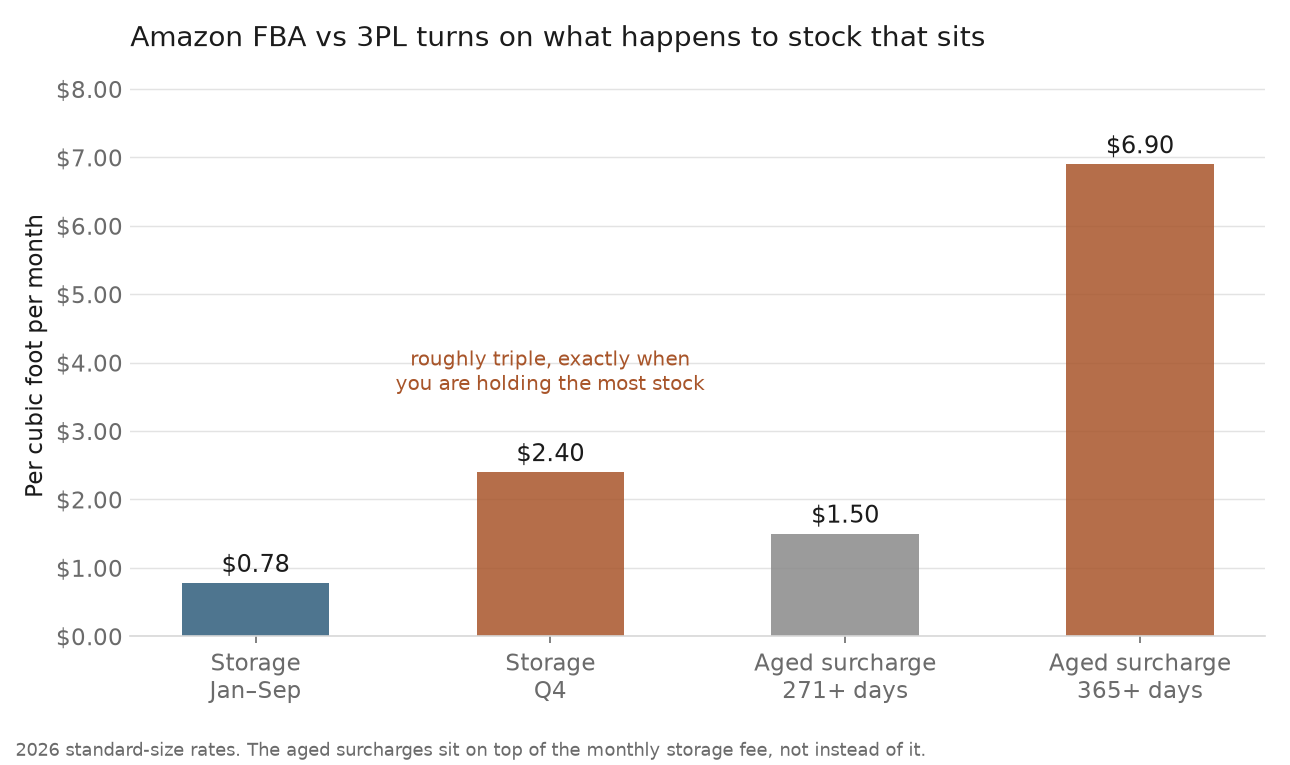
| Storage (Jan–Sep) | $0.78 per cubic foot per month | Standard size |
| Storage (Q4) | $2.40 per cubic foot per month | Roughly triple, exactly when you hold most stock |
| Aged inventory, 271+ days | $1.50 per cubic foot | Surcharge on top of storage |
| Aged inventory, 365+ days | $6.90 per cubic foot | Punitive by design |
| Inbound placement | $0 – $6.50 per unit | Depends how many centres you split shipments across |
The inbound placement fee is the one that changed the calculus most, because it penalises the simple option. Sending everything to a single fulfilment centre costs $0.27–$1.30 per unit for standard sizes. Splitting across 2–3 centres runs $0.21–$1.00. Splitting across 4 or more — the option Amazon prefers — can be $0 to $0.49.
So you either do more work splitting shipments, or you pay for the convenience of not doing it.
Amazon FBA vs 3PL: where the two models diverge
Amazon FBA vs 3PL costs are structured so differently that direct comparison is misleading unless you model your own numbers.
| FBA | 3PL | |
|---|---|---|
| Storage basis | Per cubic foot, tripling in Q4 | Per pallet per month, commonly $25–$50 |
| Best for | Fast-moving stock with high turnover | Bulk, slow movers, seasonal stock |
| Punishes | Inventory that sits | Low order volume against a monthly minimum |
| Prime eligibility | Yes | No, unless via Seller Fulfilled Prime |
| Channel coverage | Amazon | Any channel — Shopify, wholesale, retail |
| Control over packaging | Minimal | Full, including branded inserts |
The pattern: FBA charges for volume over time, a 3PL charges for handling. If your stock turns quickly, FBA’s storage cost stays small and its fulfilment efficiency wins. If your stock sits — seasonal, slow-moving, or simply over-ordered — FBA’s per-cubic-foot clock runs against you, especially through Q4 and the aged-inventory thresholds.
The hybrid most sellers should run
The approach that has become standard practice: hold bulk inventory at a 3PL, and feed fast movers into FBA in smaller, more frequent shipments.
- Your container lands and goes to the 3PL, where storage is cheap per pallet.
- You ship into FBA only what will sell within weeks, keeping FBA stock lean.
- You keep Prime eligibility on the SKUs that need it.
- You avoid Q4 storage at $2.40 per cubic foot on inventory that is not moving.
- You never touch the 271-day or 365-day aged surcharges, because nothing sits in FBA that long.
- Your non-Amazon channels ship from the same 3PL stock.
The cost of this is complexity: two inventory locations, replenishment decisions, and a 3PL relationship to manage. For a seller doing meaningful volume across two channels, that complexity usually pays for itself several times over.
How to work out your own answer
Model one representative SKU for twelve months rather than comparing rate cards.
- Take your actual monthly unit velocity and the cubic feet per unit.
- Calculate FBA storage across all twelve months, applying the Q4 rate to Oct–Dec.
- Add fulfilment fees and inbound placement at your realistic split level.
- Against that, calculate 3PL pallet storage, receiving, and pick-and-pack at your volume — see the 3PL benchmarks for realistic figures.
- Include the 3PL monthly minimum. It is frequently the deciding line for smaller sellers.
- Then add the cost of the parcel shipping from 3PL to customer, which FBA bundles and a 3PL does not.
That last point is where naive comparisons go wrong. FBA’s fulfilment fee includes shipping to the customer. A 3PL’s pick-and-pack fee does not. Compare like for like or the 3PL will look far cheaper than it is.
The fees sellers forget to model
- Removal and disposal. Getting stock out of FBA costs per unit. If you over-send and later want it back, you pay to reverse the decision.
- Returns processing. Amazon’s returns rates are generally higher than a comparable direct channel, and returned units are not always resellable.
- Unfulfillable inventory. Units Amazon deems unsellable still occupy space until you pay to remove or dispose of them.
- Low-inventory-level fees. Holding too little stock relative to demand can now attract charges of its own — so the answer is not simply keeping FBA stock minimal.
- Prep and labelling. If your goods arrive not FBA-ready, someone charges to prep them — Amazon or your 3PL. Cheaper at the 3PL, cheaper still at the factory.
That last point is worth acting on: have FBA labelling and prep done at origin where labour is cheapest, not after the goods reach the US. Specify it in the inspection brief so it is verified before shipping.
A third option: AWD
Amazon Warehousing & Distribution is Amazon’s own bulk storage product, sitting upstream of FBA. It stores pallets at lower rates than FBA and replenishes FBA automatically.
It occupies the same position in your supply chain as a 3PL, with a trade-off: simpler because it is inside Amazon’s ecosystem, but it only serves Amazon. A 3PL storing the same pallets can also ship your Shopify orders, your wholesale accounts, and anything else. If Amazon is your only channel, AWD is worth pricing. If it is not, the 3PL’s flexibility is usually the deciding factor.
Seller Fulfilled Prime
SFP lets you carry the Prime badge while shipping from your own or your 3PL’s warehouse. It removes the main argument for FBA — but it carries strict delivery-speed and on-time requirements, and failing them costs you the badge.
Practical read: SFP works when your 3PL is genuinely fast and geographically well placed. It is not a way to keep Prime while running a slow operation, and the performance bar is enforced.
Getting the numbers to run the comparison
The calculation above only works if your inputs are accurate, and the two that sellers routinely guess at are real per-SKU velocity and actual FBA fees per unit. Amazon’s fee structure changed enough in 2026 that last year’s assumptions will mislead you.
Seller Central gives you the raw data but makes it tedious to assemble per SKU. Dedicated seller software does this faster — Helium 10 is the tool most sellers use for it, with a profitability calculator that pulls current fees per ASIN and inventory reports that show genuine sell-through rate rather than averages.
Worth being clear about what it is: paid subscription software aimed at Amazon sellers, with a free tier that is limited but enough to pull fee and velocity data for a handful of SKUs. If you sell on Amazon at any scale you probably already use something like it. If you sell mostly on Shopify with a small Amazon channel, your own order exports will tell you the same thing for free — the tool saves time, not accuracy.
Whichever way you get the numbers, get them per SKU. The Amazon FBA vs 3PL answer differs by product within the same catalogue, and a blended average across your whole range will point you in the wrong direction for both your fastest and slowest movers.
Working out your own numbers? The free freight RFP generator builds the quote request that gets you comparable prices from several forwarders at once — so you are comparing the same scope, not four different ones.