If your product contains a battery — a power bank, a rechargeable torch, a Bluetooth speaker, an electric toothbrush, anything with a cell in it — you are shipping lithium batteries, which are regulated dangerous goods. Most sellers discover this at the point a forwarder refuses the booking, which is usually the week the stock was meant to move.
The rules for shipping lithium batteries are not especially complicated. They are just specific, and they turn on two questions almost nobody thinks to ask a supplier: how big is the cell, and is the battery loose in the box or fitted inside the product.
The size thresholds that decide everything
United States hazardous materials rules for lithium cells and batteries sit in 49 CFR § 173.185. The first thing the regulation does is split batteries into fully regulated and partially excepted, on size:
| Type | Excepted threshold | Above this, fully regulated |
|---|---|---|
| Lithium ion cell | 20 Wh or less | Over 20 Wh |
| Lithium ion battery | 100 Wh or less | Over 100 Wh |
| Lithium metal cell | 1 g lithium or less | Over 1 g |
| Lithium metal battery | 2 g lithium or less | Over 2 g |
Watt-hours are volts multiplied by amp-hours. A supplier who cannot tell you the Wh rating of the cell in your product cannot tell you how it ships, and that is worth treating as a warning about the rest of their documentation.
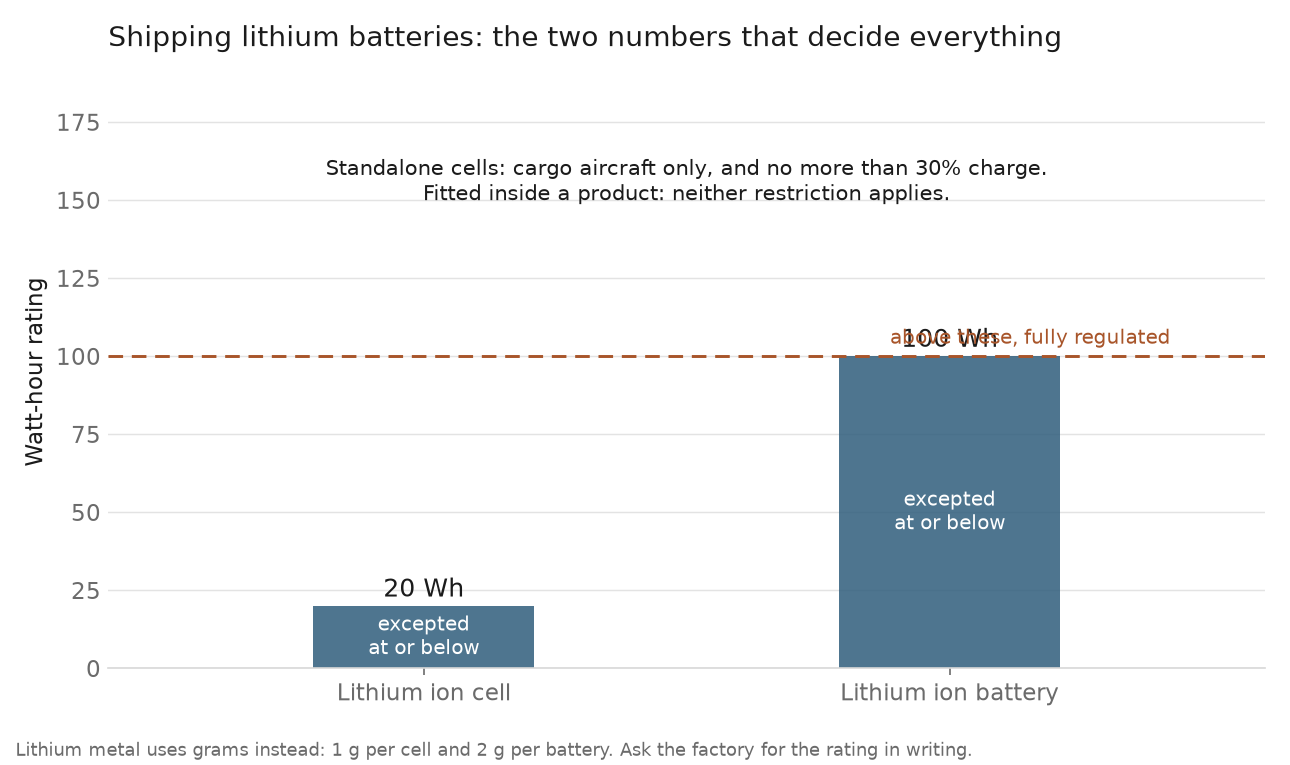
The practical line for consumer goods sits at 100 Wh. Most phone accessories, small speakers and typical power banks fall under it. Larger power stations, e-bike packs and power tool batteries frequently do not.
Loose batteries and fitted batteries are different shipments
This is the distinction that decides your freight options, and it is the one most often got wrong:
- Batteries shipped alone — a carton of cells with no product around them.
- Batteries packed with equipment — the device and its battery in the same box, but not installed.
- Batteries contained in equipment — fitted inside the product, which is how most finished consumer goods travel.
The regulation treats these as separate categories with separate paperwork, and air carriers treat them very differently indeed.
The air freight rules that catch people out
Two restrictions matter, and both apply to standalone lithium ion batteries rather than to batteries fitted inside a product.
Passenger aircraft are prohibited. Packages of lithium ion batteries shipped on their own must carry the marking stating they are forbidden for transport aboard passenger aircraft. Since a large share of air freight capacity is the belly hold of passenger flights, this removes most of the market and raises your rate accordingly.
A 30% state of charge cap applies on cargo aircraft. Standalone lithium ion cells and batteries must be shipped at no more than 30% of rated capacity, under Special Provision A100. The reasoning is straightforward: a partially charged cell is a less energetic fire.
Critically, that state of charge limit does not apply to batteries packed with, or contained in, equipment. A finished product with the battery installed is not subject to the 30% rule. Plenty of published advice gets this backwards and frightens sellers out of air freight they could legitimately have used.
None of the state of charge rules apply to road or rail movement inside the US at all. This is purely an aviation restriction.
What this does to your shipping decision
| Configuration | Air | Ocean |
|---|---|---|
| Battery installed in the product | Permitted, standard dangerous goods handling | Straightforward, declare as dangerous goods |
| Battery packed alongside the product | Permitted, no state of charge cap | Straightforward, declare as dangerous goods |
| Loose batteries only | Cargo aircraft only, 30% charge cap | Usually the sensible route |
For loose cells, ocean freight is normally the answer. It avoids the passenger aircraft prohibition and the charge cap entirely, at the cost of a longer lead time — and the real door-to-door transit is longer than the port-to-port figure you will be quoted, so plan against the full timeline rather than the sailing time.
Where air is genuinely necessary, expect the rate to sit above ordinary cargo. Dangerous goods handling is a surcharge on top of the chargeable weight calculation, not a replacement for it, and batteries are dense enough that the weight rarely works in your favour.
Shipping lithium batteries: what to do before the stock is made
Almost all problems with shipping lithium batteries are solvable at the factory and expensive at the port. Ask for four things while the order is still in production:
- The Wh rating per cell and per battery, in writing.
- A current UN 38.3 test summary. This is the transport safety test certificate. No competent forwarder will move the goods without it.
- A safety data sheet for the cell.
- Confirmation of how the batteries will be packed — installed, alongside, or loose — because that answer changes the shipment’s classification.
Then have the packaging and marking checked before the container is stuffed. A pre-shipment inspection is the natural place to confirm the cartons carry the right labels, and it costs a fraction of a rejected booking.
The unglamorous truth is that undeclared batteries are the real hazard here, both to aircraft and to your business. A shipment stopped for undeclared dangerous goods does not simply get relabelled and sent on. It gets held, it attracts penalties, and carriers remember the shipper. Declaring correctly is slower on paper and very much faster in practice.
What the UN 38.3 test report actually certifies
Every forwarder will ask for a UN 38.3 test summary, and most sellers forward it without knowing what it says. It is worth understanding, because it is the document that decides whether your product is shippable at all.
UN 38.3 is a series of tests from the UN Manual of Tests and Criteria that a cell or battery design must pass before it may be transported. In outline, the design is subjected to:
- Altitude simulation, standing in for the low pressure of an aircraft hold.
- Thermal cycling between temperature extremes.
- Vibration and mechanical shock, representing the handling of transport.
- External short circuit, and impact or crush.
- Overcharge, and forced discharge.
Two things follow that matter commercially. The certificate belongs to the cell or battery design, not to your shipment — so a supplier changing cell vendor mid-order invalidates the document you hold, even though the product looks identical.
And a test summary is not the same as a full test report. The summary is the document required to accompany transport, and it must identify the cell, the test laboratory and the tests passed. A one-line supplier declaration saying “UN38.3 certified” is not a test summary and will be refused.
Working out your own numbers? The free freight RFP generator builds the quote request that gets you comparable prices from several forwarders at once — so you are comparing the same scope, not four different ones.