Every growing Shopify or Amazon seller hits the same fork in the road: keep packing orders yourself, or hand shipping over to someone else. The 3PL vs in-house fulfillment decision sounds operational, but it’s really a financial one — and it’s easy to get the timing wrong in either direction. Switch too early and you’re paying for capacity you don’t need yet. Switch too late and fulfillment starts quietly capping how fast you can grow.
There’s no single order count where the switch magically makes sense — despite what some guides claim. The real answer depends on your product, your margins, and how much of your own time fulfillment is eating. Here’s how to actually think it through.
What In-House Fulfillment Actually Involves
“In-house” sounds simple — you pack your own orders — but past a certain size it means running a small warehouse operation, whether you call it that or not:
- Storage space (a spare room stops working fast; most sellers eventually rent or lease space)
- Packaging materials, bought and managed yourself
- At least one person’s time, often full-time, once volume climbs
- Manually printing labels, tracking inventory, and handling returns
- Absorbing every mistake yourself — mis-picks, damaged packaging, missed carrier pickups
At low volume, this is genuinely the cheaper option. There’s no minimum monthly fee, no onboarding process, and you keep full control over how orders look and feel when they arrive.
What a 3PL Actually Does
A third-party logistics provider (3PL) takes over warehousing, pick-and-pack, shipping, and often returns. You send inventory to their facility; they fulfill orders as they come in through your store.
The appeal isn’t just “less work.” 3PLs typically negotiate better shipping rates than an individual seller can get on their own, simply because they’re shipping at much higher volume across many clients. That rate difference alone can offset a meaningful chunk of what you’re paying them— and it’s a big part of why the 3PL vs in-house fulfillment math often surprises sellers who assumed doing it themselves would always be cheaper.
3PL vs In-House Fulfillment: Comparing the Real Costs
| Cost factor | In-house | 3PL |
| Setup cost | Low (existing space) to high (leased warehouse) | Usually low — onboarding fee, no lease |
| Per-order cost at low volume | Often cheapest | Minimum fees can make this pricier |
| Per-order cost at high volume | Rises with labor, space, software | Often drops — better shipping rates, shared infrastructure |
| Your time | Significant, and grows with volume | Minimal once onboarded |
| Error/damage risk | You absorb it | Often covered under an SLA (see our guide to writing a freight RFP for how to set clear terms upfront) |
| Flexibility during peak season | Limited by your own space/staff | Usually easier to scale short-term |
The pattern that shows up across most cost breakdowns: in-house tends to win at low volume, and a 3PL tends to win once volume is high and steady enough to justify their minimums. Exactly where that crossover happens is the part that varies — some sources put the break-even as low as a few hundred orders a month, others put it well into the low thousands, since it depends heavily on product complexity, storage needs, and how many sales channels you’re juggling.
The Hidden Costs Sellers Forget to Count
This is where the in-house side of the comparison usually looks better on paper than it does in reality. Costs that rarely make it into a seller’s mental math:
- Founder or staff time — hours spent packing are hours not spent on marketing, product, or customer service
- Software — inventory tools, shipping label platforms, and multi-channel sync all cost something
- Wasted packaging — buying in small quantities instead of bulk
- Opportunity cost during peak season — if a busy Q4 means missed ship dates, that’s a cost too, just not one on an invoice
- Mistakes — mis-picks and shipping errors that a 3PL’s systems are built to catch before they leave the warehouse
None of these show up on a simple “cost per box” comparison, which is exactly why so many sellers underestimate their true in-house cost until they actually run the numbers.
Any honest 3PL vs in-house fulfillment comparison needs to weigh these in, not just the numbers on a rate card.
When In-House Still Makes Sense
Outsourcing isn’t automatically the right move just because a business is growing. In-house fulfillment still tends to make sense when:
- Order volume is low and fairly predictable
- Products need highly custom packaging, kitting, or a personal touch (unboxing experience matters to your brand)
- You’re still validating the product and don’t want to lock into a provider yet
- Your margins are thin enough that a 3PL’s minimum monthly fees would outweigh the savings
Signs It’s Time to Switch to a 3PL
- You’re spending more hours per week on fulfillment than on growing the business
- Storage space is genuinely full, not just cluttered
- Shipping errors or late shipments are starting to show up in reviews
- You’re expanding into new regions or sales channels and can’t realistically fulfill them yourself
- Peak-season order spikes regularly overwhelm your current setup
If two or more of these are true at once, it’s usually worth requesting quotes and comparing 3PL options even if you’re not ready to switch immediately — knowing your real options makes the eventual decision easier.
How to Decide: A Quick Framework
Making the 3PL vs in-house fulfillment call doesn’t have to be complicated. Run through this:
- Calculate your true in-house cost per order — including labor, packaging, software, and a rough value for your own time
- Get real 3PL quotes at your current volume, not just published rate cards
- Compare both against your order-volume trend for the next 6–12 months, not just today
- Weigh the non-cost factors — time, error rates, and how much you value hands-on control over packaging
A structured RFP makes step 2 far easier, since it forces every 3PL quote to answer the same questions instead of comparing apples to oranges.
Quick-Start Checklist
Before deciding between 3PL vs in-house fulfillment for your store:
- Add up your real in-house cost per order, including your own time
- Request quotes from at least two or three 3PLs at your actual volume
- Check which “when to switch” signs above already apply to you
- Revisit the decision every 6 months as volume changes — this isn’t a one-time choice
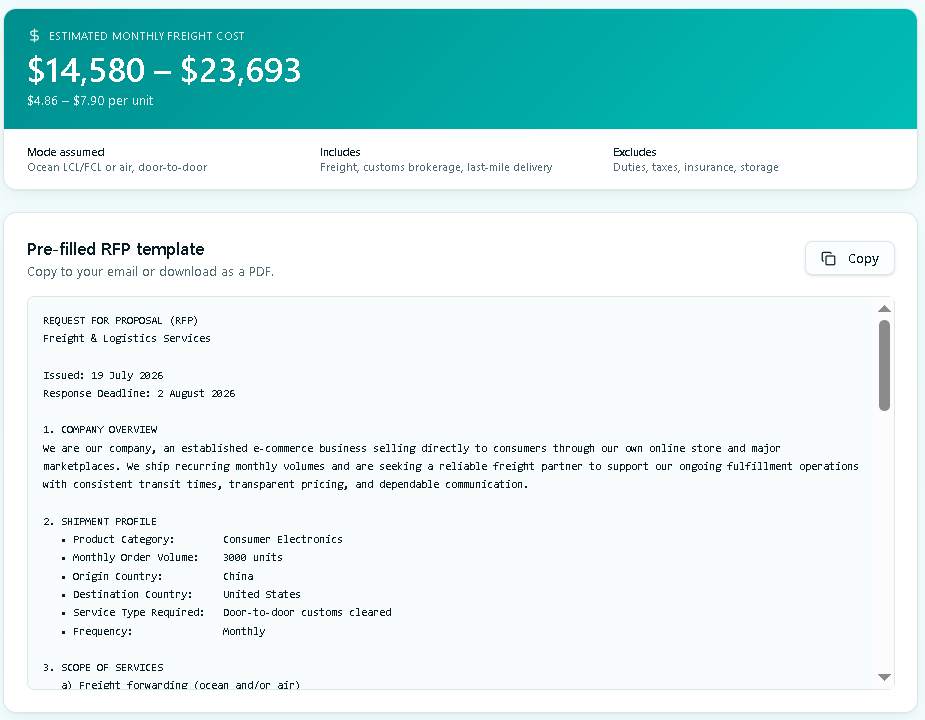
Whichever way your own 3PL vs in-house fulfillment decision goes, if you land on getting quotes, our free RFP generator builds a structured request in minutes — no login required.
Table of Contents
Making a confident 3PL vs in-house fulfillment choice starts with your own numbers, not someone else’s rule of thumb. Sellers who skip this step often assume the 3PL vs in-house fulfillment gap is bigger than it really is, when in fact it usually comes down to a few hundred dollars a month either way. The right way to settle a 3PL vs in-house fulfillment debate is to run both costs side by side using your real order volume, not a generic estimate. Once you’ve done that math, the 3PL vs in-house fulfillment answer for your specific store tends to become obvious.
Related reading
- What 3PLs actually charge in 2026 — The benchmark numbers to hold a quote against.
- How many boxes fit on a pallet — The calculation behind your storage and receiving costs.
- LCL vs FCL break-even — When a full container becomes the cheaper option.