If you are importing commercially into the United States, you need a customs bond. This is not optional and it is not negotiable — without one on file, your goods will not be released at the port of entry. The only real decision is which type to buy.
A customs bond is not insurance for you. It is a financial guarantee to US Customs and Border Protection that the duties, taxes and fees on your shipment will be paid, and that you will comply with import regulations. If you default, the surety pays CBP — and then comes after you.
The two customs bond types
Single-entry bond
Covers exactly one shipment. Typically priced at around 0.5% of the bond amount with a minimum near $50, and for ocean freight you should expect an additional ISF bond fee of roughly $75. In practice most first-time importers land somewhere in the $150-$500 range per shipment, depending on cargo value.
Continuous bond
Covers all your imports for 12 months at every US port. The standard minimum is a $50,000 bond, which as of mid-2026 costs roughly $250-$550 per year through a surety. The bond amount is generally calculated as 10% of the duties, taxes and fees you expect to pay in a year, with $50,000 as the floor.
The break-even: three shipments
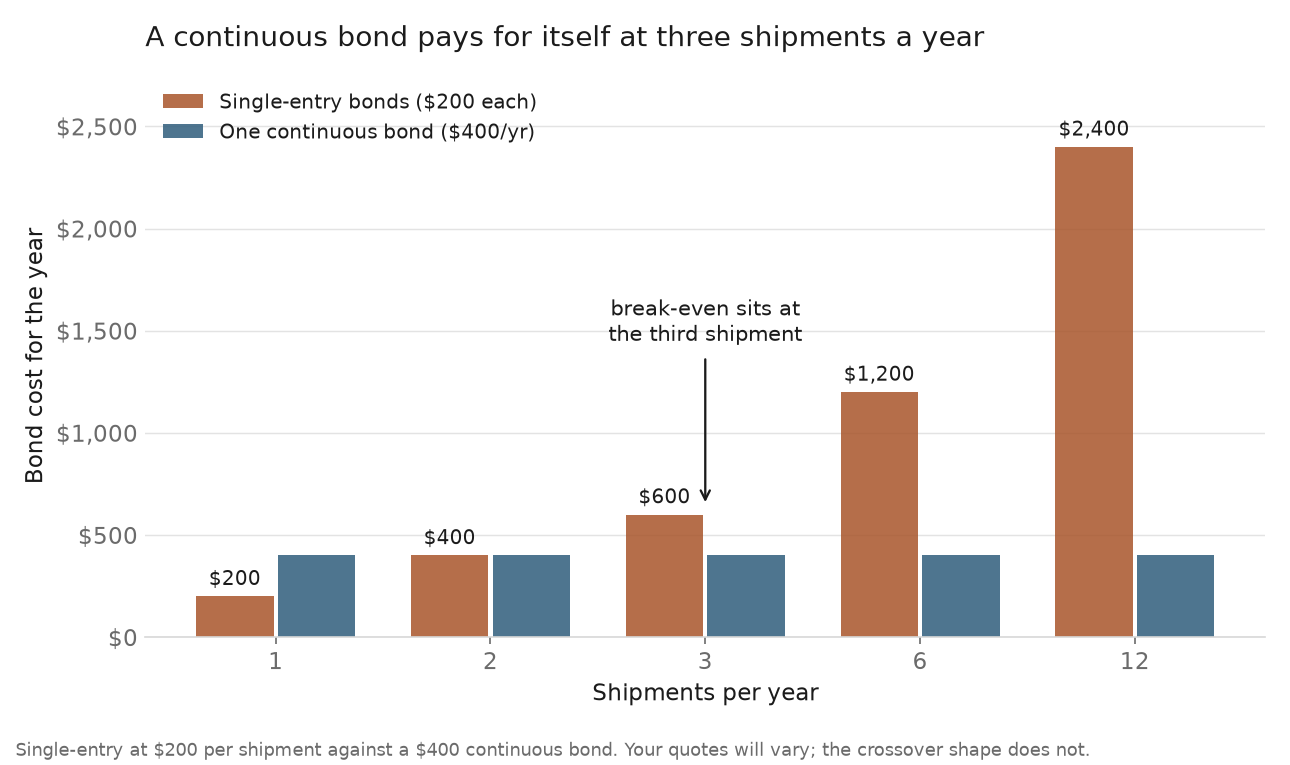
The customs bond arithmetic is unusually simple. If a single-entry bond costs you $200 a shipment and a continuous bond costs $400 a year, then:
| Shipments per year | Single-entry total | Continuous bond | Cheaper |
|---|---|---|---|
| 1 | $200 | $400 | Single-entry |
| 2 | $400 | $400 | Tie |
| 3 | $600 | $400 | Continuous |
| 6 | $1,200 | $400 | Continuous, clearly |
| 12 | $2,400 | $400 | Continuous, obviously |
The break-even sits at about three shipments in a 12-month period. If you import three or more times a year — which describes almost any seller with real product-market fit — the continuous bond is the better value and it stops being a close call quickly.
The reasons that matter more than price
Cost is the least interesting part of the customs bond decision. Three operational reasons push sellers to a continuous bond well before the arithmetic demands it:
- Speed. A single-entry bond has to be arranged per shipment. That is one more thing to get done before the vessel sails, and one more thing that can be late.
- ISF is bundled. Continuous bonds cover your Importer Security Filing obligations, so you are not buying a separate ISF bond every time you ship by ocean.
- You stop thinking about it. One annual renewal replaces a recurring per-shipment task. For a small team, the removed friction is worth more than the few hundred dollars.
Who is actually on the hook
The bond attaches to the Importer of Record (IOR) — the party legally responsible for the shipment. For most Shopify and Amazon sellers importing their own inventory, that is you, not your supplier and not your freight forwarder.
This is worth being clear-eyed about. As IOR you carry legal liability for the accuracy of the customs declaration, the correct tariff classification, and payment of duties. A forwarder can file on your behalf; they do not absorb the liability. If your supplier offers to be IOR to “make it simple”, understand you are handing control of your customs record to someone else.
How to get one
- Get a customs broker. You need one anyway, and they arrange the bond as routine business.
- Have your IRS number (EIN) or CBP-assigned importer number ready — the bond is filed against it.
- Estimate your next 12 months of duties honestly. If your bond turns out to be undersized, CBP can require you to increase it mid-year, which is disruptive.
- Ask the broker to confirm the bond is on file before your goods ship, not before they arrive. Discovering a bond problem while your container sits at the port is expensive.
When your customs bond stops being big enough
The number on your continuous bond is not permanent, and the way it is set catches importers who are growing. Under CBP’s Directive 3510-004, a continuous importer bond is written for the greater of $50,000 or 10% of the duties, taxes and fees you paid over the previous twelve months, rounded up in multiples of $10,000.
Read that second clause carefully. It is indexed to what you paid, not to how much you shipped. Duty rates can rise, and the end of the de minimis exemption pushed up what many sellers pay without a single extra container moving. A bond sized against last year’s duty bill can be short against this year’s on identical volume.
When it falls short, CBP issues a bond insufficiency notice and gives you a window to increase it. Miss the window and entries can be refused at the port. The practical effect is the same as having no bond at all, arriving on a date you did not choose and usually while cargo is already on the water.
Staying ahead of it is routine work:
- Ask your broker to check bond sufficiency once a year, and again before your peak season rather than during it.
- Recalculate after any tariff change on your products, not only after a change in volume. The trigger is the duty paid, not the box count.
- Treat an insufficiency notice as urgent post. The window is short and the consequence lands at the border.
- Remember what you are buying. Increasing the bond protects your ability to keep importing; it is still a guarantee to CBP rather than cover for you.
Single-entry bonds do not have this problem, because each one is sized to the shipment it covers. That is not an argument for using them — the arithmetic above still applies. It is a reminder that the continuous bond’s main advantage, one instrument covering everything, is also the thing that quietly needs reviewing as the business grows.
Working out your own numbers? The free freight RFP generator builds the quote request that gets you comparable prices from several forwarders at once — so you are comparing the same scope, not four different ones.
This article is general guidance, not legal or customs advice. Rules and rates change, and your situation may differ. Confirm anything specific with a licensed customs broker before you act on it.