You shipped 80kg by air. The invoice charges you for 210kg. Nobody made an error — you have just met chargeable weight, and once you understand it you can design around it.
Aircraft run out of space before they run out of lifting capacity. A pallet of pillows and a pallet of bolts weigh wildly different amounts but occupy the same floor. So carriers charge on whichever is greater: what your shipment actually weighs, or what that much space is deemed to weigh.
The formula
The international standard, set by IATA, uses a volumetric divisor of 6,000:
Volumetric weight (kg) = (Length × Width × Height in cm) ÷ 6,000
Because one cubic metre is 1,000,000 cm³, that works out to 1 CBM = about 167 kg (1,000,000 ÷ 6,000 = 166.67). That single conversion is worth memorising — it lets you sanity-check any air quote in your head.
Chargeable weight = whichever is higher, actual weight or volumetric weight.
Worked example
Ten cartons, each 60 × 40 × 50 cm, each weighing 8 kg.
- Volume per carton: 60 × 40 × 50 = 120,000 cm³
- Volumetric weight per carton: 120,000 ÷ 6,000 = 20 kg
- Actual weight per carton: 8 kg
- Chargeable per carton: the higher figure → 20 kg
- Ten cartons: 200 kg chargeable against 80 kg actual
You pay for 200 kg. Your goods weigh 80 kg. The 120 kg difference is air — literally.
Watch the divisor
6,000 is the IATA standard and applies to most air freight. But some airlines and many express couriers use 5,000 instead, which produces a higher volumetric weight and a higher bill on the same box.
| Divisor | Volumetric weight of a 60x40x50 carton | Effect |
|---|---|---|
| 6,000 (IATA standard) | 20 kg | Baseline |
| 5,000 (some couriers) | 24 kg | 20% more chargeable weight |
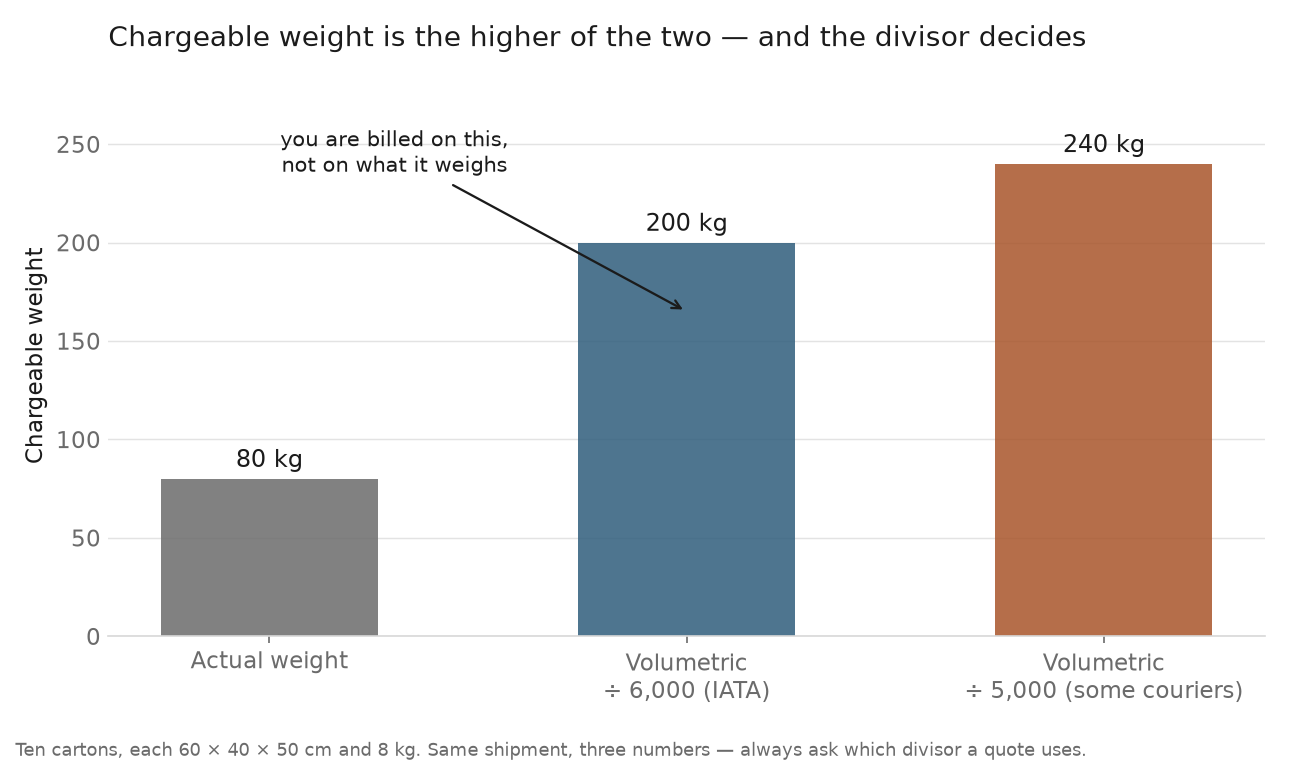
Always ask which divisor a quote uses. It is a fair question, it takes one line in an email, and on a large shipment the difference is not trivial.
How to stop losing money to chargeable weight
- Find your break-even density. At divisor 6,000, cargo denser than about 167 kg/CBM is charged on actual weight; anything lighter is charged on volume. Work out where your product sits and you will know immediately whether you are a volume problem or a weight problem.
- Shrink the box, not the product. For volume-charged cargo, every centimetre of empty headroom in the carton is money. Right-sizing cartons is the highest-return packaging change available to a light-goods seller.
- Remove retail packaging air. Bulk-pack for freight and let your 3PL handle retail presentation, if the product allows it.
- Reconsider the mode. Chargeable weight punishes low-density cargo hardest. If your goods are light and bulky, air is expensive in a way that gets worse with volume — which is precisely when sea freight and the LCL-to-FCL calculation start deserving a look.
Note this is the same underlying idea as pallet math: freight pricing is a competition for space, and every unit of empty space you ship is a unit you pay for.
The sea freight equivalent: W/M
Ocean freight uses the same idea under a different name. LCL is quoted on W/M – weight or measure – and the carrier charges whichever produces the larger number, using the convention that 1,000 kg is equivalent to 1 CBM.
So a 3 CBM shipment weighing 800 kg is charged as 3 units (measure wins). A 1 CBM shipment weighing 2,400 kg is charged as 2.4 units (weight wins). The break-even density for ocean is 1,000 kg/CBM, against roughly 167 kg/CBM for air.
That difference is worth internalising. Air punishes low density about six times harder than sea does. Cargo that is merely inefficient by sea can be genuinely uneconomic by air.
A density reference
Where your product sits determines which number you are fighting:
| Density | Air (divisor 6,000) | Sea LCL (W/M) |
|---|---|---|
| Under 167 kg/CBM | Charged on volume | Charged on volume |
| 167 – 1,000 kg/CBM | Charged on weight | Charged on volume |
| Over 1,000 kg/CBM | Charged on weight | Charged on weight |
The middle row is the interesting one. Between 167 and 1,000 kg/CBM your air freight is priced on actual weight while your sea freight is still priced on volume – so packaging efficiency changes your ocean cost but not your air cost, and vice versa.
Express couriers are a different game again
DHL, FedEx and UPS express services frequently use a divisor of 5,000 rather than 6,000, which makes the same carton about 20% more expensive. Some domestic services use 139 (the imperial equivalent of 5,000) on inches and pounds.
Always confirm three things on any air or express quote:
- Which divisor applies
- Whether the rate is per kg of chargeable weight or a banded rate
- Whether fuel and security surcharges are included or added
Two quotes using different divisors are not comparable, and the difference is invisible until the invoice arrives.
One product category changes the air freight question entirely. If your goods contain lithium cells, the rules on shipping batteries decide which aircraft can carry them at all — and loose cells are barred from passenger flights, which is where much of the cheap capacity lives.
Rounding, and why the carrier’s figure beats yours
Two shipments with identical contents can produce different chargeable weights, and the reason is usually measurement rather than arithmetic.
Carriers measure the shipment as presented, at its widest points, and round up. That has three practical consequences:
- Bulges count. A carton packed slightly over-full measures larger than the flat carton dimension on your spec sheet. Across fifty cartons, a centimetre each way is real volume.
- The pallet is part of the shipment. Its footprint, its height and any overhang go into the measurement. Cargo that hangs over the edge is measured to the overhang, not to the pallet.
- Rounding is upward and applied per unit. Fractions of a centimetre and of a kilo go up, not to the nearest value, and the rounding happens before the totals are added.
So the number to plan against is not the one from your product specification. It is the one from a measured, palletised, wrapped shipment — which is why forwarders ask for dimensions of the ready-to-ship consignment and are unimpressed by carton drawings.
The useful habit is to have the supplier measure and weigh the finished pallets and send you the figures before booking. It costs them ten minutes, it makes your quote comparable to your invoice, and it is the same discipline that keeps a pre-shipment inspection useful: verify at the factory, where a problem is still cheap.
Working out your own numbers? The free freight RFP generator builds the quote request that gets you comparable prices from several forwarders at once — so you are comparing the same scope, not four different ones.