Every quality problem you discover after a container lands is a problem you are paying to have shipped, cleared and stored. Discovering it at the factory costs a few hundred dollars. Discovering it at your warehouse costs the freight, the duty, and the inventory.
A pre-shipment inspection typically runs from around $198 per inspector-day, and most consumer goods orders finish in a single day. Against a container of goods, that is close to a rounding error.
When to inspect
At 80–100% production completion. This timing is deliberate and matters.
- Too early and there is not enough finished product to sample meaningfully.
- Too late and the goods are already packed, loaded, or gone.
- At 80–100%, a representative sample exists, and there is still time for the factory to rework or replace before the booking.
Book the pre-shipment inspection against the production schedule, not the shipping date. If you wait until the cargo is ready to leave, you have removed your own ability to act on the result.
What AQL means
AQL — Acceptable Quality Limit — is the threshold of defects at which you accept or reject a batch. Inspectors use standard sampling tables: your order size and chosen inspection level determine how many units get checked and how many defects are allowed before the batch fails.
Defects sort into three tiers, and each carries its own AQL:
| Defect type | Typical AQL | Meaning |
|---|---|---|
| Critical | 0 | Safety or legal risk. Zero tolerance — one is a fail |
| Major | 2.5 | Would cause a return, complaint, or unsellable unit |
| Minor | 4.0 | Cosmetic; a customer likely accepts it |
That combination — 0 / 2.5 / 4.0 — is the common default for consumer goods and a reasonable starting point. Tighten the major AQL if your category has a low return tolerance; loosen the minor one if cosmetic variation is genuinely acceptable in your market.
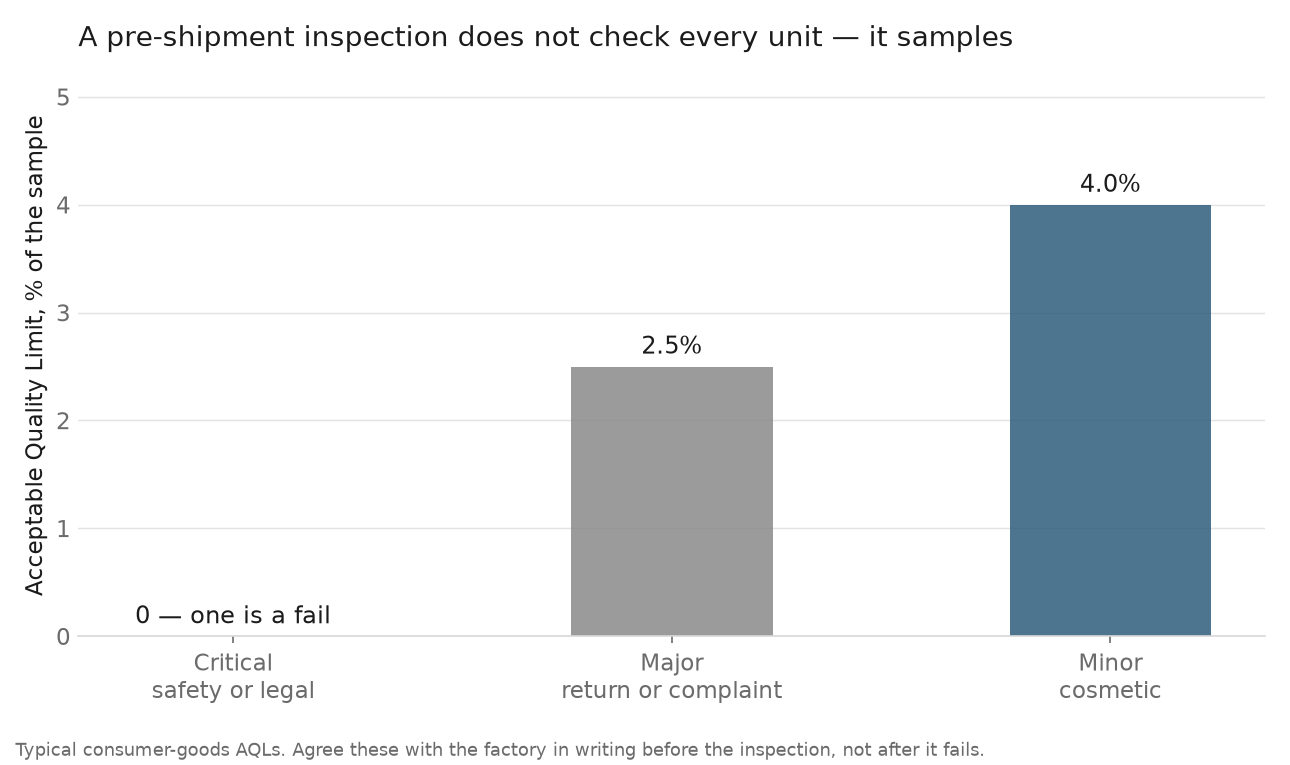
The important thing is that you set these before the pre-shipment inspection, and that your definitions of critical, major and minor are written down. An inspector cannot apply a standard you have not given them.
Why third-party matters
Supplier self-inspection has an obvious structural problem: the party judging the goods is the party being paid for them. An independent inspection firm has no relationship with your factory and no incentive to pass failing product. That independence is the entire value of the service.
This is not an accusation against your supplier. It is the same reason auditors are external.
What a good inspection brief contains
- Your AQL levels for critical, major and minor.
- Written defect definitions with photographs where possible. “Scratched” means different things to different people.
- Dimensional and weight checks against your specification — which also protects your freight class and density assumptions.
- Packaging and labelling checks: barcodes scan, country of origin marking is present and correct, carton markings match the packing list.
- Carton drop test if the goods are fragile — packaging adequacy is the exclusion that defeats damage claims.
- Quantity verification against the purchase order.
- Photographs of representative units, defects found, and packed cartons.
The pre-shipment inspection timing trap
Build the pre-shipment inspection into your schedule as a stage with its own duration, not as a checkpoint that happens instantly. A failed inspection means rework, and rework means the factory needs days or weeks you did not budget.
This matters most around Chinese New Year and Golden Week. An inspection failing two weeks before a shutdown does not mean a two-week delay — it can mean waiting until the factory returns to full output, which is measured in weeks, not days.
Inspect early enough that a failure is recoverable. That is the whole discipline.
The four inspection types
Pre-shipment is the common one, but it is not the only point where inspection is possible, and the others solve different problems.
| Type | When | What it is for |
|---|---|---|
| Initial production check | Before or at production start | Verify raw materials and components before the run commits |
| During production (DUPRO) | Around 20–50% complete | Catch systemic defects early enough to correct the whole run |
| Pre-shipment (PSI) | 80–100% complete | Accept or reject the finished batch |
| Container loading supervision | At loading | Verify quantity, carton condition and correct loading into the container |
DUPRO is the underused one. A pre-shipment inspection tells you the batch failed. A during-production check tells you why while there is still time to fix the process rather than rework the output. For a first order with a new supplier, DUPRO plus PSI is worth the extra inspector-day.
Container loading supervision matters if you have had short shipments or damage on arrival. It is the only stage where someone independent watches your goods actually go into the box.
When the inspection fails
A failure is not automatically a disaster, but the next few decisions are. Work through them in order:
- Get the report and the photographs before discussing anything with the supplier. Argue from evidence, not impressions.
- Separate defect tiers. A batch failing on minor cosmetic defects is a different negotiation from one failing on critical safety defects.
- Decide what you actually want: rework, replacement, partial acceptance with a discount, or rejection. Know this before you open the conversation.
- Re-inspect after rework. A supplier’s assurance that it is fixed is not evidence that it is fixed. Budget the second inspector-day.
- Hold the payment. This is the leverage the whole process depends on, which is why payment terms should never release the balance before inspection passes.
That final point is the one to set up in advance. Structure payment so the balance is due after a passed inspection, not after production completes. An inspection you cannot act on is an expensive way to receive bad news.
Who pays, and what a failure costs
Inspection fees are almost always paid by the buyer, which surprises sellers who assume a supplier confident in their quality would cover it. The logic is that the inspection exists for your benefit and independence is the point — a supplier paying the inspector has reintroduced the problem the inspection was meant to solve.
A failure then costs more than the re-inspection fee:
- The re-inspection itself, at the same day rate.
- Rework or replacement time at the factory, which is the real cost, because it consumes production schedule.
- A missed booking, and with it whatever the next sailing costs in both freight and lost selling time.
This is why the payment structure matters more than the inspection fee. If your balance is due on production completion, a failed inspection leaves you having already paid for goods you have rejected, negotiating for a remedy from a position of no leverage. If the balance is due on a passed inspection, the supplier has a direct financial reason to make the rework happen quickly.
Agree the re-inspection cost allocation up front as well. A common and reasonable position is that the first inspection is yours and any re-inspection caused by a failure is the supplier’s.
Working out your own numbers? The free freight RFP generator builds the quote request that gets you comparable prices from several forwarders at once — so you are comparing the same scope, not four different ones.