The LTL vs FTL question arrives the first time a domestic order is too big for parcel and too small to feel like a truckload. You have eight pallets, a carrier quotes LTL, and somebody suggests you should just book the whole trailer. Both can be right. Which one is right for you turns on a number most sellers never work out.
The structure is the same one that governs LCL against a full container at sea: shared capacity carries per-shipment costs that do not shrink with your freight, and past a certain size you are better off paying for the whole vehicle and leaving some of it empty.
What you are actually buying
LTL buys space on a trailer shared with other shippers. Your pallets move through a hub-and-spoke network, are unloaded and reloaded at one or more terminals, and travel with freight belonging to people you will never meet. You pay for the space and weight you occupy, adjusted by freight class.
FTL buys the trailer. It is loaded at your dock and opened at the destination, with no terminal handling in between. You pay a lane rate whether the trailer is full or half empty.
That difference in handling matters as much as the price. Every terminal touch is an opportunity for damage, and LTL freight is touched repeatedly.
Where the LTL vs FTL crossover sits
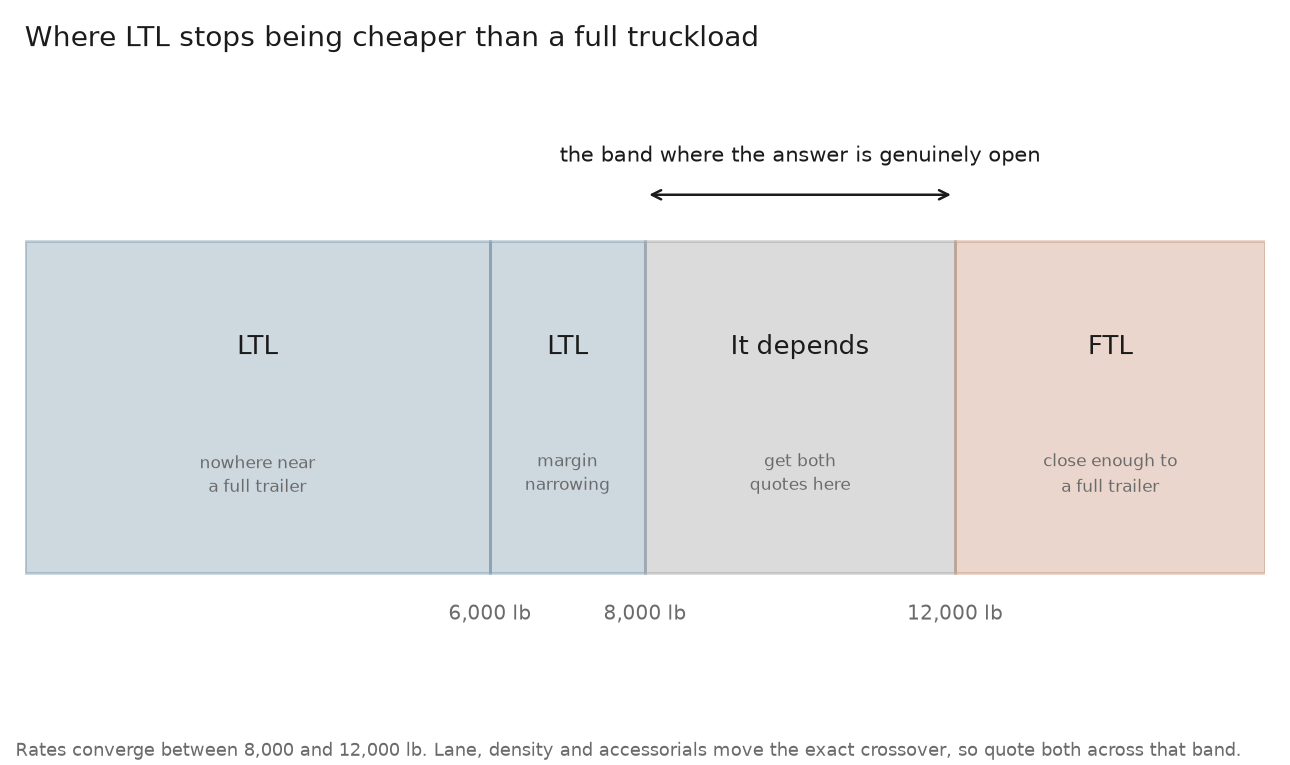
Across most lanes, LTL vs FTL pricing converges somewhere between 8,000 and 12,000 lb, or roughly six to ten standard pallets. Below that band LTL is normally cheaper. Above it, a dedicated truck usually wins on both price and transit time.
The band is wide because it is genuinely lane-dependent. A short haul between two cities with dense LTL coverage pushes the crossover up; a long or awkward lane with thin coverage pulls it down, sometimes below 6,000 lb. The NMFTA’s own comparison frames the same trade-off from the carrier’s side.
| Shipment | Usually cheaper | Why |
|---|---|---|
| Under 6,000 lb | LTL | Nowhere near enough freight to justify a whole trailer |
| 6,000 – 8,000 lb | LTL | Still sharing, but the margin is narrowing |
| 8,000 – 12,000 lb | It depends | The band where you must actually get both quotes |
| Over 12,000 lb | FTL | You are close enough to a full trailer that sharing costs more |
Four things that move the number
Freight class. LTL pricing is driven by density. Light, bulky freight classes badly, prices badly, and reaches the crossover at a much lower weight than dense freight does. If your product is classed 175 or above, test FTL earlier than the rule of thumb suggests.
Accessorials. LTL attracts them and FTL largely does not. Liftgate, residential delivery, limited access and reconsignment are all LTL-network charges. A quote that looks cheaper before accessorials can be more expensive after them, and they are assessed per shipment.
Transit time. LTL moves through terminals on a schedule; FTL moves direct. On a long lane the difference is routinely several days. If you are replenishing stock that is about to run out, the faster mode may be worth paying for even on the wrong side of the break-even.
Damage exposure. Every extra handling event raises the probability of a claim, and winning a freight claim recovers a capped portion of the loss at best. Fragile or high-value freight has a real, if unbilled, LTL surcharge attached to it.
The cases where FTL wins well below the break-even
Three situations override the arithmetic entirely:
- Freight that cannot be stacked or handled by a forklift at a terminal without risk.
- Deliveries with a hard appointment window, where LTL schedule variance is the expensive part rather than the rate.
- Any shipment where the value of the goods is large enough that a single damage claim would hurt more than the whole freight bill for the year.
None of these are captured by an LTL vs FTL rate comparison, which is exactly why the rate comparison alone is a poor decision tool.
How to test it on your own lane
This takes one afternoon and settles the question for a year:
- Take your three most common shipment sizes and get both an LTL and an FTL quote for each, on the same lane, on the same day.
- Ask for the LTL quote inclusive of every accessorial your delivery actually needs. A quote that omits them is not comparable.
- Plot the two totals. The point where the lines cross is your break-even, not the industry rule of thumb.
- Recheck whenever your average shipment size rises by half, or whenever your product packaging changes enough to shift its density.
The mistake worth avoiding is not picking wrong once. It is setting the mode in your process three years ago at four pallets a shipment, growing to eleven, and never revisiting it because each invoice on its own looks unremarkable.
The option that lives inside the crossover band
Between LTL and a full truckload sits a third service that most sellers never hear offered, and it exists precisely for the weight band where the answer is otherwise unclear. It goes by partial truckload, volume LTL or spot volume, depending on who is selling it.
The idea is straightforward. Your freight shares a trailer, as with LTL, but it is not run through the hub-and-spoke terminal network. It is loaded, it travels, and it is delivered, with far fewer handling events in between.
That combination fits the 8,000 to 12,000 lb band unusually well:
- It is priced as a negotiated rate, not off an LTL class tariff, so an awkward freight class stops driving the number.
- Handling drops sharply. Fewer touches is the main reason LTL freight gets damaged, so the claim exposure falls with it.
- Transit is usually faster than LTL and slower than a dedicated truck, because you may still wait for the trailer to fill.
The catch is that it is a spot market. Rates move week to week, capacity is not guaranteed, and you generally cannot build a tariff around it the way you can with contracted LTL. Treat it as a third quote to collect on the awkward shipments rather than as a mode you standardise on — which is exactly the band where you were being told to get two quotes anyway.
Working out your own numbers? The free freight RFP generator builds the quote request that gets you comparable prices from several forwarders at once — so you are comparing the same scope, not four different ones.