Most 3PL sales calls are run by the 3PL. They present their strengths, you nod, and the questions that would have changed your decision get asked six months later when something has gone wrong.
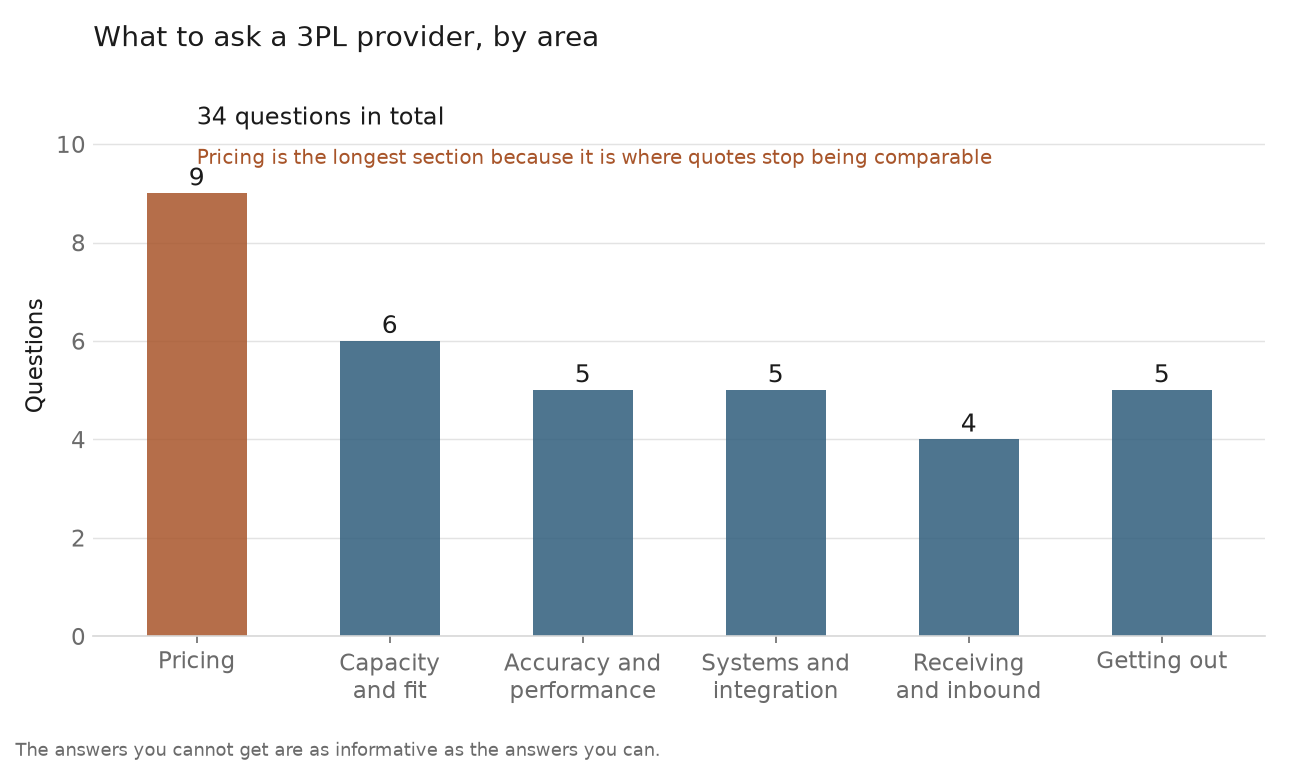
These are the questions to ask a 3PL provider before you sign. Not all of it applies to every business, but the answers you cannot get are as informative as the answers you can.
Pricing
- What is the monthly minimum, when does it start, and is there a ramp-up period?
- Is storage charged per pallet, per bin, or per cubic foot?
- What exactly is included in the pick fee — packaging materials, dunnage, tape?
- What is the receiving rate for palletised freight versus loose cartons, in writing?
- What are the long-term storage surcharges and at what inventory age do they trigger?
- How is returns processing charged — per return, per unit, or per labour hour?
- What is your hourly rate for special projects, relabelling, and kitting?
- Are there account, platform, or software fees on top of operational charges?
- How much notice do I get before a rate increase, and how often do they happen?
Model these against your actual volumes rather than comparing rate cards — see the 2026 benchmarks for what each line should look like.
Capacity and fit
- How many clients of roughly my size and order profile do you handle?
- What is your current warehouse utilisation, and what happens if I double volume in Q4?
- Do you have a client concentration problem — is one account most of your volume?
- What is your cut-off time for same-day dispatch?
- What are your peak-season dispatch times, honestly, not your average?
- Which carriers do you have contracts with, and are those rates passed through or marked up?
The utilisation question matters more than it sounds. A warehouse at 95% capacity in August has no room for your Q4, and you will discover this in November.
Accuracy and performance
- What is your order accuracy rate, measured how, over what period?
- What is your on-time dispatch rate?
- What is your inventory accuracy at last count, and how often do you cycle count?
- Who pays when you pick the wrong item — the replacement, the return shipping, both?
- Are any of these guaranteed in the contract, or are they aspirations?
Ask for the numbers in writing. A provider that tracks these will produce them quickly. A provider that does not track them will explain why the metric is complicated.
Systems and integration
- Do you have a native integration with my platform, or is it middleware?
- How quickly does inventory sync, and is it real-time or batched?
- Can I see live inventory and order status myself, without emailing you?
- What happens to order flow when your system goes down?
- Do you support the barcode and labelling requirements for the channels I sell on?
Receiving and inbound
- What is your standard receiving turnaround from container arrival to available-to-sell?
- What are your appointment lead times for inbound containers?
- What labelling and documentation do you need on inbound freight, exactly?
- What happens if a shipment arrives without the correct paperwork?
That last one is where demurrage gets created. A 3PL with a two-week appointment backlog turns your on-time container into a daily charge.
Getting out
- What is the contract term and the notice period?
- What are the removal fees if I leave — per pallet, per unit, or per hour?
- Who owns the pallets, and what are the charges for unreturned equipment?
- How long does inventory removal take once I give notice?
- Do I get my data — order history, inventory records — on exit?
Ask these before signing, when you have leverage. Exit terms are the most negotiable clauses in a 3PL contract and the least negotiated, because nobody wants to discuss leaving during a sales call.
The two questions to ask a 3PL provider that reveal the most
“Can I speak to a client of similar size who has been with you two years?” A confident provider makes the introduction. A hesitant one offers a case study instead.
“Tell me about a client you lost, and why.” Every 3PL has lost clients. The answer tells you whether they understand their own weaknesses, and whether they will be honest with you when something goes wrong — which, eventually, it will.
How to run the conversation
- Send the list in advance. You want considered answers, not improvised ones.
- Get pricing answers in writing. Verbal rates do not survive contact with an invoice.
- Ask the same questions of three providers. The spread in the answers teaches you more than any single answer.
- Note which questions get deflected. That is where the problems live.
If you are still deciding whether a 3PL is the right model at all, the FBA comparison and the forwarder-versus-3PL distinction come first.
What a bad answer sounds like
The questions matter less than your ability to hear the answers. A provider who wants the business will rarely refuse to answer; they will answer in a shape that sounds cooperative and tells you nothing.
Four patterns are worth recognising:
- The reassurance instead of the number. “We’re very accurate” in place of a stated pick accuracy rate means it is not measured. Anything a warehouse genuinely tracks can be quoted from memory.
- The deflected fee. “That would be quoted separately” on receiving, storage overflow or exit costs usually means it exists and is not attractive. Ask for the figure before signing, not the process for obtaining it.
- The reference you cannot contact. Named clients are easy; a client of similar size and product type, willing to take a call, is the real test.
- The soft exit. Vagueness about notice periods, removal fees and data export is the single most reliable warning sign, because it is the only part of the relationship they have no incentive to make easy.
None of these are proof of a bad provider. They are prompts to ask the same question a second time, more specifically, and to write the answer into the agreement rather than into your notes.
Working out your own numbers? The free freight RFP generator builds the quote request that gets you comparable prices from several forwarders at once — so you are comparing the same scope, not four different ones.