Freight is priced on the space you occupy, and space is counted in pallets. Get your pallet count wrong and every downstream number is wrong too — the quote, the container decision, the receiving fee at your 3PL.
Most sellers overestimate how many boxes fit on a pallet. Here is the actual arithmetic.
Start with the pallet
The standard US pallet is 48 x 40 inches. That gives you 1,920 square inches of footprint. Usable stack height is typically 60 inches of cargo above the pallet itself — most warehouses and most trailers work comfortably to about 60-64 inches total including the ~5-6 inch pallet, though this varies and you should confirm with your carrier and your 3PL.
So your working envelope is roughly 48 x 40 x 60 inches of cargo.
The calculation: how many boxes fit on a pallet
- Cartons per layer. Divide the pallet footprint by your carton footprint — but only counting whole cartons that physically fit without overhang. Try both orientations; rotating the carton 90 degrees often fits one more per layer.
- Layers. Divide 60 inches of usable height by your carton height, rounding down.
- Multiply. Cartons per layer x layers = cartons per pallet.
- Check the weight. Multiply by carton weight. If you exceed roughly 2,000 lbs, you are weight-limited, not volume-limited, and must reduce the stack.
A worked example
Carton: 18 x 12 x 10 inches, 22 lbs each.
- Footprint check: 48/18 = 2 across, 40/12 = 3 across → 6 cartons per layer at that orientation. Rotated: 48/12 = 4, 40/18 = 2 → 8 per layer. Take the rotation: 8 per layer.
- Height: 60/10 = 6 layers
- Total: 8 x 6 = 48 cartons per pallet
- Weight: 48 x 22 = 1,056 lbs. Comfortably under the limit, so volume is the constraint.
Notice that the rotation alone changed the answer by 33%. That single check is the highest-value minute in this entire calculation, and it is the one most people skip.
Why your real count is lower than your calculated one
- Overhang is not allowed. Cartons hanging past the pallet edge get crushed, refused, or reclassified. If your carton does not tile neatly into 48 x 40, you lose the remainder — you cannot use it.
- Mixed SKUs break the pattern. Neat math assumes identical cartons. A pallet of three different box sizes stacks far less efficiently.
- Crush limits. Light cartons cannot carry six layers of heavier ones above them. Your stack height may be capped by what the bottom layer survives, not by 60 inches.
- Slip sheets and wrap. Minor, but they consume height and footprint.
Where the money leaks
Two failure modes, opposite directions, both expensive:
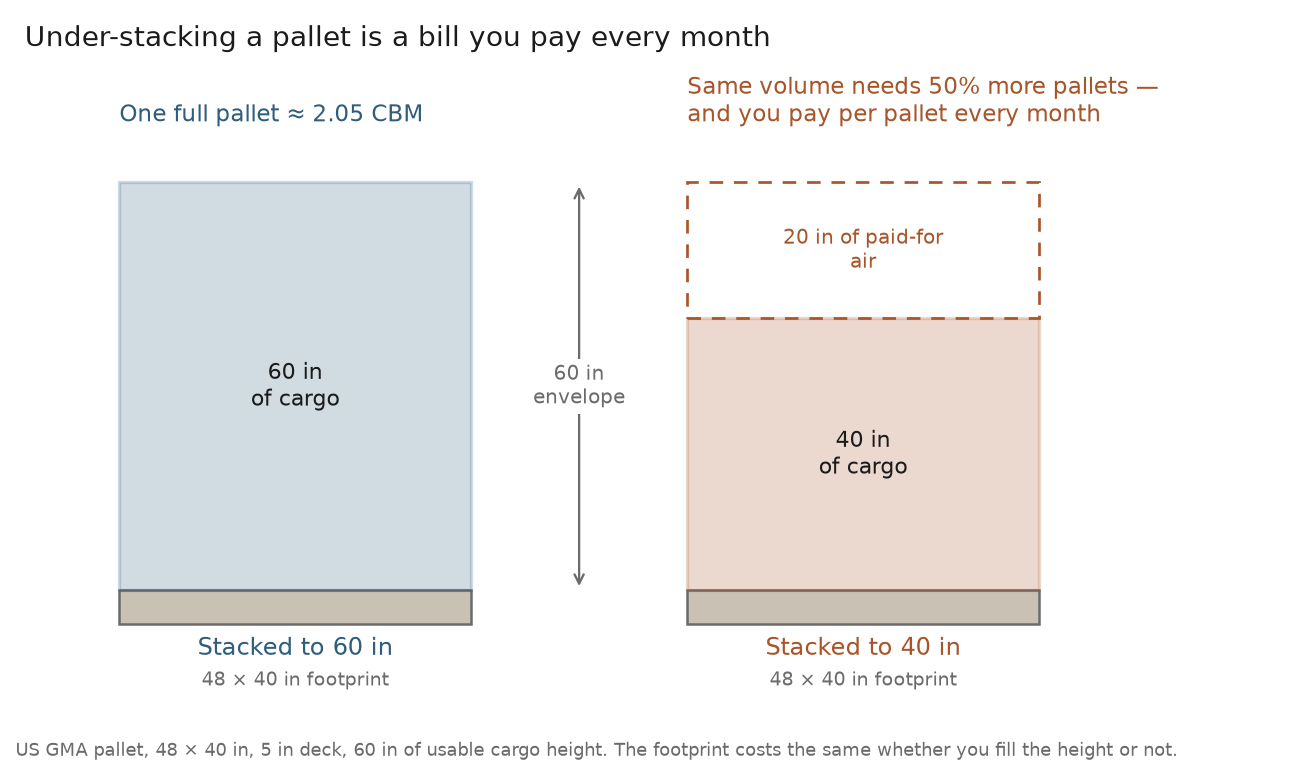
Paying for air. A pallet stacked to 40 inches when 60 was available wastes a third of the available height, which means you are shipping 50% more pallets than necessary — and paying per pallet at the 3PL every month afterwards. Sellers do this by accident when cartons are stacked to a comfortable lifting height rather than a shipping height.
Paying penalties. Overhanging, over-height or unstable pallets attract reclassification charges, refusals at the dock, and damage claims that are hard to win because the packaging was the cause.
Once you know your true cartons-per-pallet number, you know your pallet count, and once you know your pallet count you can convert to CBM and check whether you have crossed the LCL to FCL break-even. The whole chain of freight decisions starts here.
Not every pallet is 48 x 40
The 48 × 40 inch pallet is the US standard, but you will meet others, and mixing standards is a reliable source of wasted space.
| Pallet | Dimensions | Where you meet it |
|---|---|---|
| North American / GMA | 48 × 40 in (122 × 102 cm) | US domestic, the default |
| Euro (EUR 1) | 47.2 × 31.5 in (120 × 80 cm) | European suppliers and shipments |
| Asia standard | 43.3 × 43.3 in (110 × 110 cm) | Common from Asian factories |
| Half pallet | 48 × 20 in (122 × 51 cm) | Retail-ready and small consignments |
A Euro pallet in a container sized around 48-inch pallets wastes space in every direction. If your supplier ships on Euro pallets into a US warehouse expecting GMA, you pay for that mismatch twice – once in container fill, again in warehouse racking.
Converting pallets to CBM
Once you know your pallet count, convert it to cubic metres so you can check it against ocean freight pricing:
- Pallet volume in cubic inches = 48 × 40 × total height including the pallet itself
- Divide by 61,024 to get CBM (there are 61,024 cubic inches in a cubic metre)
- Multiply by your pallet count
A 48 × 40 pallet loaded to 60 inches of cargo plus a 5-inch pallet is 65 inches tall: 48 × 40 × 65 = 124,800 cubic inches, or about 2.05 CBM per pallet.
That is a useful number to carry in your head. Roughly 2 CBM per fully loaded standard pallet means eight pallets is about 16 CBM – which puts you straight into the LCL versus full container decision.
Double stacking
Warehouses and carriers will sometimes stack one pallet on another, which halves the floor space your shipment occupies and can meaningfully cut cost. It requires that your pallets are stable, evenly loaded, and that the bottom pallet’s cargo can carry the weight above it.
If your freight is stackable, say so explicitly on the quote request. Carriers assume non-stackable unless told otherwise, and non-stackable freight is priced on the floor space it blocks, not the space it uses.
Conversely, if your cargo genuinely cannot be stacked, mark it clearly. A crushed bottom layer discovered at destination is a damage claim you will struggle to win, because the packaging will be judged the cause.
Overhang, slip sheets and the floor-load question
Three practical details change how many boxes fit on a pallet after the arithmetic is done.
Overhang costs more than it saves. Cartons that hang over the pallet edge lose the structural support of the deck, crush more easily in transit, and are measured to the overhang rather than to the pallet. A layer that only fits by hanging over is usually a layer you should not load.
Slip sheets remove the pallet entirely. A thin sheet replaces the deck, recovering roughly five inches of height and the pallet’s own weight. They need specialised handling equipment at both ends, so they suit shippers moving high volumes to a single 3PL rather than general freight.
Floor loading trades labour for volume. Cartons stacked directly into the container use the space a pallet footprint wastes and can add meaningful capacity. The cost is unloading time at the other end, which reappears as waiting charges or as a higher receiving fee at a 3PL, since handling loose cartons is the most expensive way to receive freight.
The general rule holds: whatever you save in freight by loading tighter, check that it is not simply reappearing as labour somewhere further down the chain.
Working out your own numbers? The free freight RFP generator builds the quote request that gets you comparable prices from several forwarders at once — so you are comparing the same scope, not four different ones.