Three letters in your supplier’s quote decide who pays for what, who carries the risk, and at which exact moment that risk moves from them to you. Get them wrong and you will discover the answer at the worst possible time — usually when something has already gone wrong.
The current standard is Incoterms 2020, in force since 1 January 2020. That is the version your contracts should reference by name. Writing just “FOB Shanghai” without the version is a small sloppiness that occasionally becomes a large argument.
The four you will actually be quoted
| Term | Seller handles | You handle | Risk passes to you |
|---|---|---|---|
| EXW (Ex Works) | Nothing beyond having goods ready | Everything: collection, export clearance, freight, import, delivery | At the factory door |
| FOB (Free on Board) | Delivery to port, export clearance, loading on vessel | Ocean freight, insurance, import clearance, duties, delivery | When goods are loaded on the vessel |
| DAP (Delivered at Place) | Everything up to your named address | Import clearance and duties only | On arrival at your address |
| DDP (Delivered Duty Paid) | Everything including import clearance and duties | Nothing | On arrival at your address |
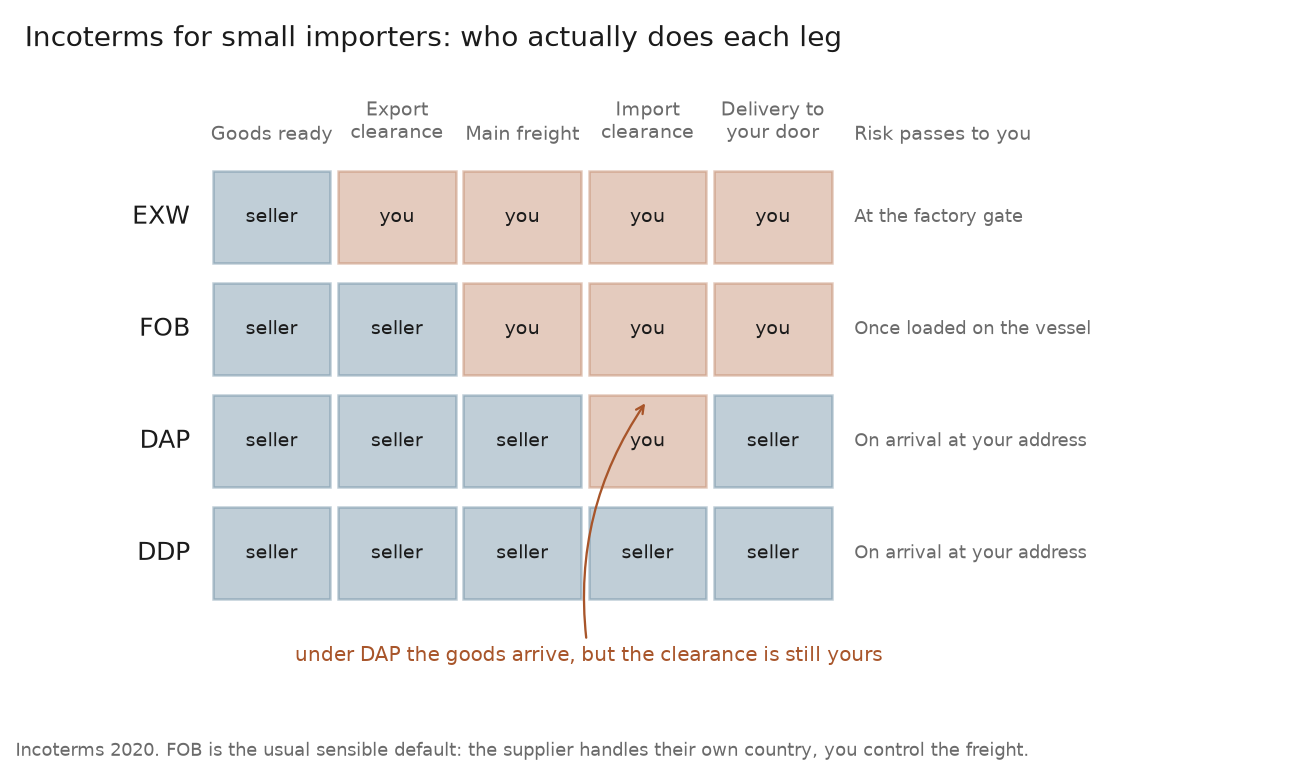
Why FOB is the sensible default
For most sellers sourcing from China or Vietnam by sea, FOB is the standard choice — and it is standard because it splits the work along the line where each side has actual competence.
Your supplier handles the part they understand: getting goods to their local port and through their own country’s export formalities. You take over at the point where you can shop the market — ocean freight is where the price differences between forwarders are largest, and FOB is what lets you get competing quotes on it.
One trap: FOB is a sea-freight-only term. If you are shipping by air, the correct equivalent is FCA. Suppliers quote “FOB” on air shipments constantly out of habit; it is technically meaningless there and creates ambiguity about exactly when risk transferred.
Why EXW usually costs you more than it looks
EXW appears cheapest because the quoted price excludes almost everything. It represents the minimum obligation on the seller and the maximum on you — including arranging collection from their premises and handling export clearance in a country where you have no presence and no standing.
That last part is the real problem. Export formalities are typically far easier for a local company to complete than a foreign buyer. The International Chamber of Commerce itself advises traders to use FCA rather than EXW wherever possible, for exactly this reason.
In practice, an EXW price plus the costs you then have to absorb usually lands above the FOB price you could have negotiated directly.
Why DDP is a trap in the other direction
DDP looks like the dream: one price, supplier handles everything, goods appear at your door. For small sellers it is tempting and it is frequently a mistake.
- You lose visibility of the duty. Duties and fees are buried inside one number. You cannot tell whether you are being charged accurately, and you cannot forecast landed cost when tariffs change.
- Your supplier is clearing customs in a country they do not know. The ICC notes that complying with the buyer’s country requirements is difficult and costly for the seller, and a particular burden for smaller businesses. Errors on your customs record are still your customs record.
- You may not be the Importer of Record — or you may be, without realising. This is the part that bites. Get it wrong and your compliance history is being written by someone else’s paperwork.
For incoterms for small importers, the ICC’s own recommendation is to consider DAP rather than DDP, which keeps import clearance and duty in your hands where they belong, while the seller still handles transport to your door.
Incoterms for small importers: the short version
- Shipping by sea and want control of freight costs: FOB.
- Shipping by air: FCA, not FOB.
- Want the supplier to handle transport but keep your own customs record: DAP.
- Offered EXW: ask for an FOB or FCA price instead and compare properly.
- Offered DDP: ask for the duty and clearance broken out. If they will not itemise it, that is information in itself.
Whichever you choose, the discipline that matters most in incoterms for small importers is to name the version — “FOB Shanghai (Incoterms 2020)” — and name the exact place. “FOB China” is not a term; it is a future dispute.
CFR and CIF, the two you will also be offered
Suppliers quoting sea freight offer these constantly, and they sit awkwardly between FOB and DAP in a way that catches people out. Both are sea and inland waterway terms only, like FOB.
CFR (Cost and Freight) means the seller pays the ocean freight to a named destination port. CIF (Cost, Insurance and Freight) is CFR plus marine insurance arranged by the seller.
The trap is the same in both, and it is genuinely counter-intuitive: risk still passes to you when the goods are loaded at origin, exactly as under FOB. The seller pays for the main carriage but does not carry the risk of it. If the cargo is lost mid-ocean, it is lost as your cargo, on a voyage someone else booked.
Two further problems follow from that split:
- You do not choose the carrier or the routing. The seller buys the freight, so the schedule, the transhipments and the reliability are theirs to pick, and they are not the party waiting for the stock.
- Destination charges land on you anyway. The freight is prepaid to the port; terminal handling, documentation and release charges at your end are not, and a keenly priced CFR quote is often recovered there.
- CIF insurance is minimum cover. Under Incoterms 2020 the seller need only buy the lowest level of institute cargo cover, which is a named-perils policy rather than all-risk. It is not the cargo insurance most sellers assume they are getting.
So CFR and CIF give away the thing FOB was chosen to keep — control of the main carriage — while leaving the risk where it was. If a supplier quotes CIF, it is usually worth asking for the FOB price alongside it and comparing the two on a landed basis rather than on the headline.
Working out your own numbers? The free freight RFP generator builds the quote request that gets you comparable prices from several forwarders at once — so you are comparing the same scope, not four different ones.
This article is general guidance, not legal or customs advice. Rules and rates change, and your situation may differ. Confirm anything specific with a licensed customs broker before you act on it.