Compare 3PL Freight Quotes for Your Shopify or Amazon Store — Free
Stop guessing what to ask freight companies for. Answer a few quick questions and get a ready-to-send quote request, built for e-commerce sellers who are outgrowing DIY shipping.
FreightQuoteTool is a free freight quote tool that helps e-commerce sellers generate a ready-to-send RFP in minutes — no login required.
No login · No signup · 100% free
What This Freight Quote Tool Actually Does
If you’re scaling past a few dozen orders a month, you’ve probably realized you need a real freight partner — not just whatever carrier your platform defaults to. The problem is knowing what to even ask for. Freight companies (called 3PLs) all quote differently, and it’s easy to leave out something important or get quoted for the wrong service entirely.
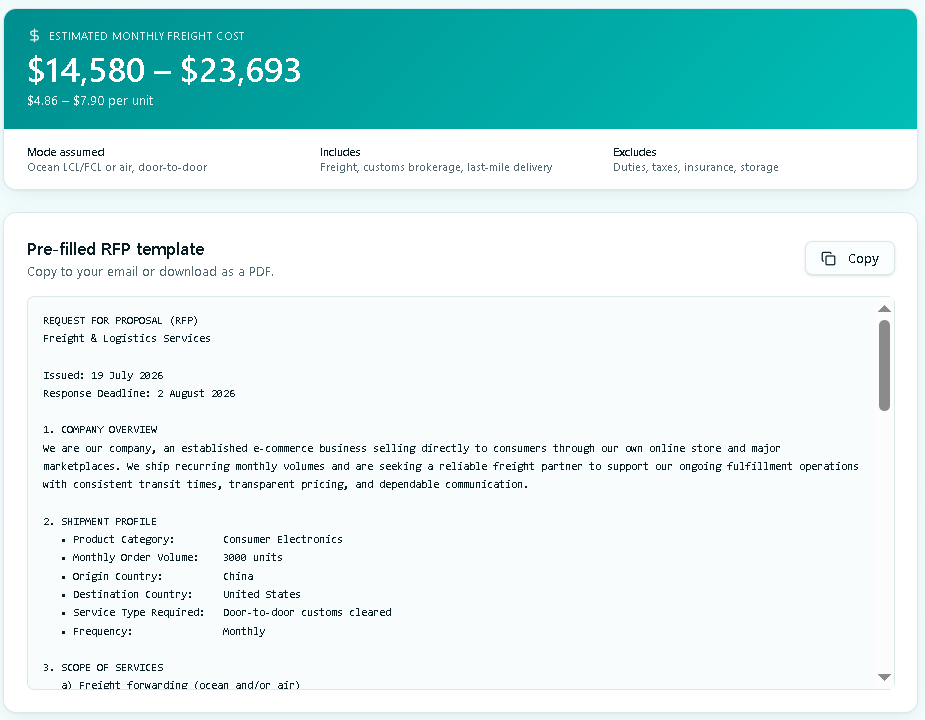
This tool asks you a handful of simple questions about your shipping — how much you ship, what kind of products, where from and where to — and turns your answers into a clear, professional document you can send straight to freight providers. No account needed. No email required. No cost.
Who it’s for
Built for Shopify and Amazon sellers who are past the “just use whatever shipping option shows up” stage and are ready to talk to real freight companies — but don’t have a logistics background and don’t want to hire a consultant just to write one request.
If you’re shipping electronics, home goods, apparel, food, or pretty much anything else in bulk, this works for you.
New to working with logistics providers? Read our guide on how to choose a 3PL.
How it works
1. Tell us about your shipment — volume, product type, where it’s coming from and going to.
2. We build your request — a properly structured document freight companies will recognize and take seriously, plus a scorecard to help you compare their responses later.
3. Download and send it — get a free PDF instantly, no sign-up, no waiting.
Takes about 2 minutes. Completely free. No email required.
Is this freight quote tool really free?
Yes. There's no login, no signup, and no cost to generate your RFP.
Who is this freight quote tool for?
Shopify and Amazon sellers who are outgrowing DIY shipping and need to request quotes from 3PL providers.
Freight guides
Practical guides on what shipping actually costs and how the numbers are built up.
- LCL vs FCL: The Exact CBM Where a Full Container Gets Cheaper — Most sellers switch to a full container far too late.
- Do You Need a Customs Bond for Your First Import? Single-Entry vs Continuous — Every US commercial import needs a customs bond.
- ISF Filing: The 24-Hour Rule and the $5,000 Penalty — ISF is due 24 hours before your vessel departs, not arrives.
- Why Your Freight Quote Doubled: The Accessorial Charges Nobody Quotes — Quoted $1,400, invoiced $2,600? That is accessorials: the charges never in a quote, and which of them you can actually prevent.
- 3PL Pricing Explained: What Small Sellers Actually Get Quoted in 2026 — 2026 benchmarks for 3PL receiving, storage, pick and pack and monthly minimums, plus the two line items that decide if the deal works.
- How Many Boxes Fit on a Pallet? The Math Before You Book Freight — Pallet count drives your freight quote and most sellers guess wrong.
- Incoterms for Small Importers: Why FOB Usually Beats EXW and DDP — What EXW, FOB, DAP and DDP actually shift onto you, and why FOB is the sensible default for sea freight from China or Vietnam.
- Chargeable Weight: Why Air Freight Bills You for Space, Not Weight — Shipped 80kg, billed for 200kg? That is chargeable weight.
- Freight Forwarder vs Customs Broker vs 3PL: Who Actually Does What — Three companies, overlapping pitches, and only one holds a customs licence.
- Freight Class Explained: The NMFC Density Overhaul and Your LTL Rates — Freight classification moved to a density-based system in 2025-26.
- Original B/L, Telex Release or Seaway Bill: Which One to Ask For — Three ways to release ocean cargo, and picking wrong can strand your container.
- The $800 De Minimis Exemption Is Gone: What Small Importers Pay Now — The $800 duty-free threshold ended in 2025 and Section 321 is repealed from July 2027.
- HTS Codes: Why Getting Classification Wrong Costs More Than You Think — Your HTS code sets your duty rate, and the importer of record owns the mistake.
- Cargo Insurance: Why the Carrier Only Owes You $500 — If your container is lost at sea, the carrier may owe $500 total – not $500 per carton.
- Demurrage and Detention: How Free Days Actually Work — Two different charges, two different clocks, both running daily.
- Ocean Transit Times from China: Why 20 Days Becomes 45 — The transit time you are quoted is port-to-port on a good day.
- Freight Damage Claims: How to Actually Win One — Most damage claims are lost in the sixty seconds before you sign the delivery receipt.
- Amazon FBA vs 3PL: The 2026 Cost Comparison — FBA fees rose again in 2026 and inbound placement fees now reach $6.50 a unit.
- Pre-Shipment Inspection: What AQL Actually Means — A few hundred dollars at the factory beats a container of unsellable stock.
- Questions to Ask a 3PL Provider Before You Sign — The 31 questions that separate a 3PL quote you can trust from one that grows after signing – on pricing, capacity, integration, and getting out.
- LTL vs FTL: The Weight Where a Full Truckload Gets Cheaper — LTL and FTL pricing converges between 8,000 and 12,000 lb. Where the crossover sits on your lane.
- Drayage: The Port-to-Door Charge That Is Never in the Ocean Quote — The short truck move from the terminal, its real line items, and the charge that dwarfs it.
- Container Weight Limits: The 80,000 lb Ceiling That Decides Your Payload — The box holds nearly 59,000 lb. Road law allows roughly 44,000 lb of cargo.
- Importer of Record: The Liability You Take On Without Reading It — Duties are a personal debt that selling the goods does not clear.
- Anti-Dumping Duties: The Tariff That Can Exceed Your Cargo’s Value — Set per factory, governed by written scope, and assessed long after entry.
- Shipping Lithium Batteries: The Rules That Decide How Your Freight Moves — A battery fitted inside the product follows different rules to a loose one.